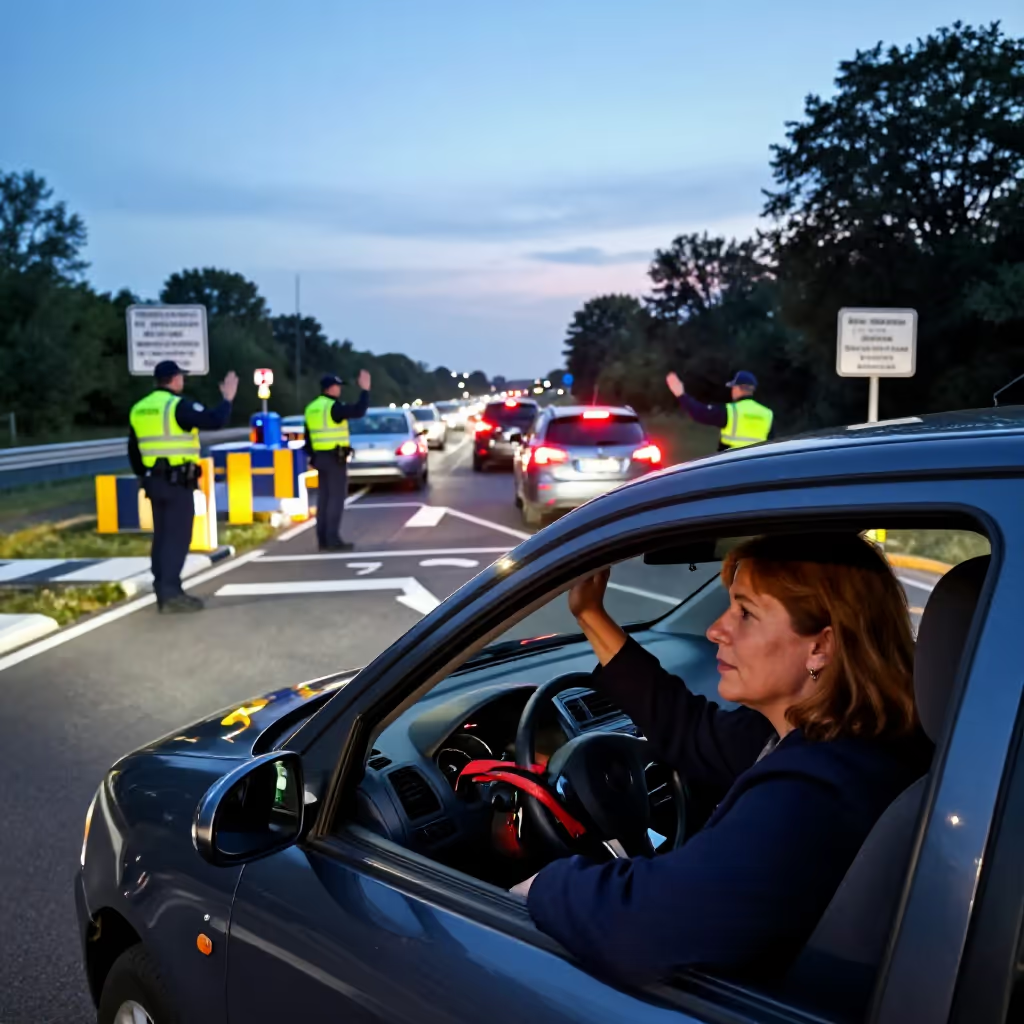
A person who lives in one country but regularly crosses the border to work in another country.
example
Tausende Grenzgänger pendeln täglich von Frankreich in die Schweiz.
Thousands of cross-border commuters travel daily from France to Switzerland.

Usage tips
Compound word
The word is made up of 'die Grenze' (border/boundary) and 'der Gänger' (a person who walks/goes). A 'Grenzgänger' is therefore literally someone who goes across a border. This basic idea applies to both the concrete and the figurative meaning.
EXAMPLE
Er ist ein Grenzgänger, der die Grenzen des Möglichen immer wieder neu auslotet.
He is a boundary-crosser who keeps exploring the limits of what is possible in new ways.
Context clue
The literal meaning refers to work and geography, often with the verb 'pendeln' (to commute). The figurative, metaphorical meaning is found in the context of art, culture, or science, often in the structure 'Grenzgänger zwischen A und B' (boundary-crosser between A and B).
EXAMPLE
Als Grenzgänger arbeitet er in Luxemburg, wohnt aber in Deutschland.
As a cross-border commuter, he works in Luxembourg but lives in Germany.
Typical collocations
In the literal meaning, the preposition 'zwischen' (between) is often used to name the countries. The typical verb in this context is 'pendeln' (to commute).
EXAMPLE
Die meisten Grenzgänger in dieser Region pendeln zwischen Frankreich und der Schweiz.
Most cross-border commuters in this region commute between France and Switzerland.
Figurative meaning
In the figurative meaning, two abstract fields are often connected with 'zwischen' (between). Examples are 'ein Grenzgänger zwischen den Kulturen' (a boundary-crosser between cultures), '... zwischen den Genres' (... between genres), or '... zwischen Genie und Wahnsinn' (... between genius and madness).
EXAMPLE
Ihre Forschung macht sie zu einer Grenzgängerin zwischen Biologie und Informatik.
Her research makes her a boundary-crosser between biology and computer science.
Compare with
near_synonym · confusable
Grenzgänger vs Pendler
commuter
'der Pendler' and 'der Grenzgänger' both describe people who regularly travel to work or training. 'der Pendler' is more general: the person travels back and forth between their home and workplace, for example within a city or between two cities. 'der Grenzgänger' is more specific: the person lives in one country and regularly crosses a national border to work. So you can be a commuter without being a cross-border commuter. The words are easy to confuse because both describe regular journeys to work. As soon as a national border is important, 'Grenzgänger' is more precise.
Grenzgänger
Viele Grenzgänger wohnen in Deutschland und arbeiten jeden Tag in der Schweiz.
Many cross-border commuters live in Germany and work in Switzerland every day.
Pendler
Als Pendler steht Max jeden Morgen früh auf, weil sein Büro in einer anderen Stadt liegt.
As a commuter, Max gets up early every morning because his office is in another city.