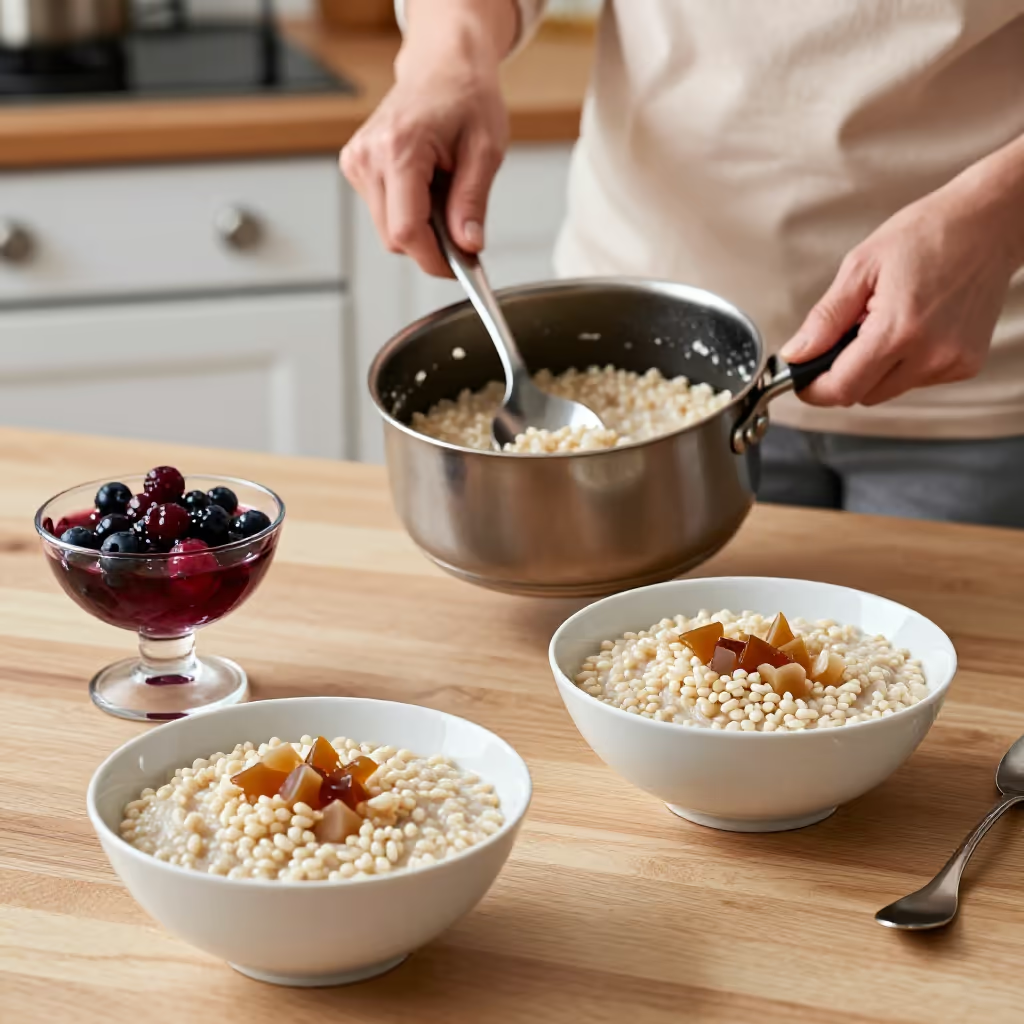
A dish made from coarsely ground grain that is cooked with liquid into a porridge. The term also refers to a sweet dish made from fruit, such as the well-known 'Rote Grütze' (red berry pudding).
example
Als Nachtisch gab es Rote Grütze mit Vanillesoße.
For dessert, there was red berry pudding with vanilla sauce.

Usage tips
Colloquial meanings
While the meaning as a food is neutral, the meanings 'Verstand' (mind/brains) and 'zerstörte Masse' (destroyed mass) are clearly colloquial. They are used in informal conversation with friends or family, but not in formal texts.
EXAMPLE
Komm, streng deine Grütze an, das Rätsel ist nicht so schwer!
Come on, use your brains; the puzzle isn't that hard!
Context clue
The meaning of 'Grütze' depends strongly on the context. If it is about food, it means the dish. In a prompt to think, it means 'Verstand' (mind/brains). When something is broken, it describes a destroyed mass.
EXAMPLE
Im Urlaub an der Nordsee haben wir oft Rote Grütze gegessen.
On vacation by the North Sea, we often ate red berry pudding.
Well-known dish: Rote Grütze
Especially well known is 'Rote Grütze' (red berry pudding), a northern German sweet dish made from red fruits. It is often perceived as a typical German dessert and is traditionally served with vanilla sauce or cream.
EXAMPLE
Meine Oma macht die beste Rote Grütze.
My grandma makes the best red berry pudding.
Fixed expression for thinking
The colloquial meaning 'Verstand' (mind/brains) is almost always used in the fixed expression 'seine Grütze anstrengen' (to use one's brains). It is a casual way of telling someone to think hard.
EXAMPLE
Ich muss meine Grütze ganz schön anstrengen, um diese Aufgabe zu lösen.
I really have to use my brains to solve this task.
To smash something to bits
When something is completely destroyed, especially in an accident, you can use the colloquial expression 'etwas zu Grütze fahren' (to wreck something completely by driving/crashing) or 'zu Grütze schlagen' (to smash something to bits). It expresses total destruction.
EXAMPLE
Er hat sein neues Auto direkt in der ersten Woche zu Grütze gefahren.
He wrecked his new car completely in the very first week.
Compare with
near_synonym · confusable
Grütze vs Kopf
head
'der Kopf' and 'die Grütze' can both figuratively mean the mind or thinking. 'Kopf' is neutral and very common. You can say that you have something 'im Kopf' (in your head) or need a 'klarer Kopf' (a clear head). 'Grütze' is colloquial and often somewhat rough or joking. Especially in sentences like 'Benutz deine Grütze!' (Use your brains!), it means: think. Learners may confuse the words because both can refer to the mind. In normal or polite situations, 'Kopf' is better. 'Grütze' only fits in casual and rather familiar contexts.
Grütze
Benutz deine Grütze, bevor du einfach irgendetwas entscheidest.
Use your brains before you just decide anything.
Kopf
Du hast die Lösung bestimmt schon im Kopf.
You probably already have the solution in your head.