

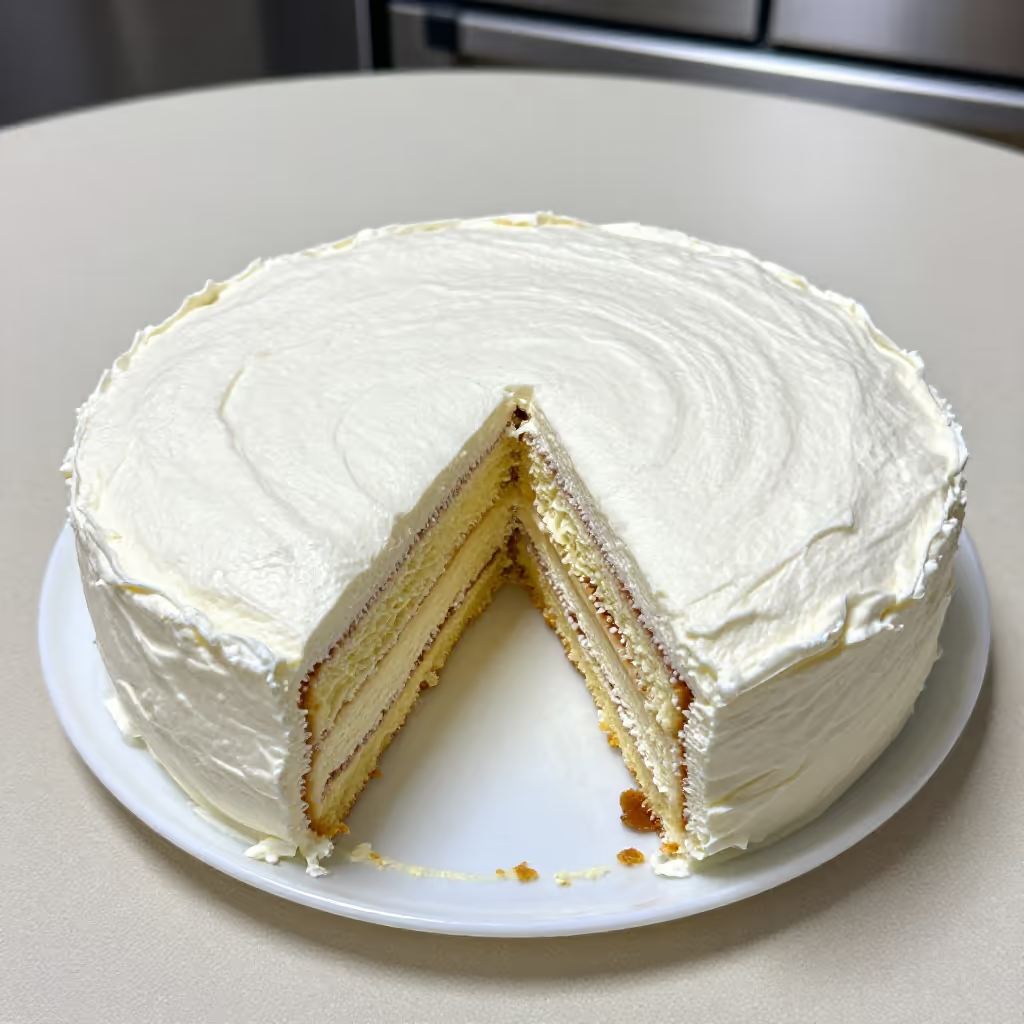
die Hälfte
half
One of two equal parts of a whole.
EXAMPLE
Ich hätte gern die Hälfte des Kuchens, bitte.
I’d like half of the cake, please.
half
Loading your saved state.
half
One of two equal parts of a whole.
Ich hätte gern die Hälfte des Kuchens, bitte.
I’d like half of the cake, please.

halfway point
The middle point of a period of time, a distance, or a process.
Wir haben erst die Hälfte des Weges geschafft.
We’ve only completed half of the way.

better half
An informal and often humorous term for one’s spouse or life partner.
Er kommt heute Abend mit seiner besseren Hälfte zur Party.
He’s coming to the party tonight with his better half.
The noun 'die Hälfte' (half) is derived directly from the adjective 'halb' (half). It literally describes the state of something having been divided in half.
Ein halber Apfel ist die Hälfte eines ganzen Apfels.
Half an apple is half of a whole apple.
'Hälfte' (half) is very often used with the genitive to say what it is half of. In colloquial speech, 'von' + dative is often used instead.
Die Hälfte der Bevölkerung lebt in Städten.
Half of the population lives in cities.
The phrase 'um die Hälfte' (by half) is used to describe a reduction or increase of 50%.
Die Firma hat ihre Kosten um die Hälfte reduziert.
The company reduced its costs by half.
The phrase 'zur Hälfte' (half / halfway) describes that something is only partially or 50% finished or filled.
Das Stadion war zur Hälfte leer.
The stadium was half empty.
The expression 'bessere Hälfte' (better half) for one’s partner is informal and is often used in an affectionate, ironic way.
Ich muss erst meine bessere Hälfte fragen, ob wir am Samstag Zeit haben.
I first have to ask my better half whether we have time on Saturday.
middle / center
„Mitte“ refers to the central point or area of a distance. „Hälfte“ identifies the same point by dividing the whole into two equal parts. Use „Mitte“ when the central location is important, and „Hälfte“ when you mean the part already covered or the part that remains.
Nach der Hälfte der Strecke machen wir eine kurze Pause.
We’ll take a short break halfway through the route.
Wir treffen uns in der Mitte der Strecke zwischen den beiden Dörfern.
We’ll meet in the middle of the route between the two villages.