

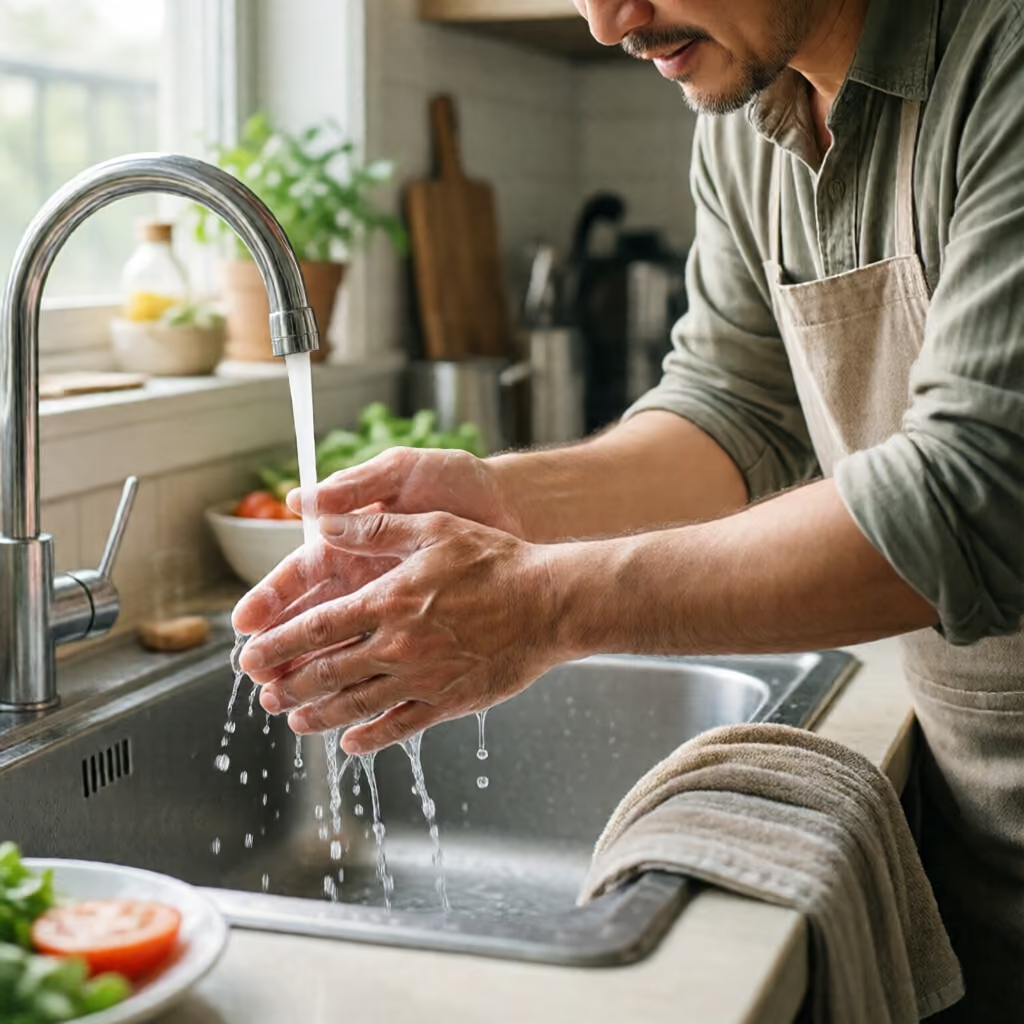
das Händewaschen
handwashing
Washing the hands with water and usually soap to remove dirt and pathogens.
EXAMPLE
Vor dem Essen ist gründliches Händewaschen besonders wichtig.
Thorough handwashing is especially important before eating.
handwashing
das Händewaschen
Loading your saved state.
handwashing
Washing the hands with water and usually soap to remove dirt and pathogens.
Vor dem Essen ist gründliches Händewaschen besonders wichtig.
Thorough handwashing is especially important before eating.
| gender | neuter das |
|---|---|
| genitive | des Händewaschens |
| singular | plural | |
|---|---|---|
| nominative | das Händewaschen | – |
| accusative | das Händewaschen | – |
| dative | dem Händewaschen | – |
| genitive | des Händewaschens | – |
The article changes with the case; it is shown in colour.
'Händewaschen' (handwashing) is made up of 'Hände' (hands) and 'Waschen' (washing). The word refers to an action and is therefore capitalized as a nominalized verb.
Regelmäßiges Händewaschen gehört für das Pflegepersonal zum Alltag.
Regular handwashing is part of everyday life for care staff.
Common combinations are 'gründliches Händewaschen' (thorough handwashing), 'regelmäßiges Händewaschen' (regular handwashing), and 'Händewaschen mit Seife' (handwashing with soap). These expressions describe how or with what the action is carried out.
Gründliches Händewaschen mit Seife kann das Ansteckungsrisiko verringern.
Thorough handwashing with soap can reduce the risk of infection.
Time expressions with 'vor' (before), 'nach' (after), or 'zwischen' (between) are often used with 'Händewaschen' (handwashing). The preposition 'nach' takes the dative, for example when referring to an activity that takes place afterward.
Nach dem Händewaschen trocknete sich das Kind die Hände ab.
After washing his hands, the child dried them.