


The most important city of a country, federal state, or region, where the seat of government is usually located.
example
Paris ist nicht nur die Hauptstadt von Frankreich, sondern auch ein Zentrum für Kultur und Mode.
Paris is not only the capital of France, but also a center for culture and fashion.
Usage tips
Word composition
The word is made up of 'Haupt' (main, head) and 'Stadt' (city). So the capital is literally the 'Haupt-Stadt' (main city) of a country.
EXAMPLE
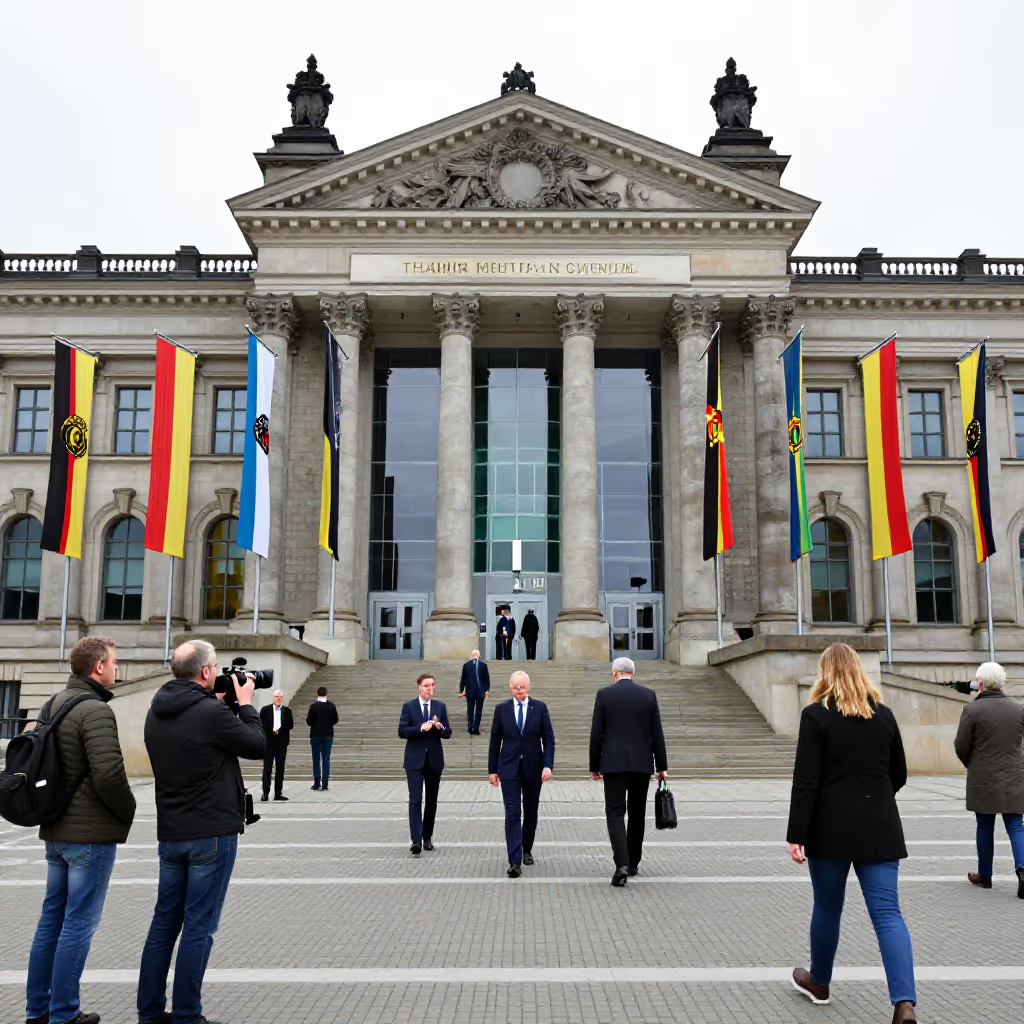
Die Hauptstadt von Deutschland ist Berlin.
The capital of Germany is Berlin.
Related adjective
The adjective 'hauptstädtisch' is derived from the noun 'die Hauptstadt' (the capital). It means 'belonging to the capital' or 'typical of the capital'.
EXAMPLE
Das hauptstädtische Leben ist oft hektisch und teuer.
Life in the capital is often hectic and expensive.
Typical prepositions
To describe the location, you use the preposition 'in' with the dative: 'in der Hauptstadt' (in the capital). To express belonging to a country, you use 'von': 'die Hauptstadt von Deutschland' (the capital of Germany).
EXAMPLE
Die Regierung hat ihren Sitz in der Hauptstadt.
The government has its seat in the capital.
Compare with
antonym
Hauptstadt vs Provinz
province
'die Hauptstadt' and 'die Provinz' are opposites here. The capital is the central and politically important city of a country or region. 'die Provinz' often refers to areas outside the capital and outside large, important cities. The word 'Provinz' can be neutral, but it sometimes sounds derogatory when you want to say that a place seems not very modern or not very cosmopolitan. For a specific administrative division of a country, there is also the meaning 'province', but in contrast to the capital, this meaning is about life or places outside the center.
Hauptstadt
Berlin ist die Hauptstadt von Deutschland.
Berlin is the capital of Germany.
Provinz
Nach vielen Jahren in der Hauptstadt zog sie zurück in die Provinz.
After many years in the capital, she moved back to the provinces.