


das Hemd
shirt
A piece of clothing for the upper body that typically has a collar, sleeves, and a row of buttons on the front.
Für die Hochzeit hat er sich ein neues weißes Hemd gekauft.
For the wedding, he bought himself a new white shirt.

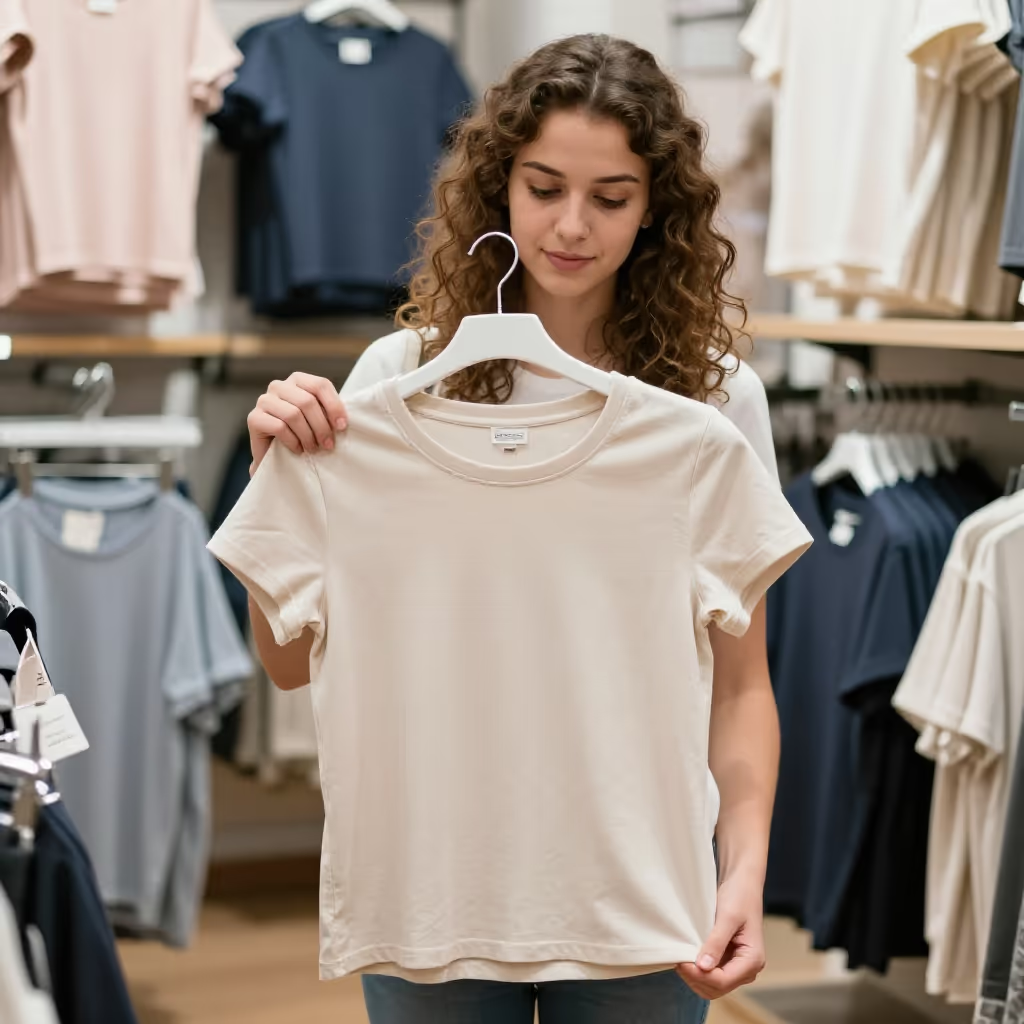
shirt
Loading your saved state.
shirt
A piece of clothing for the upper body that typically has a collar, sleeves, and a row of buttons on the front.
Für die Hochzeit hat er sich ein neues weißes Hemd gekauft.
For the wedding, he bought himself a new white shirt.

The word 'Hemd' (shirt) is a base word that is often used to form new nouns. Examples such as 'Nachthemd' (nightgown/nightshirt) or 'Unterhemd' (undershirt) show that it refers to a piece of clothing for the upper body.
Im Winter trage ich unter dem Pullover immer ein Unterhemd.
In winter, I always wear an undershirt under my sweater.
Certain verbs and adjectives are often combined with 'Hemd' (shirt). Typical examples are 'ein Hemd anziehen' (to put on a shirt), 'ein Hemd bügeln' (to iron a shirt), as well as descriptions like 'ein kariertes Hemd' (a checked shirt) or 'ein langärmliges Hemd' (a long-sleeved shirt).
Er muss sein Hemd für das Vorstellungsgespräch noch bügeln.
He still has to iron his shirt for the job interview.
The idiom 'sein letztes Hemd geben' (to give one's last shirt) is a fixed structure. The possessive pronoun ('sein' (his), 'mein' (my), 'ihr' (her/their)) adapts to the person who gives something.
Meine Oma ist so großzügig, sie würde ihr letztes Hemd für uns geben.
My grandma is so generous, she would give her last shirt for us.
shirt
'das Shirt' and 'das Hemd' are both items of clothing for the upper body. 'Shirt' usually means a light, fairly casual top made of cotton, often without a collar and without a button placket. 'Hemd' typically means a garment with a collar, sleeves, and buttons down the front. It often looks a bit neater or more formal. Learners may confuse the words because both are worn on the upper body. For free time and sports, 'Shirt' is usually appropriate; for the office, a celebration, or a neat outfit, 'Hemd' is more likely.

Zum Vorstellungsgespräch trägt Max ein helles Hemd unter seiner Jacke.
For the job interview, Max wears a light-colored shirt under his jacket.
Für den Spaziergang zieht Lisa ein bequemes Shirt und eine Jeans an.
For the walk, Lisa puts on a comfortable shirt and jeans.