


hinausgehen
to go outside
To move out of an enclosed room or building to the outside.
EXAMPLE
Wollen wir kurz hinausgehen und frische Luft schnappen?
Shall we go outside for a moment and get some fresh air?
to go outside / go beyond
Loading your saved state.
to go outside
To move out of an enclosed room or building to the outside.
Wollen wir kurz hinausgehen und frische Luft schnappen?
Shall we go outside for a moment and get some fresh air?

to go beyond
To exceed a certain measure, limit, or expectation.
Seine Kenntnisse gehen weit über das hinaus, was man in der Schule lernt.
His knowledge goes far beyond what you learn in school.

to face onto
Describes the orientation of a window or door in a certain direction.
Unser Balkon geht direkt zum Innenhof hinaus.
Our balcony faces directly onto the courtyard.
'Hinausgehen' (to go outside) is a separable verb. The prefix 'hinaus-' goes at the end in main clauses. In subordinate clauses and in the infinitive with 'zu', the verb stays together.
Er geht kurz auf den Balkon hinaus.
He goes out onto the balcony for a moment.
The prefix 'hinaus-' expresses movement from inside to outside, from the perspective of a person who is inside. It describes someone moving away from the speaker to the outside.
Könntest du bitte kurz hinausgehen? Ich brauche einen Moment Ruhe.
Could you please go outside for a moment? I need a moment of quiet.
In the figurative meaning 'to exceed', 'hinausgehen' is always used with the preposition 'über' and the accusative. The construction is: 'über etwas (Akkusativ) hinausgehen' (to go beyond something).
Sein Engagement für das Projekt ging weit über seine normalen Aufgaben hinaus.
His commitment to the project went far beyond his normal duties.
This meaning is used almost exclusively to describe the orientation of windows, doors, or balconies. The subject is always a part of a building.
Die Fenster unserer Küche gehen direkt zum Garten hinaus.
The windows of our kitchen face directly onto the garden.
to exceed / cross
Both verbs can be used when a value lies above a limit. „Überschreiten“ puts the defined threshold at the center, while „hinausgehen über“ more strongly shows that a measure or expectation is insufficient. Use „überschreiten“ for a clear limit and „hinausgehen über“ for standards or expectations.
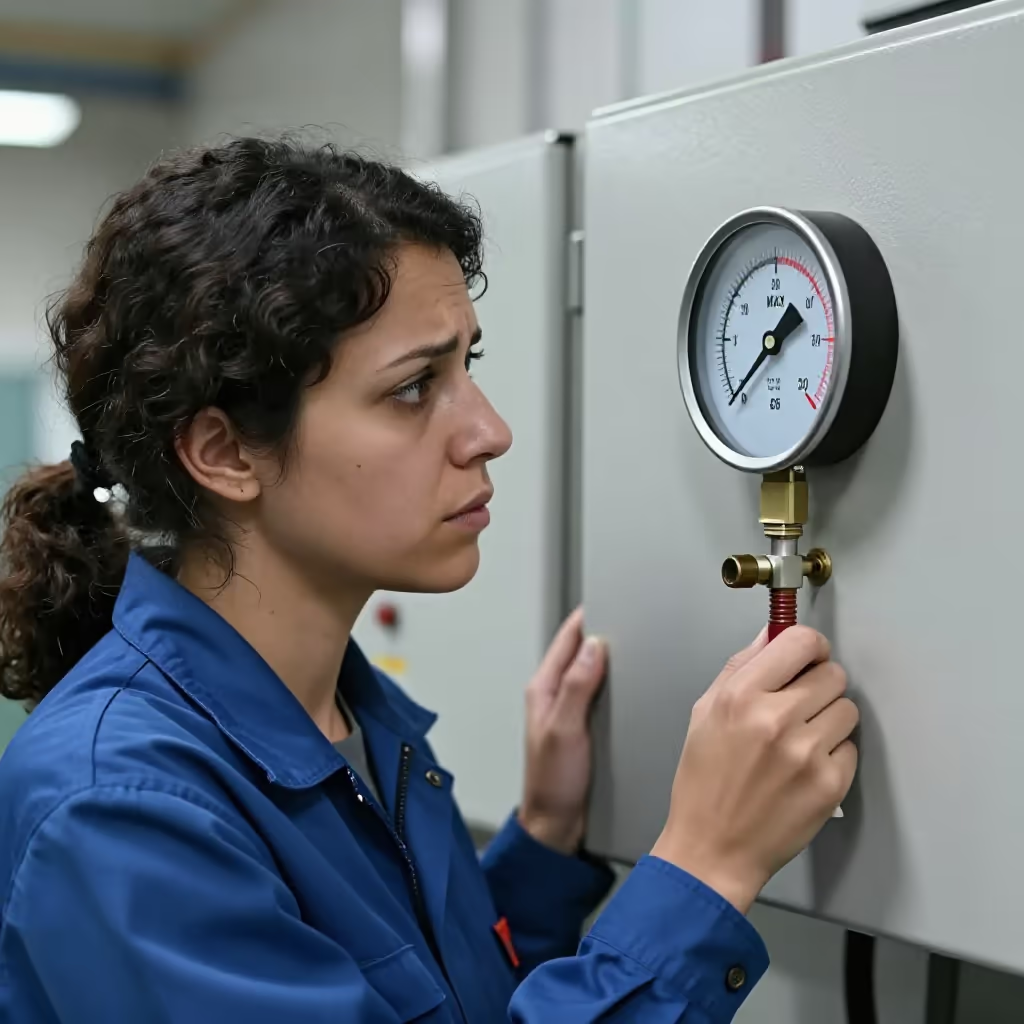
Die Kosten gehen deutlich über unsere ursprüngliche Erwartung hinaus.
The costs go well beyond our original expectation.
Die Kosten überschreiten die festgelegte Grenze von 1.000 Euro.
The costs exceed the set limit of 1,000 euros.