

die Hüfte
hip
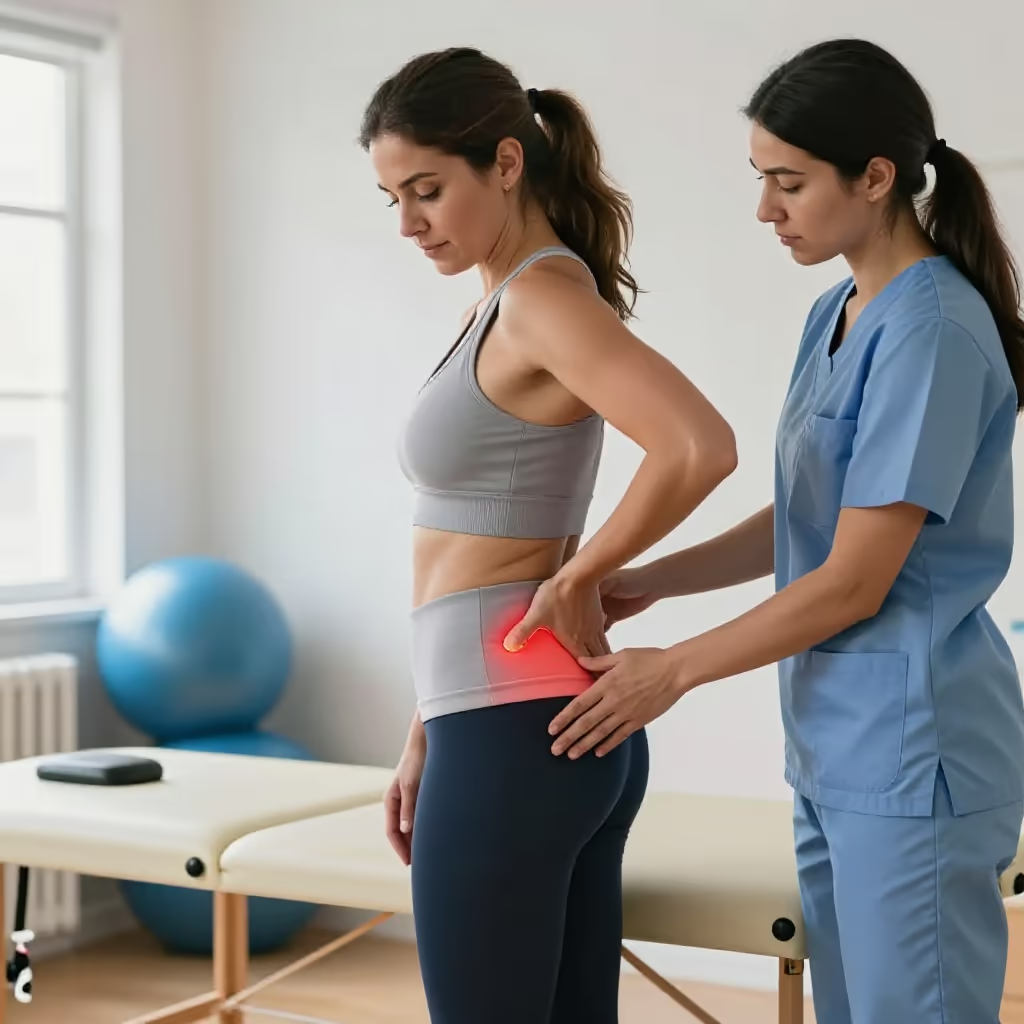
The side part of the human body between the lowest rib arch and the thigh bone, including the hip joint.
EXAMPLE
Sie wiegte sich beim Tanzen in den Hüften.
She swayed her hips while dancing.
hip
Loading your saved state.
hip
The side part of the human body between the lowest rib arch and the thigh bone, including the hip joint.
Sie wiegte sich beim Tanzen in den Hüften.
She swayed her hips while dancing.
In the context of movement and dance, the plural 'die Hüften' (the hips) is often used. Typical verbs are 'wiegen' (to sway), 'schwingen' (to swing), or 'kreisen lassen' (to rotate).
Beim Salsa-Tanzen muss man die Hüften gut bewegen können.
When dancing salsa, you have to be able to move your hips well.
The gesture of placing your hands on the sides of your body is described with the fixed expression 'die Hände in die Hüften stemmen' (to put one's hands on one's hips). This often expresses an expectant or defiant attitude.
Die Mutter stemmte die Hände in die Hüften und sah ihr Kind streng an.
The mother put her hands on her hips and looked sternly at her child.
In medical contexts, people often talk about injuries or operations. Common phrases are 'sich die Hüfte brechen' (to break one's hip) or 'eine künstliche Hüfte bekommen' (to get an artificial hip).
Meine Großmutter hat bei einem Sturz ihre Hüfte gebrochen.
My grandmother broke her hip in a fall.
basin / pelvis / cymbal
Becken and Hüfte both belong to the area between the torso and the legs. Becken refers to the bony pelvic ring, whereas Hüfte refers mainly to the side of the body and the hip joint. When talking about bones and the lower torso, „Becken“ is the right word; for the side of the body or the joint, „Hüfte“ is usually the better choice.

Nach dem Sturz untersuchte die Ärztin die Hüfte der Patientin.
After the fall, the doctor examined the patient's hip.
Nach dem Sturz untersuchte die Ärztin das Becken der Patientin.
After the fall, the doctor examined the patient's pelvis.