

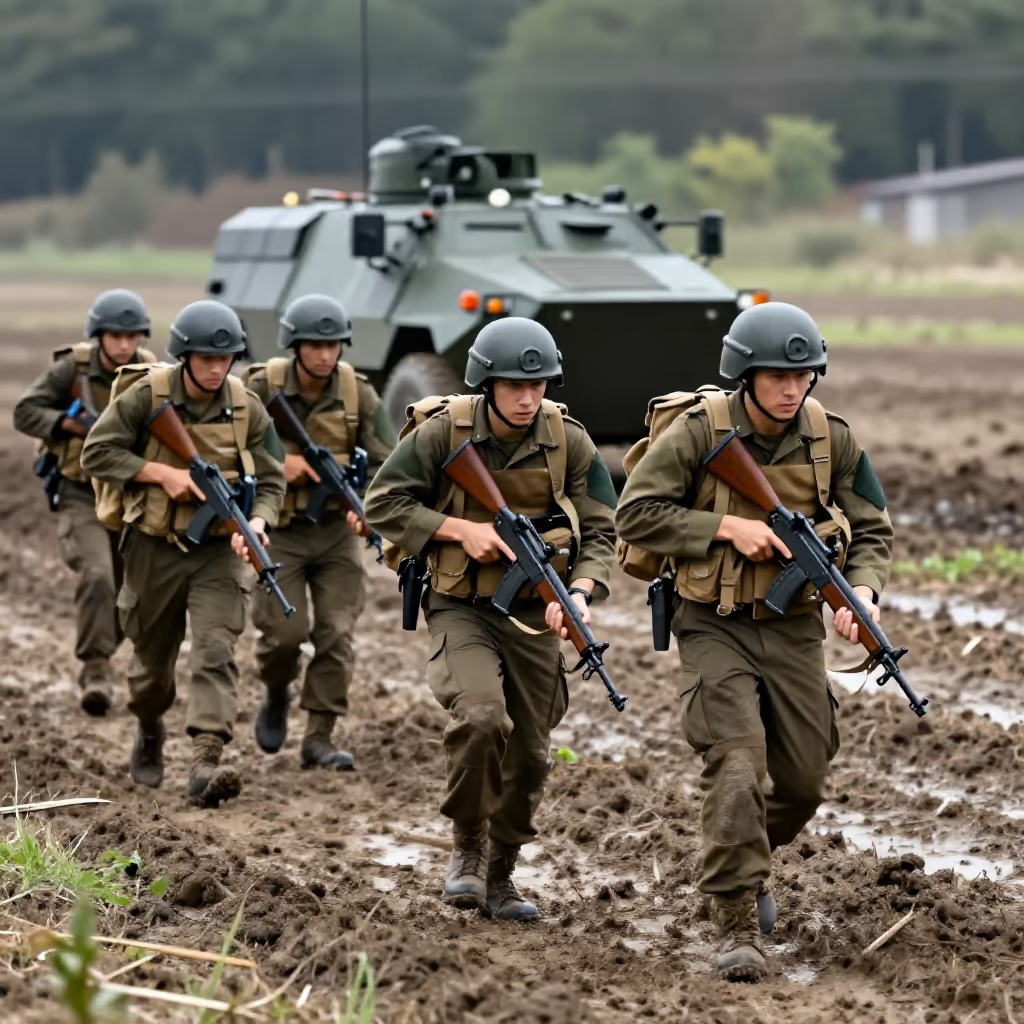
die Infanterie
infantry
The branch of the army whose soldiers fight on foot. It often forms the core of an army.
EXAMPLE
Mein Großvater diente während des Krieges bei der Infanterie.
My grandfather served in the infantry during the war.
infantry
die Infanterie, die Infanterien
Loading your saved state.
infantry
The branch of the army whose soldiers fight on foot. It often forms the core of an army.
Mein Großvater diente während des Krieges bei der Infanterie.
My grandfather served in the infantry during the war.
| gender | feminine die |
|---|---|
| plural | die Infanterien |
| genitive | der Infanterie |
| singular | plural | |
|---|---|---|
| nominative | die Infanterie | die Infanterien |
| accusative | die Infanterie | die Infanterien |
| dative | der Infanterie | den Infanterien |
| genitive | der Infanterie | der Infanterien |
The article changes with the case; it is shown in colour.
'Infanterie' (infantry) is a technical term from the military field. It is used when speaking precisely about the branch of foot soldiers.
Die Ausbildung bei der Infanterie ist körperlich sehr anspruchsvoll.
Training in the infantry is physically very demanding.
Common verbs used in connection with 'Infanterie' (infantry) are 'bei der Infanterie dienen' (to serve in the infantry), 'zur Infanterie gehören' (to belong to the infantry), or 'die Infanterie einsetzen' (to deploy the infantry).
Im Manöver wurde die Infanterie zur Sicherung des Geländes eingesetzt.
During the maneuver, the infantry was deployed to secure the area.
The word 'Infanterie' (infantry) is almost always used in the singular because it describes an entire branch of troops as a collective. The plural form 'Infanterien' is very rare.
Er war stolz darauf, zur Infanterie zu gehören.
He was proud to belong to the infantry.