


die Inhaberin
owner
A female person who owns something, especially a shop, business, or company.
Die Inhaberin des kleinen Buchladens berät ihre Kunden noch persönlich.
The owner of the small bookshop still advises her customers personally.

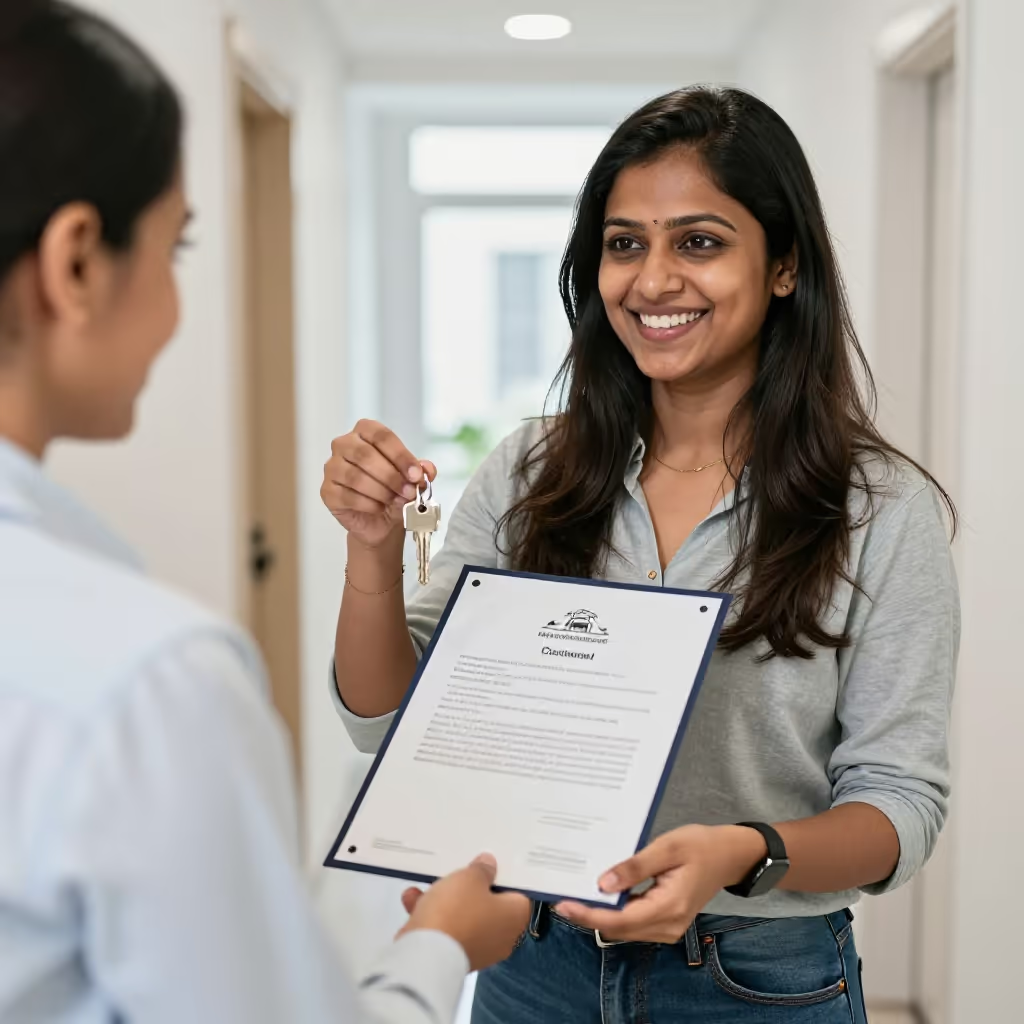
owner / holder
Loading your saved state.
owner
A female person who owns something, especially a shop, business, or company.
Die Inhaberin des kleinen Buchladens berät ihre Kunden noch persönlich.
The owner of the small bookshop still advises her customers personally.

The word is derived from the verb 'innehaben' (to hold, to possess), which means 'besitzen' (to own) or 'halten' (to hold). An 'Inhaberin' is therefore literally a female person who holds or owns something. The suffix '-in' marks the feminine form.
Die neue Inhaberin hat das Konzept des Restaurants komplett verändert.
The new owner completely changed the restaurant's concept.
To say what someone is the owner or holder of, German usually uses the genitive. Alternatively, especially in spoken language, the preposition 'von' with the dative is also used.
Sie ist die Inhaberin des ältesten Hotels der Stadt.
She is the owner of the oldest hotel in the city.
You can tell from the context whether an owner or a record holder is meant. Words like 'Geschäft' (business/shop), 'Firma' (company), or 'Laden' (shop) point to an owner, while 'Titel' (title), 'Rekord' (record), or 'Amt' (office) refer to the holder of a title.
Die Inhaberin der Bäckerei backt jeden Morgen selbst.
The owner of the bakery bakes everything herself every morning.
In a business context, 'Inhaberin' is often combined with the type of company or business. Typical phrases are 'Inhaberin eines Geschäfts' (owner of a shop/business), 'Inhaberin einer Agentur' (owner of an agency), or 'Inhaberin eines Restaurants' (owner of a restaurant).
Die Inhaberin der kleinen Boutique kennt viele ihrer Stammkunden mit Namen.
The owner of the small boutique knows many of her regular customers by name.
managing director
'Geschäftsführerin' and 'Inhaberin' can both refer to an important woman in a company. But they do not mean the same thing. The 'Geschäftsführerin' manages the company in everyday operations and makes operational decisions. The 'Inhaberin' owns the company or business. One person can be both, but does not have to be. Learners often confuse the words because both occur in the context of companies and businesses. When it is about management and responsibility in day-to-day business, 'Geschäftsführerin' fits. When it is about ownership, 'Inhaberin' is more precise.

Wegen des Umbaus hat die Inhaberin das Restaurant für zwei Wochen geschlossen.
Because of the renovation, the owner closed the restaurant for two weeks.
Die Geschäftsführerin erklärt dem Team am Morgen die neuen Ziele.
The managing director explains the new goals to the team in the morning.