

isolieren
to isolate
To separate someone or something spatially or socially from their surroundings.
EXAMPLE
Nach dem Umzug in die neue Stadt fühlte er sich anfangs sehr isoliert.
After moving to the new city, he felt very isolated at first.
to isolate
Loading your saved state.
to isolate
To separate someone or something spatially or socially from their surroundings.
Nach dem Umzug in die neue Stadt fühlte er sich anfangs sehr isoliert.
After moving to the new city, he felt very isolated at first.

to insulate
To equip a building or building component with special material in order to protect it against heat, cold, sound, or electricity.
Wir müssen das Dach besser isolieren, um Heizkosten zu sparen.
We need to insulate the roof better in order to save on heating costs.

to isolate
In science or medicine, to separate a substance, material, or organism from others in order to present it in pure form or examine it.
Dem Forscherteam gelang es, den neuen Wirkstoff im Labor zu isolieren.
The research team succeeded in isolating the new active ingredient in the laboratory.
The verb 'isolieren' comes from the Latin word 'insula' for 'island'. So the basic idea is to place someone or something as if on an island and separate it from everything else.
Manche Menschen isolieren sich bewusst von der lauten Welt.
Some people consciously isolate themselves from the noisy world.
'Isolieren' belongs to a large group of verbs that end in '-ieren' and often come from other languages. These verbs are always regular and form their past participle without 'ge-', so 'isoliert'.
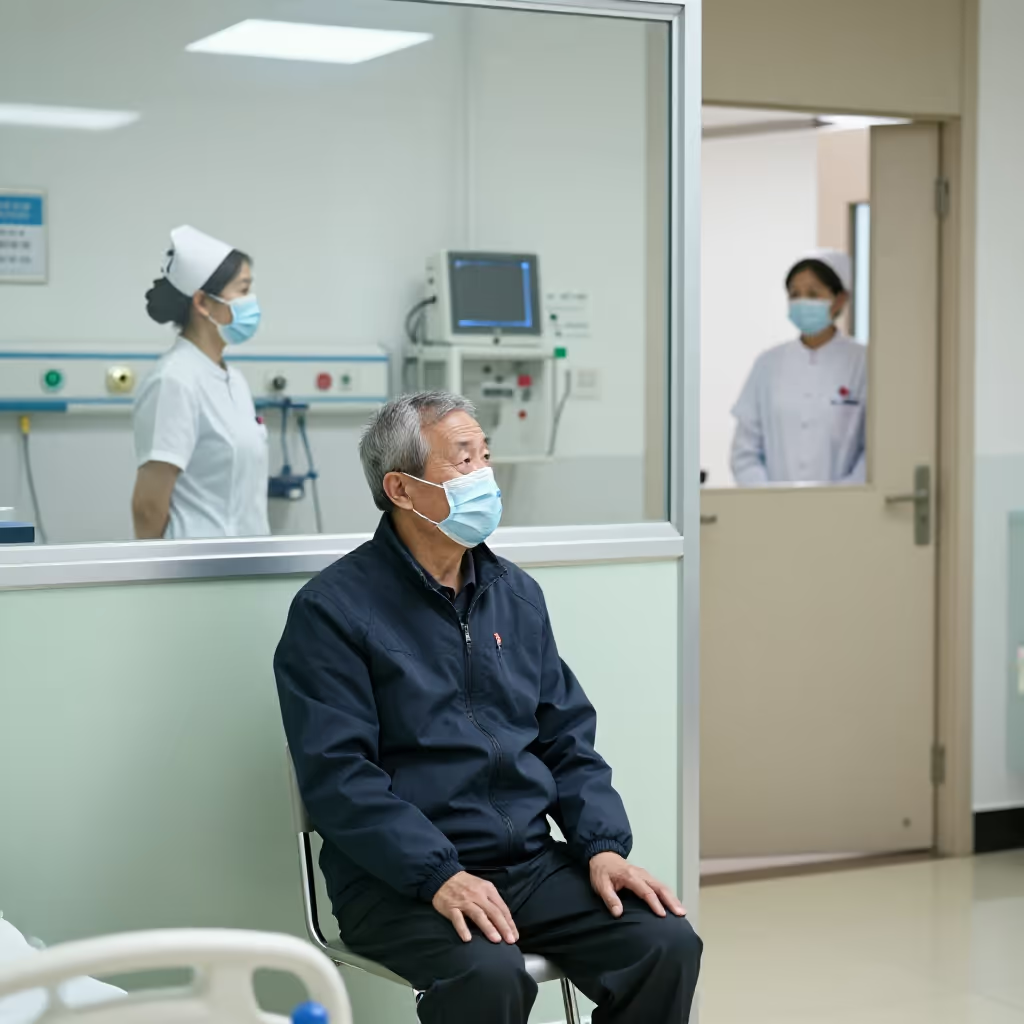
Der Patient wurde in einem speziellen Zimmer isoliert.
The patient was isolated in a special room.
You can recognize the meaning from the context: if it is about people and feelings, social separation is meant. With houses and materials, it is about protection against cold or heat. In a laboratory or research context, it means the separation of substances.
Er fühlte sich nach dem Streit von seinen Freunden isoliert.
After the argument, he felt isolated from his friends.
The past participle 'isoliert' is very often used like an adjective to describe the state of being separated. It occurs especially often in the phrase 'sich isoliert fühlen' (to feel isolated).
Viele ältere Menschen fühlen sich in der Großstadt isoliert.
Many older people feel isolated in the big city.
In the technical sense, 'isolieren' is often used with building components and a preposition. Typical phrases are 'das Haus gegen Kälte isolieren' (to insulate the house against cold) or 'die Wände gegen Lärm isolieren' (to insulate the walls against noise).
Ein gut isoliertes Haus verbraucht weniger Energie.
A well-insulated house uses less energy.
to exclude
Isolieren and ausgrenzen can both mean separating someone socially from others. “Ausgrenzen” emphasizes deliberate exclusion by a group, while “isolieren” focuses more on the lack of contact or the resulting state of separation. For a group deliberately leaving someone out, “ausgrenzen” is especially appropriate.

Nach dem Umzug isolierte sich der neue Schüler und sprach kaum noch mit seinen Mitschülern.
After moving, the new student isolated himself and hardly spoke to his classmates anymore.
Die Mitschüler grenzten den neuen Schüler bewusst aus und bezogen ihn nicht in ihre Spiele ein.
The classmates deliberately excluded the new student and did not include him in their games.