

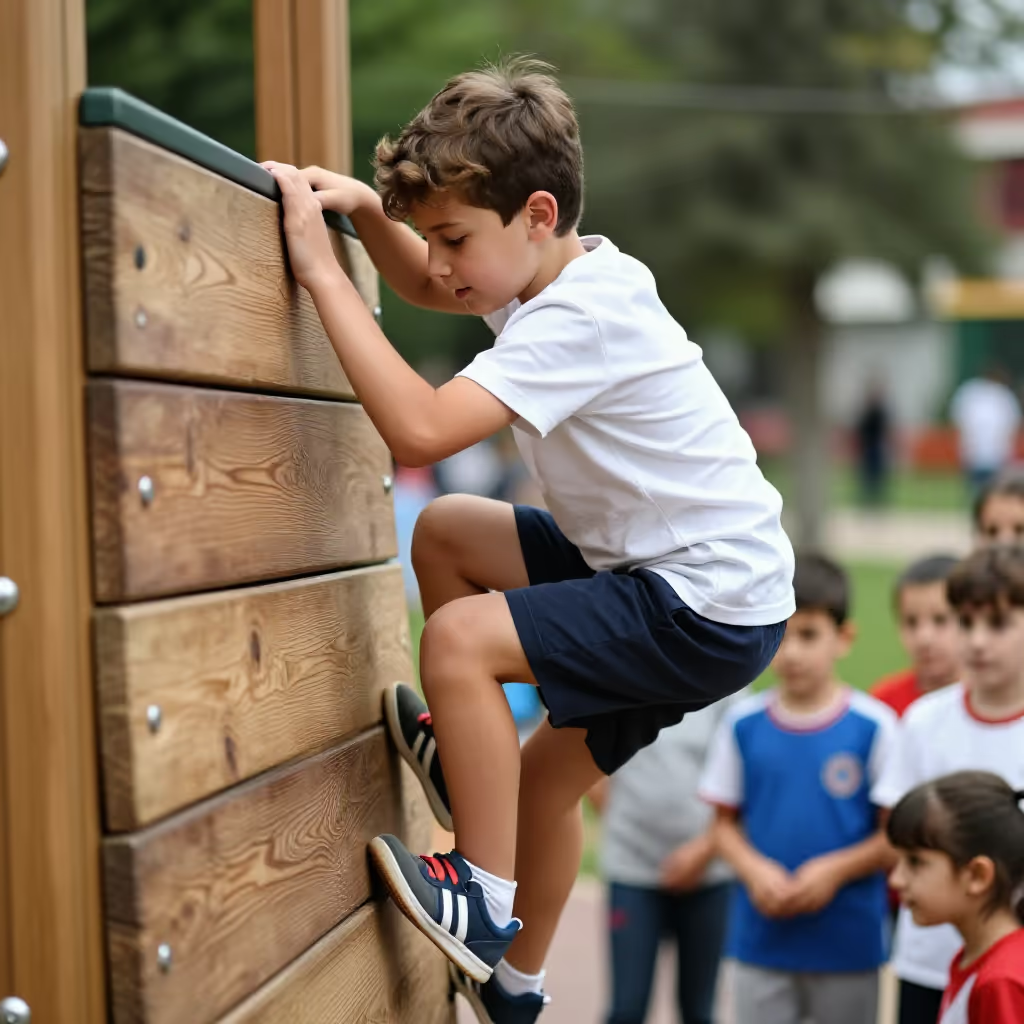
klettern
to climb
To move upward on something or over something with the help of hands and feet.
EXAMPLE
Die Kinder lieben es, auf den großen Felsen im Park zu klettern.
The children love climbing on the big rocks in the park.
to climb
Loading your saved state.
to climb
To move upward on something or over something with the help of hands and feet.
Die Kinder lieben es, auf den großen Felsen im Park zu klettern.
The children love climbing on the big rocks in the park.

to climb / rise
To rise or increase in a figurative sense, especially with prices, temperatures, or values.
Die Temperaturen klettern diese Woche auf über 30 Grad.
Temperatures are climbing to over 30 degrees this week.

to climb
To move up in a hierarchy or ranking.
Sie ist in der Firma schnell die Karriereleiter hochgeklettert.
She quickly climbed the career ladder in the company.
Since 'klettern' (to climb) describes movement from one place to another, the perfect tense is always formed with the auxiliary verb 'sein' (to be). A common mistake is using 'haben' (to have).
Wir sind am Wochenende in den Alpen geklettert.
We went climbing in the Alps at the weekend.
When climbing, prepositions that indicate direction are important. You climb 'auf' (onto/up) a mountain, 'über' (over) a wall, or 'durch' (through) a window.
Die Katze ist auf das Dach geklettert.
The cat climbed onto the roof.
In a figurative sense, 'klettern' (to climb) is used for numbers, prices, or temperatures that are rising. It describes a continuous increase, often with the preposition 'auf' (to) for the value reached.
Die Benzinpreise sind auf ein neues Rekordhoch geklettert.
Gasoline prices have climbed to a new record high.
In a professional context, the fixed expression 'die Karriereleiter hochklettern' (to climb the career ladder) is often used. It means to advance professionally and reach a higher position.
Er hat hart gearbeitet, um die Karriereleiter so schnell hochzuklettern.
He worked hard to climb the career ladder so quickly.
to rise / climb
“Steigen” and “klettern” can both be used with prices, temperatures, and other values. “Steigen” describes the increase neutrally, while “klettern” usually makes it sound more vivid and noticeable. “Steigen” is more suitable for factual reports; with a remarkable or sharp increase, “klettern” can emphasize the effect.

Die Benzinpreise klettern kurz vor den Ferien deutlich nach oben.
Gasoline prices are climbing noticeably just before the holidays.
Die Benzinpreise steigen in dieser Woche leicht.
Gasoline prices are rising slightly this week.