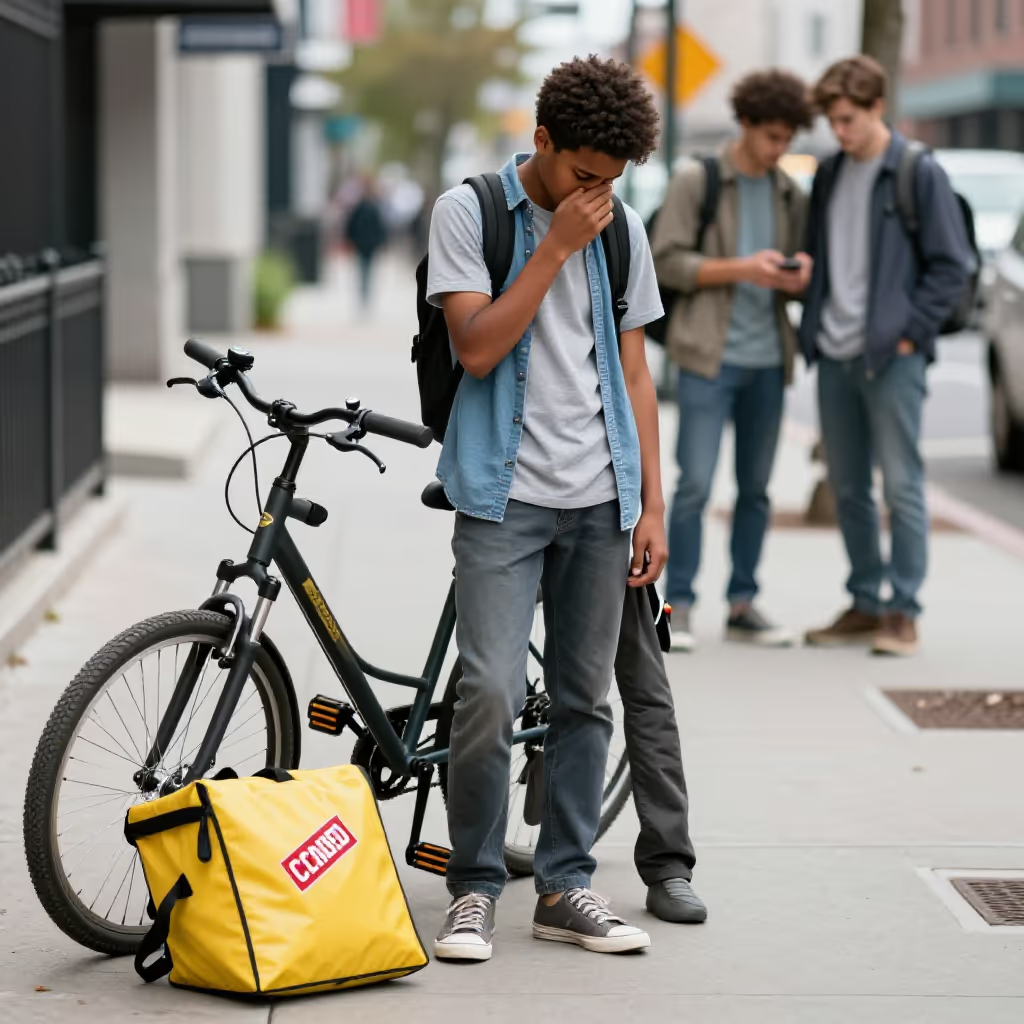
A state of great sorrow, misery, or suffering. It describes a deep feeling of sadness or a pitiable situation.
example
Nach der Flutkatastrophe war der Jammer in der betroffenen Region unermesslich.
After the flood disaster, the misery in the affected region was immeasurable.

Usage tips
Word family
'Der Jammer' (misery / complaining) is closely related to the verb 'jammern' (to complain, to lament). The noun describes either the state of sorrow or the act of complaining itself.
EXAMPLE
Sein lautes Jammern ging allen auf die Nerven.
His loud complaining got on everyone's nerves.
Use in the singular
The word 'Jammer' (misery / complaining) is used almost exclusively in the singular. Even when talking about many problems or great suffering, you speak of 'großer Jammer' (great misery), not 'die Jammern'.
EXAMPLE
Der Jammer nach dem Hochwasser war unbeschreiblich.
The misery after the flood was indescribable.
Fixed expression
A common fixed expression is 'ein Bild des Jammers bieten' (to present a picture of misery). This describes a sight that is very sad, miserable, or chaotic.
EXAMPLE
Nach der Party bot das Wohnzimmer ein Bild des Jammers.
After the party, the living room presented a picture of misery.
Context clue
When 'Jammer' (complaining) has the meaning of 'Klagen' (complaints / lamenting), it often appears with a possessive pronoun such as 'sein' (his), 'ihr' (her), or 'dein' (your). This shows that it is about a person's personal complaining.
EXAMPLE
Ihr ständiger Jammer über das Wetter ist ermüdend.
Her constant complaining about the weather is tiring.
Sentence structure
The expression 'ein Jammer sein' (to be a pity) is often used in the fixed structure 'Es ist ein Jammer, dass ...' (It's a pity that ...), followed by a subordinate clause, or with 'zu + Infinitiv' (to + infinitive).
EXAMPLE
Es ist ein Jammer, dass du nicht zur Feier kommen kannst.
It's a pity that you can't come to the celebration.
Compare with
antonym
Jammer vs Glück
happiness / luck
'das Glück' and 'der Jammer' describe opposite emotional states or situations. 'das Glück' means joy, contentment, or a very positive state. 'der Jammer' means great sorrow, suffering, or a very sad and bad situation. The contrast is clear: 'Glück' is about something good and fulfilling, while 'Jammer' is about something burdensome and sad. 'Jammer' often sounds stronger and somewhat more dramatic than simple sadness.
Jammer
Nach dem Brand war der Jammer im ganzen Dorf groß.
After the fire, there was great misery throughout the village.
Glück
Nach der langen Reise war das Glück groß, als die Familie endlich ankam.
After the long journey, the family was overjoyed when they finally arrived.