


kräftig
strong
Refers to physical strength; muscular and robust.
EXAMPLE
Er ist ein kräftiger Mann und kann schwere Kisten heben.
He is a strong man and can lift heavy boxes.
strong / intense
Loading your saved state.
strong
Refers to physical strength; muscular and robust.
Er ist ein kräftiger Mann und kann schwere Kisten heben.
He is a strong man and can lift heavy boxes.

intense
Intense in taste, color, or smell.
Die Suppe ist sehr kräftig gewürzt.
The soup is very intensely seasoned.
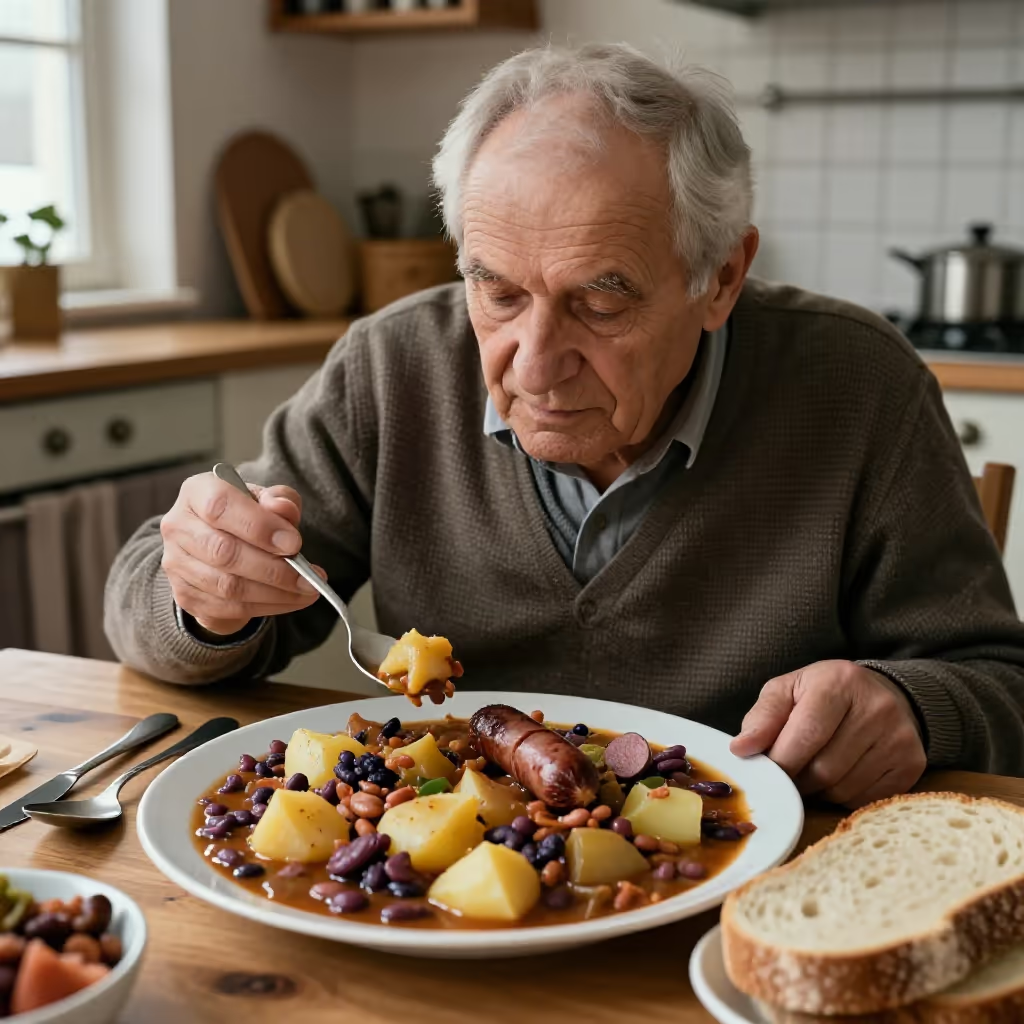
hearty
Rich and filling, usually in reference to a meal.
Nach der langen Wanderung brauchen wir ein kräftiges Abendessen.
After the long hike, we need a hearty dinner.

strong
Strong and clearly noticeable, for example with wind, rain, or applause.
Ein kräftiger Wind wehte vom Meer her.
A strong wind was blowing in from the sea.
The adjective 'kräftig' (strong/intense) is derived directly from the noun 'die Kraft' (strength/power). Something that is 'kräftig' therefore has a lot of power, strength, or intensity.
Für diese Arbeit braucht man kräftige Arme.
You need strong arms for this work.
'Kräftig' can also be used as an adverb to intensify a verb. It then means something like 'strongly,' 'intensely,' or 'with a lot of energy.'
Vor Gebrauch die Flasche bitte kräftig schütteln.
Please shake the bottle vigorously before use.
In relation to the senses, 'kräftig' (intense) is often used for intense impressions. Typical combinations are 'ein kräftiger Kaffee' (a strong coffee), 'ein kräftiger Käse' (a strong cheese), 'eine kräftige Farbe' (a bold color), or 'ein kräftiger Geschmack' (an intense flavor).
Ich mag den kräftigen Geschmack von dunkler Schokolade.
I like the intense flavor of dark chocolate.
When it comes to food, 'kräftig' (hearty) describes a rich and filling meal. Common phrases are 'ein kräftiges Frühstück' (a hearty breakfast) or 'eine kräftige Suppe' (a hearty soup).
Ein kräftiges Frühstück gibt Energie für den ganzen Tag.
A hearty breakfast gives you energy for the whole day.
'Kräftig' (strong) also describes strong natural events or loud sounds. For example, people speak of 'ein kräftiger Wind' (a strong wind), 'ein kräftiger Regen' (heavy rain), or 'kräftiger Applaus' (strong applause).
Nach der Vorstellung gab es kräftigen Applaus für die Schauspieler.
After the performance, there was strong applause for the actors.
strong
For tastes, colors, or smells, both „stark“ and „kräftig“ can express a high level of intensity. „Stark“ generally indicates the degree, while „kräftig“ tends to emphasize the perception’s full, distinctive character. „Kräftig“ is therefore often suitable for a clearly noticeable taste that seems full-bodied.

Dieser Kaffee hat einen kräftigen Geschmack.
This coffee has a full-bodied taste.
Dieser Kaffee hat einen starken Geschmack.
This coffee has a strong taste.