

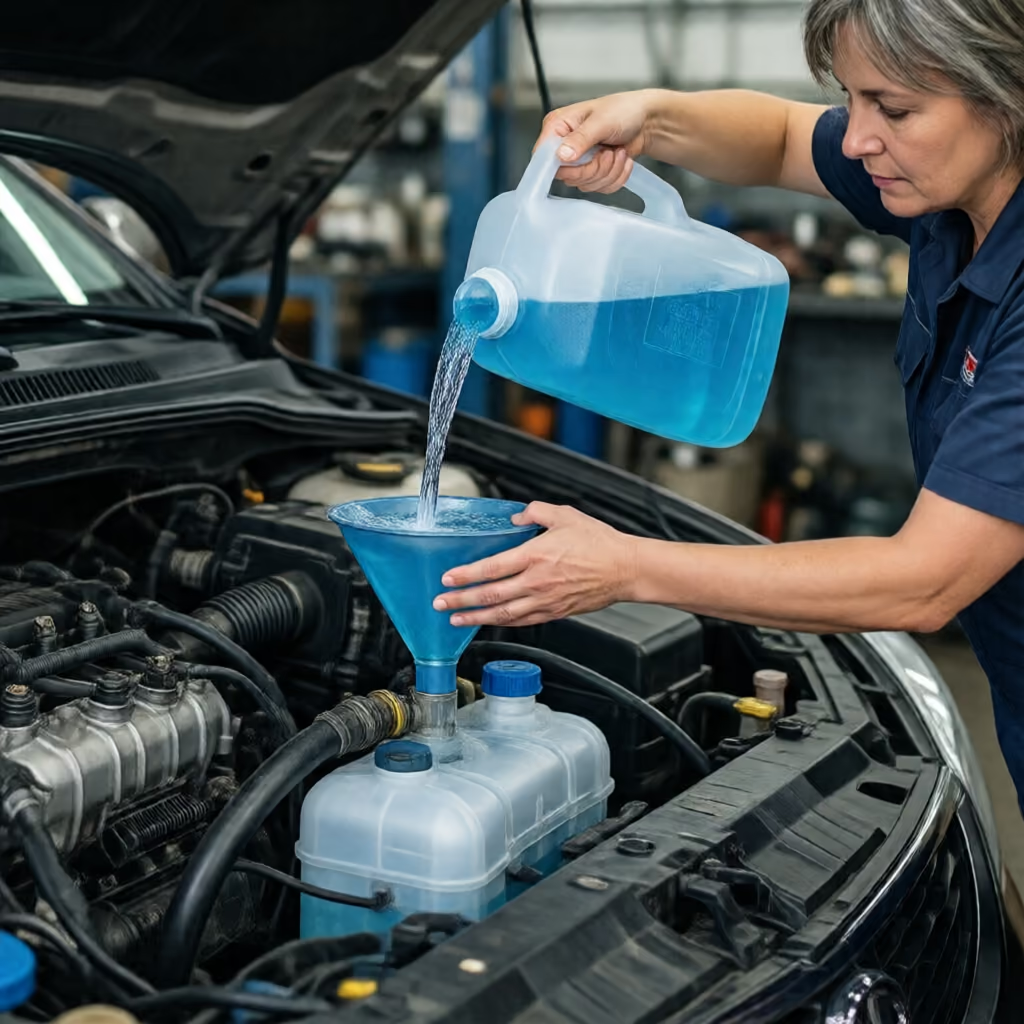
das Kühlwasser
coolant
Water used to cool engines, machines, or technical systems.
EXAMPLE
Der Motor überhitzte, weil zu wenig Kühlwasser vorhanden war.
The engine overheated because there was not enough coolant.
coolant
das Kühlwasser
Loading your saved state.
coolant
Water used to cool engines, machines, or technical systems.
Der Motor überhitzte, weil zu wenig Kühlwasser vorhanden war.
The engine overheated because there was not enough coolant.
| gender | neuter das |
|---|---|
| genitive | des Kühlwassers |
| singular | plural | |
|---|---|---|
| nominative | das Kühlwasser | – |
| accusative | das Kühlwasser | – |
| dative | dem Kühlwasser | – |
| genitive | des Kühlwassers | – |
The article changes with the case; it is shown in colour.
„Kühlwasser“ is made up of the verb stem „kühl-“ (from „kühlen“ (to cool)) and „Wasser“ (water). The first word describes the function of the water: it is used for cooling.
Vor der langen Fahrt kontrollierte der Fahrer das Kühlwasser.
Before the long journey, the driver checked the coolant.
Common collocations include „Kühlwasser kontrollieren“ (to check the coolant), „Kühlwasser nachfüllen“ (to top up the coolant), „Kühlwasser verlieren“ (to lose coolant), and „Kühlwasser tritt aus“ (coolant is leaking). These expressions are especially common in connection with vehicles and engines.
Wegen eines undichten Schlauchs verlor das Auto langsam Kühlwasser.
The car slowly lost coolant because of a leaking hose.
„Kühlwasser“ is mainly used in technical contexts, for example with vehicles, machines, and systems. It often concerns the fluid level, the temperature, or a leak.
Die Werkstatt prüfte den Füllstand und die Temperatur des Kühlwassers.
The garage checked the coolant level and temperature.