

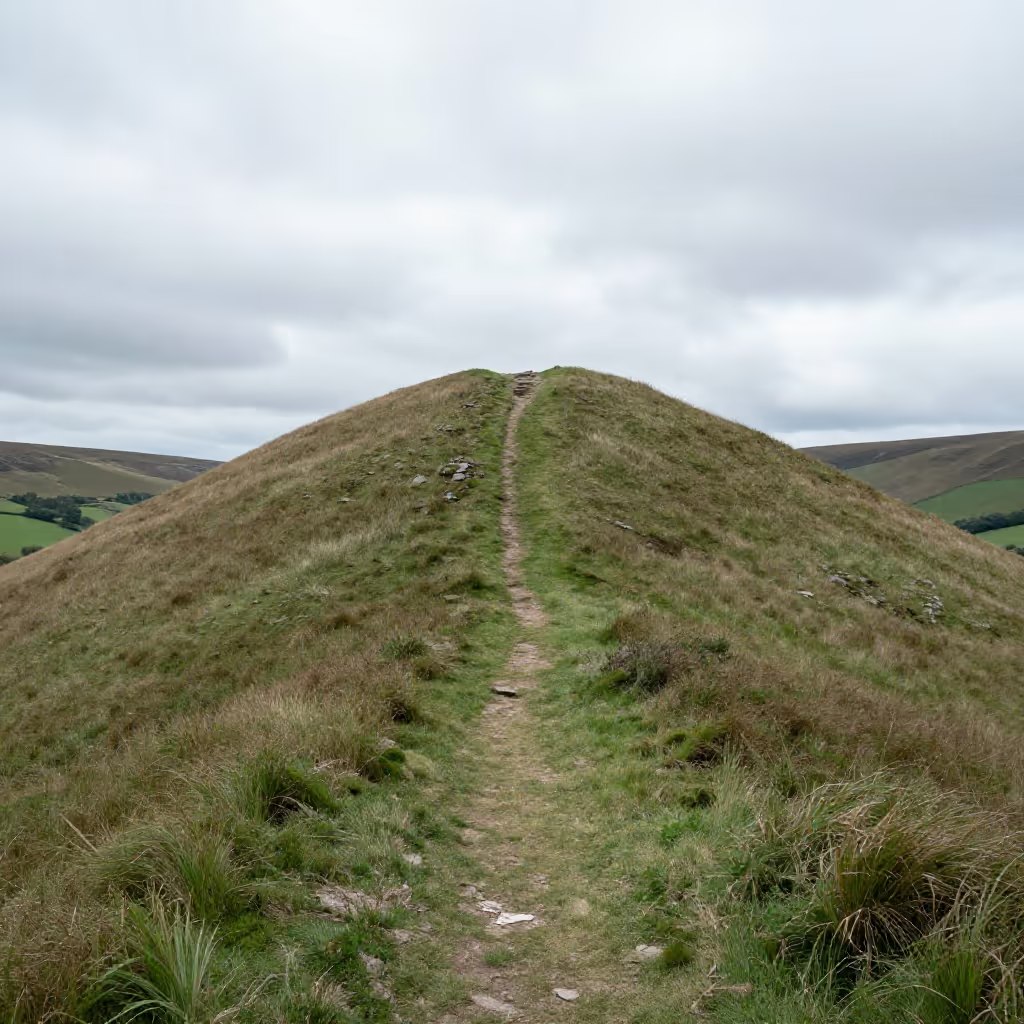
die Kuppe
crest
The rounded summit of a hill or mountain.
EXAMPLE
Von der Kuppe des Hügels hatten wir eine fantastische Aussicht.
From the crest of the hill, we had a fantastic view.
crest / fingertip
Loading your saved state.
crest
The rounded summit of a hill or mountain.
Von der Kuppe des Hügels hatten wir eine fantastische Aussicht.
From the crest of the hill, we had a fantastic view.

fingertip / toe tip
The soft, fleshy tip of a finger or toe.
Er hat sich mit dem Hammer auf die Kuppe seines Daumens geschlagen.
He hit the tip of his thumb with the hammer.
You can always recognize the meaning of 'Kuppe' (crest / fingertip) from the context. If it is about geography, such as 'Berg' (mountain) or 'Hügel' (hill), it means the summit. If it is about the body, such as 'Finger' (finger) or 'Zeh' (toe), it means the soft tip.
Wir wanderten bis zur Kuppe des Berges.
We hiked up to the crest of the mountain.
When talking about the summit of a hill, the preposition is important. 'Auf der Kuppe' (on the crest, dative) describes a location, while 'auf die Kuppe' (onto the crest, accusative) indicates a direction.
Auf der Kuppe stand eine kleine Hütte.
There was a small hut on the crest.
In connection with fingers or toes, 'Kuppe' (tip) is often used in phrases that describe touching something or a small injury.
Er spürte den feinen Stoff mit seinen Fingerkuppen.
He felt the fine fabric with his fingertips.
tip / top / lace
For a finger, Spitze can refer generally to the very end. Kuppe is more precise and means the soft, fleshy area at that end. If only the outermost point is meant, Spitze is appropriate; when referring to touch, pressure, or a minor injury, Kuppe is often more precise.

Mit der Kuppe des Zeigefingers drückte sie vorsichtig auf den Schalter.
She carefully pressed the switch with the pad of her index finger.
Mit der Spitze des Zeigefingers berührte sie vorsichtig den Schalter.
She carefully touched the switch with the tip of her index finger.