

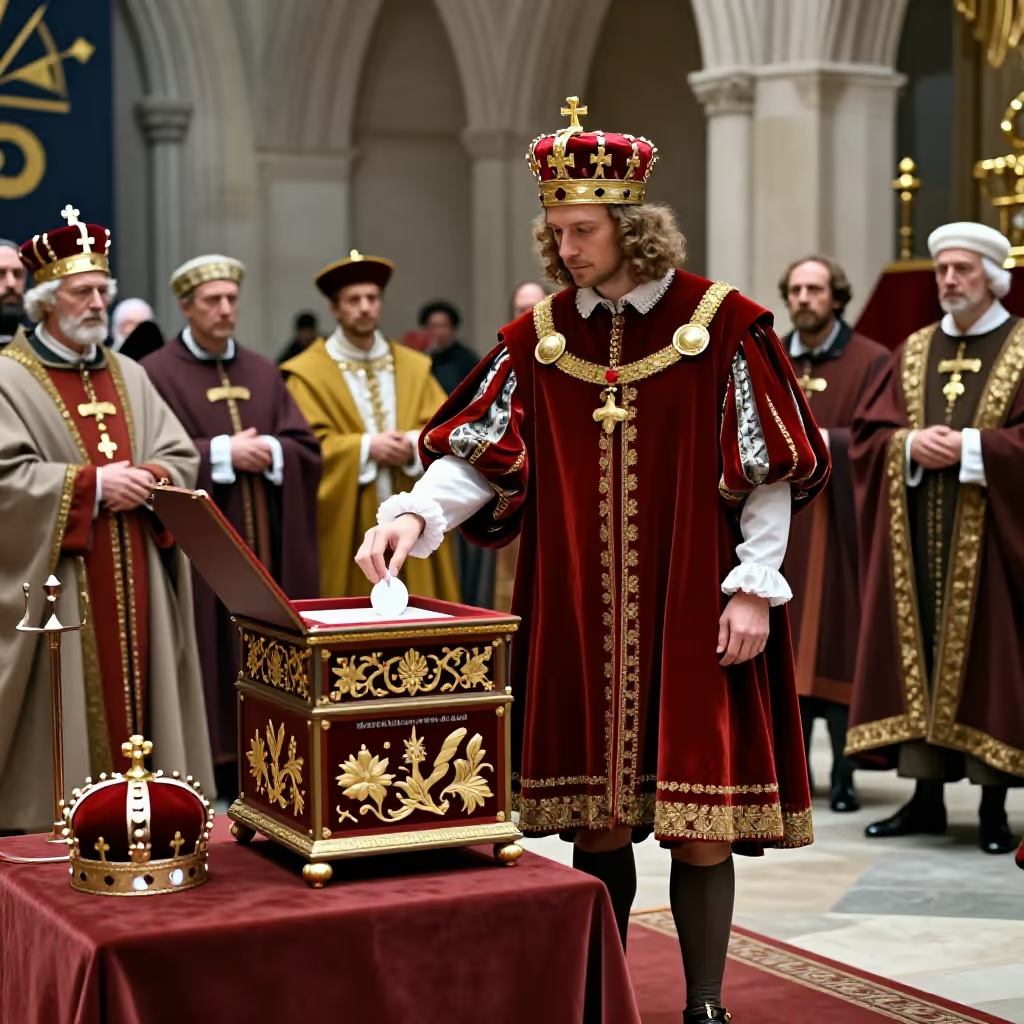
A historical title for one of the highest-ranking princes in the Holy Roman Empire who had the right to elect the Roman-German king and emperor.
example
August der Starke war Kurfürst von Sachsen und später auch König von Polen.
Augustus the Strong was Elector of Saxony and later also King of Poland.
Usage tips
Compound word
The word is made up of 'Kur' and 'Fürst' (prince). 'Kur' is an old word for 'Wahl' (election) from the verb 'küren' (to choose / to elect). A Kurfürst was therefore literally an 'electing prince' who was allowed to elect the emperor.
EXAMPLE
Die Fürsten kürten den neuen König.
The princes elected the new king.
Historical term
'Kurfürst' (elector) is a purely historical title that is no longer used today. It is closely connected with the history of the Holy Roman Empire (ca. 962–1806).
EXAMPLE
Im Geschichtsunterricht lernen wir über die Rolle der Kurfürsten.
In history class, we learn about the role of the electors.
Typical use
The title is almost always used in the form 'Kurfürst von [Region]' (Elector of [region]) to identify the prince's territory or rule.
EXAMPLE
Der Kurfürst von Brandenburg hatte großen politischen Einfluss.
The Elector of Brandenburg had great political influence.
Compare with
confusable
Kurfürst vs Herzog
duke
'Herzog' and 'Kurfürst' are both historical noble titles and can therefore easily be confused. A 'Herzog' was the ruler of a duchy and ranked below a king. A 'Kurfürst' was a particularly important prince in the Holy Roman Empire because he was allowed to help elect the king or emperor. Both words are mainly used in historical texts. So the important difference is: 'Herzog' describes a high noble title, while 'Kurfürst' also includes a special right to vote in elections.
Kurfürst
Im Kurs lernen wir, dass ein Kurfürst an der Wahl des Kaisers beteiligt war.
In the course, we learn that an elector was involved in choosing the emperor.
Herzog
Sie liest im Zug einen Text über einen Herzog, der im Mittelalter ein großes Gebiet regierte.
On the train, she is reading a text about a duke who ruled a large territory in the Middle Ages.