


das Lebensalter
age
The number of years a person has lived; a person's age. It is a somewhat more formal term than 'Alter' (age).
Unabhängig vom Lebensalter kann jeder eine neue Sprache lernen.
Regardless of age, anyone can learn a new language.
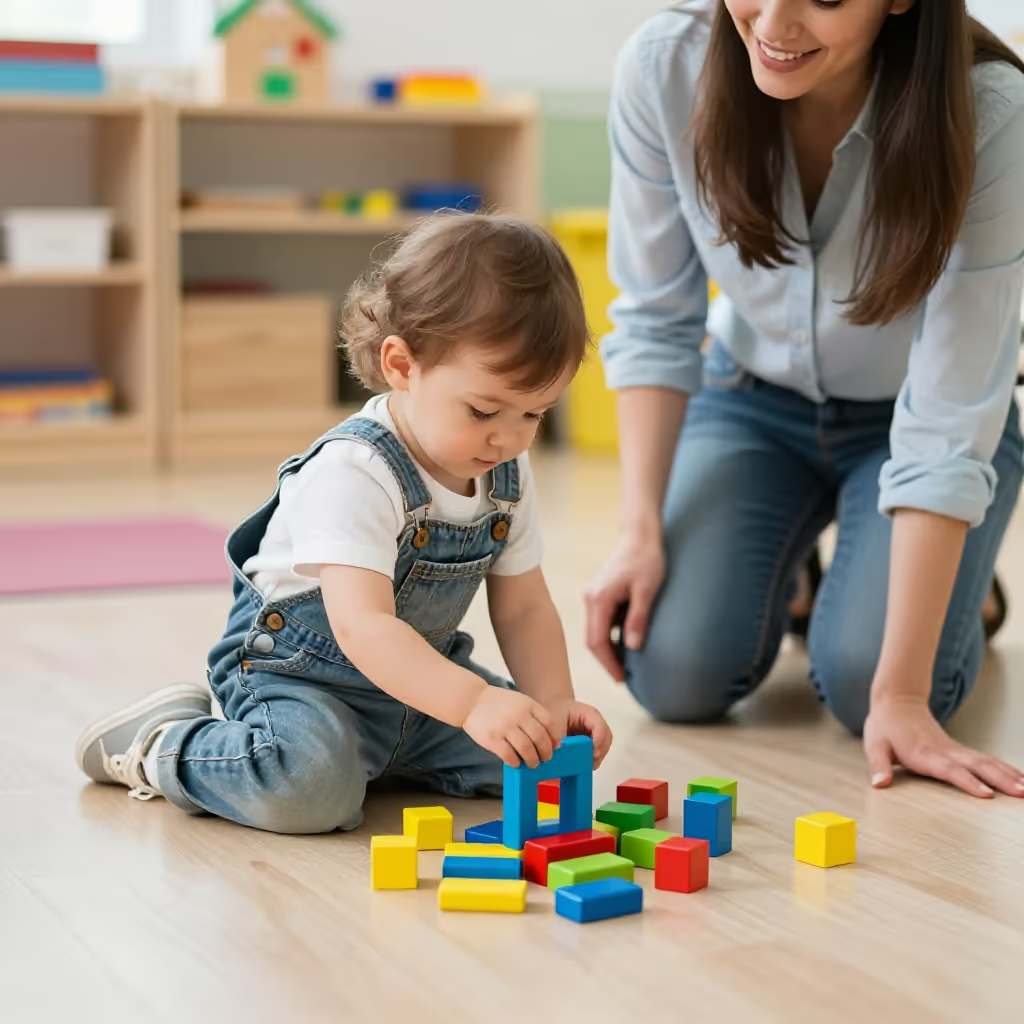

age
Loading your saved state.
age
The number of years a person has lived; a person's age. It is a somewhat more formal term than 'Alter' (age).
Unabhängig vom Lebensalter kann jeder eine neue Sprache lernen.
Regardless of age, anyone can learn a new language.

The word is made up of 'das Leben' (life) and 'das Alter' (age). The 's' between them is a linking element. Literally, it therefore means 'the age of life'.
Das gesetzliche Renteneintrittsalter hängt vom Lebensalter ab.
The statutory retirement age depends on one's age.
'Lebensalter' (age) is a more formal and often written-language variant of 'Alter' (age). You often find it in official documents, academic texts, or elevated language.
Bitte geben Sie im Formular Ihr genaues Lebensalter an.
Please state your exact age on the form.
When 'Lebensalter' (stage of life) describes a phase of life, it is often accompanied by adjectives such as 'früh' (early), 'mittel' (middle), or 'fortgeschritten' (advanced). These combinations point to a stage of life, not just a number.
Im frühen Lebensalter ist die Lernfähigkeit besonders hoch.
At an early stage of life, the ability to learn is especially high.
'Lebensalter' (age) is frequently used with the preposition 'in' or 'mit'. The expression 'im Lebensalter von ...' (at the age of ...) is a formal way to state an exact number of years, often in official announcements.
Er verstarb im gesegneten Lebensalter von 95 Jahren.
He passed away at the blessed age of 95.
age
'das Alter' and 'das Lebensalter' both mean how many years a person has lived. In everyday language, people usually say 'Alter', for example in questions, forms, or conversations. 'Lebensalter' sounds somewhat more formal and precise, especially in texts about health, statistics, or rules. In many sentences, both words can be understood, but 'Alter' is more natural in normal conversation.

Das Lebensalter spielt bei dieser Untersuchung eine wichtige Rolle.
Age plays an important role in this examination.
Die Lehrerin fragt die Kinder nach ihrem Alter.
The teacher asks the children their age.