

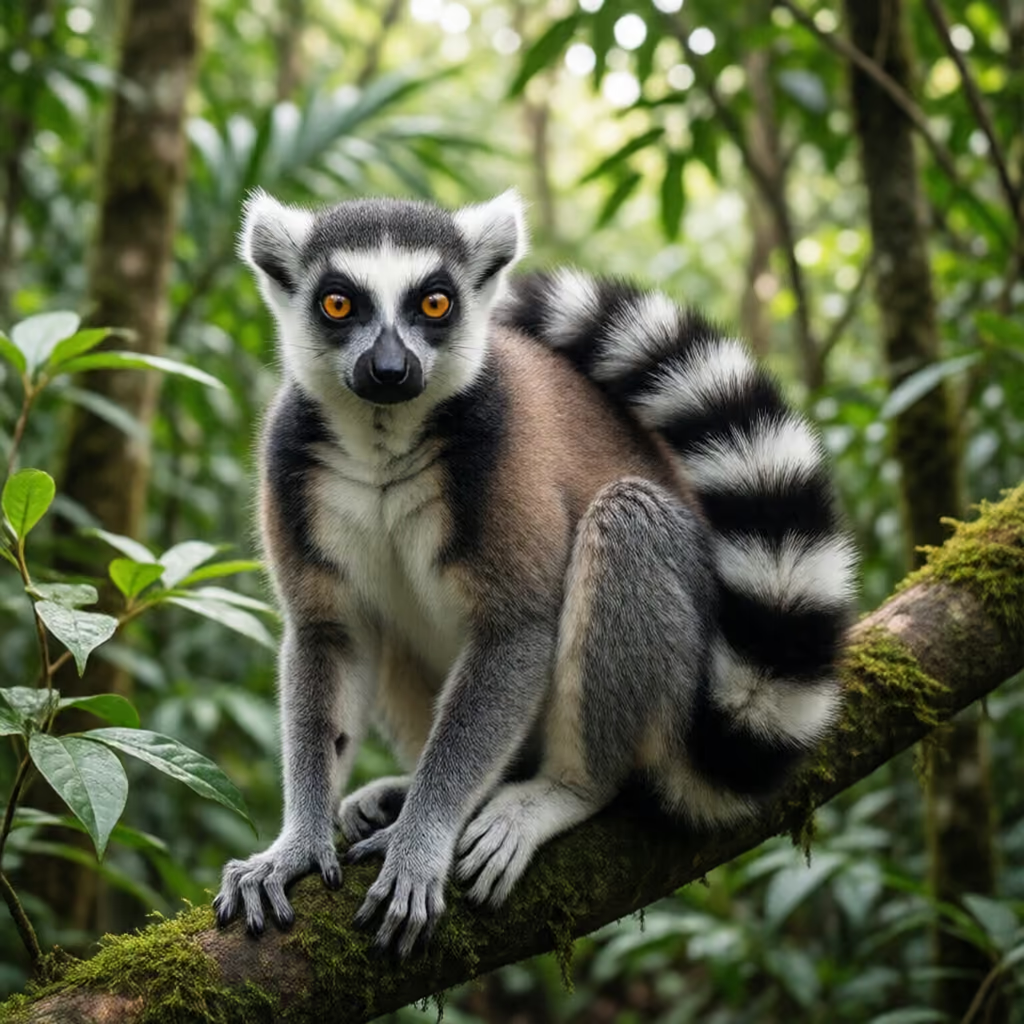
der Lemur
lemur
A usually nocturnal primate that lives in Madagascar and some neighboring islands. Lemurs often have large eyes and a long tail.
EXAMPLE
Der Lemur kletterte langsam durch die Äste.
The lemur slowly climbed through the branches.
lemur
der Lemur, die Lemuren
Loading your saved state.
lemur
A usually nocturnal primate that lives in Madagascar and some neighboring islands. Lemurs often have large eyes and a long tail.
Der Lemur kletterte langsam durch die Äste.
The lemur slowly climbed through the branches.
| gender | masculine der |
|---|---|
| plural | die Lemuren |
| genitive | des Lemuren |
| singular | plural | |
|---|---|---|
| nominative | der Lemur | die Lemuren |
| accusative | den Lemuren | die Lemuren |
| dative | dem Lemuren | den Lemuren |
| genitive | des Lemuren | der Lemuren |
The article changes with the case; it is shown in colour.
The word 'Lemur' often appears with verbs related to observing animals: you can observe, photograph, or feed a lemur. Movements such as climbing, jumping, and sleeping are also often associated with the word.
Die Besucher beobachteten einen Lemuren, der von Ast zu Ast sprang.
The visitors observed a lemur jumping from branch to branch.
Words such as 'Gehege' (enclosure), 'Zoo' (zoo), 'Madagaskar' (Madagascar), 'Primat' (primate), or 'Schwanz' (tail) usually indicate that 'Lemur' is being used in a zoological context. This makes the word easy to recognize even in an informational text.
Das neue Gehege im Zoo wurde extra für die Lemuren aus Madagaskar gebaut.
The new enclosure at the zoo was built especially for the lemurs from Madagascar.
'Lemur' belongs to standard neutral language and is used both in everyday situations, such as a visit to the zoo, and in zoological texts.
Im Zoo erzählte die Führerin, warum der Lemur nachts besonders aktiv ist.
At the zoo, the guide explained why the lemur is especially active at night.