
A covering for the face or part of it, worn for protection (e.g., against viruses or dust), as a disguise (during carnival), or when carrying out certain professions.
example
Beim Schweißen muss man eine spezielle Maske tragen, um die Augen zu schützen.
When welding, you have to wear a special mask to protect your eyes.
Usage tips
Context clue: verbs
The verb used helps you recognize the meaning of 'Maske' (mask). A protective mask is 'getragen' (worn) or 'aufgesetzt' (put on), a cosmetic mask is 'aufgetragen' (applied), and a figurative mask can 'fallen' (fall).
EXAMPLE
Im Operationssaal tragen alle eine Maske.
In the operating room, everyone wears a mask.
Typical verbs
When it is about a protective mask or disguise mask, the typical verbs are 'tragen' (to wear), 'aufsetzen' (to put on), and 'abnehmen' (to take off).
EXAMPLE
Setz bitte deine Maske auf, bevor du den Raum betrittst.
Please put on your mask before you enter the room.
Verbs for cosmetics
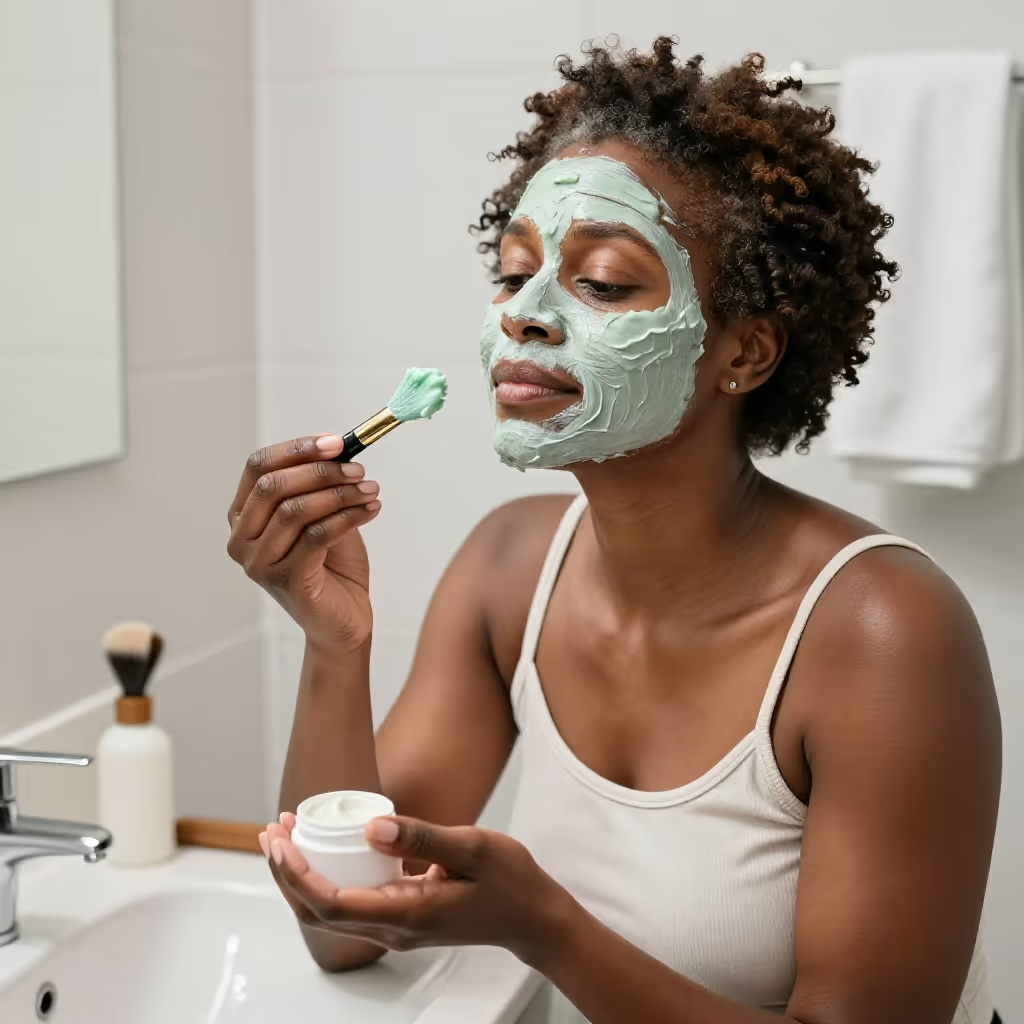
With a cosmetic mask, different verbs are used. You 'trägt' it 'auf' (apply it), 'lässt' it 'einwirken' (let it work), and then 'wäscht' it 'ab' (wash it off).
EXAMPLE
Diese Maske muss zehn Minuten einwirken.
This mask has to be left on for ten minutes.
Fixed expression
In the figurative meaning, the expression 'die Maske fallen lassen' (to let the mask fall/drop the mask) is very common. It means that someone shows their true face or their true intentions.
EXAMPLE
Unter Druck ließ der Politiker seine freundliche Maske fallen.
Under pressure, the politician dropped his friendly mask.
Compare with
near_synonym · confusable
Maske vs Fassade
facade
'die Maske' and 'die Fassade' can both refer figuratively to something that hides the truth. With 'Maske', the focus is more on a person: someone shows a certain face or behavior so that others do not see their real feelings. 'Fassade' is more about an outward appearance that makes a whole situation, person, or thing seem better than it really is. Learners may confuse the words because both have to do with hiding something. 'Maske' fits better with a person's behavior and feelings, while 'Fassade' fits better with a pleasant outward impression.
Maske
Nach dem Gespräch fiel ihre freundliche Maske, und sie wirkte sehr traurig.
After the conversation, her friendly mask dropped, and she seemed very sad.
Fassade
Hinter der ruhigen Fassade der Familie gab es viele Probleme.
Behind the family's calm facade, there were many problems.