

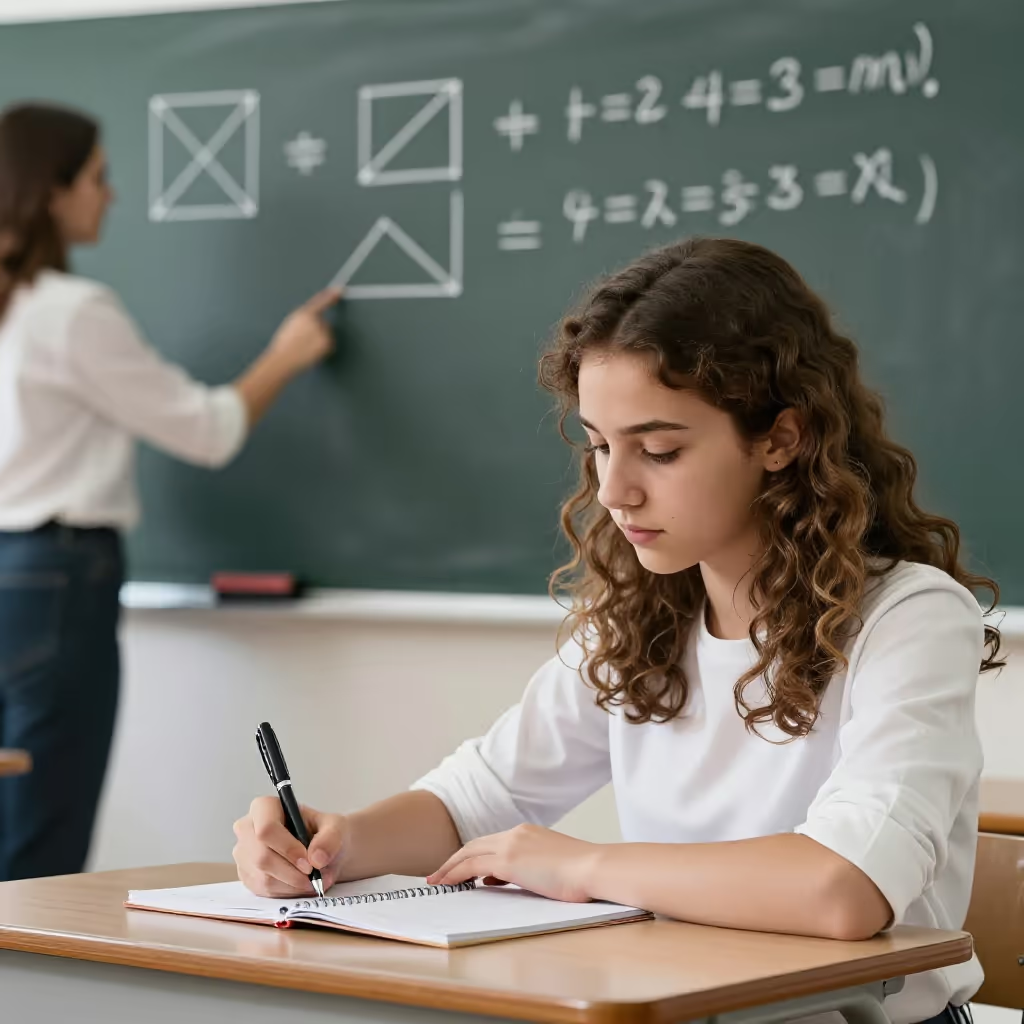
die Mathe
math
Colloquial short form for the school subject or the scientific field of mathematics.
EXAMPLE
Ich habe morgen eine wichtige Klausur in Mathe.
I have an important math test tomorrow.
math
Loading your saved state.
math
Colloquial short form for the school subject or the scientific field of mathematics.
Ich habe morgen eine wichtige Klausur in Mathe.
I have an important math test tomorrow.
'Mathe' (math) is the colloquial and very common short form of 'die Mathematik' (mathematics). In formal or academic texts, you should use the long form.
In der Schule war Mathe mein Lieblingsfach.
At school, math was my favorite subject.
In everyday language, 'Mathe' (math) is often combined with verbs like 'haben' (to have, in the sense of having class), 'lernen' (to study), 'üben' (to practice), or 'verstehen' (to understand). 'Eine Prüfung in Mathe' (a math exam) is also a fixed combination.
Wir haben heute Nachmittag zwei Stunden Mathe.
We have two hours of math this afternoon.
When 'Mathe' (math) is referred to as a school subject or university subject, it often appears without an article, especially after prepositions like 'in' or as a direct object.
Sie ist wirklich gut in Mathe.
She is really good at math.
mathematics
Mathematik is the standard term for the science and the school subject. Mathe is the colloquial short form. Mathematik is appropriate in official or formal texts, while Mathe is usually used in casual conversation.

In der Pause erzählt Nina ihrer Freundin von ihrer guten Note in Mathe.
During the break, Nina tells her friend about her good grade in math.
Im Zeugnis steht, dass Nina in Mathematik eine gute Note hat.
Nina’s report card says that she got a good grade in mathematics.