

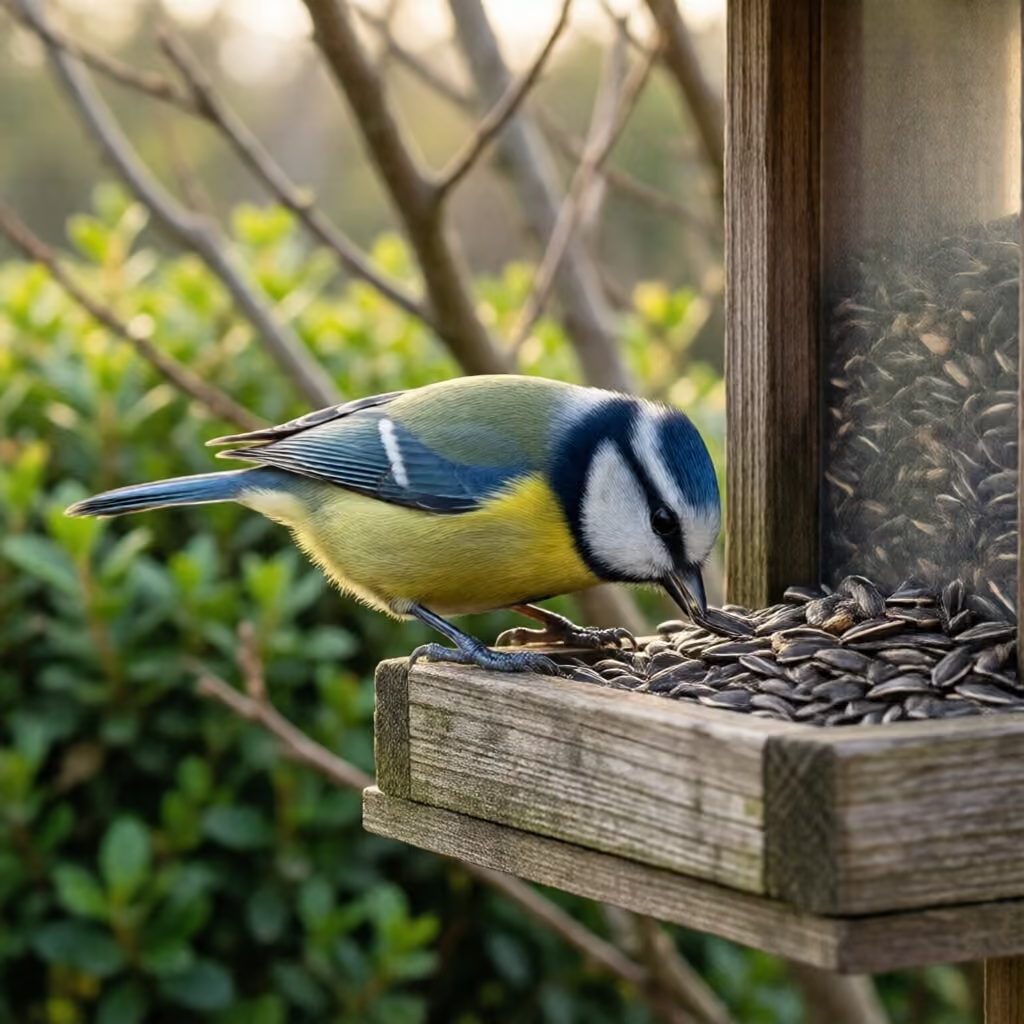
die Meise
titmouse
A small songbird from the tit family that is commonly found in gardens and forests.
Eine Meise sitzt auf dem Futterhaus und pickt Sonnenblumenkerne.
A titmouse is sitting on the bird feeder and pecking at sunflower seeds.

titmouse
die Meise, die Meisen
Loading your saved state.

titmouse
A small songbird from the tit family that is commonly found in gardens and forests.
Eine Meise sitzt auf dem Futterhaus und pickt Sonnenblumenkerne.
A titmouse is sitting on the bird feeder and pecking at sunflower seeds.

to have a screw loose
Colloquial: to behave unusually or crazily; not to be entirely sensible.
Du hast wohl eine Meise, wenn du bei diesem Wetter im T-Shirt rausgehst.
You must have a screw loose if you're going outside in a T-shirt in this weather.
| gender | feminine die |
|---|---|
| plural | die Meisen |
| genitive | der Meise |
| singular | plural | |
|---|---|---|
| nominative | die Meise | die Meisen |
| accusative | die Meise | die Meisen |
| dative | der Meise | den Meisen |
| genitive | der Meise | der Meisen |
The article changes with the case; it is shown in colour.
With „die Meise“ (titmouse), the context determines the meaning: words such as „Vogel“ (bird), „Garten“ (garden), „Futterhaus“ (bird feeder), or „sitzen“ (to sit) point to the animal. Together with „haben“ (to have) and a person as the subject, „eine Meise haben“ (to have a screw loose) usually belongs to the colloquial idiom.
Im Garten beobachtete sie eine Meise am alten Baum.
In the garden, she watched a titmouse in the old tree.
Du hast doch eine Meise, wenn du mitten in der Nacht schwimmen gehst.
You must have a screw loose if you go swimming in the middle of the night.
Typical collocations for the bird involve watching, feeding, and singing. „Die Meise“ (the titmouse) is also often used with places such as a garden, forest, or bird feeder.
Die Kinder fütterten die Meise auf dem Balkon.
The children fed the titmouse on the balcony.
Eine Meise zwitscherte im Garten.
A titmouse was singing in the garden.
„Eine Meise haben“ (to have a screw loose) is a fixed, colloquial expression. „Eine Meise“ (a screw loose) is used as an accusative object after „haben“ (to have); words such as „wohl“ (probably), „doch“ (after all), or „echt“ (really) often intensify the surprised or critical tone.
Hast du echt eine Meise? Du kannst doch nicht einfach mein Auto nehmen!
Have you got a screw loose or something? You can't just take my car!