

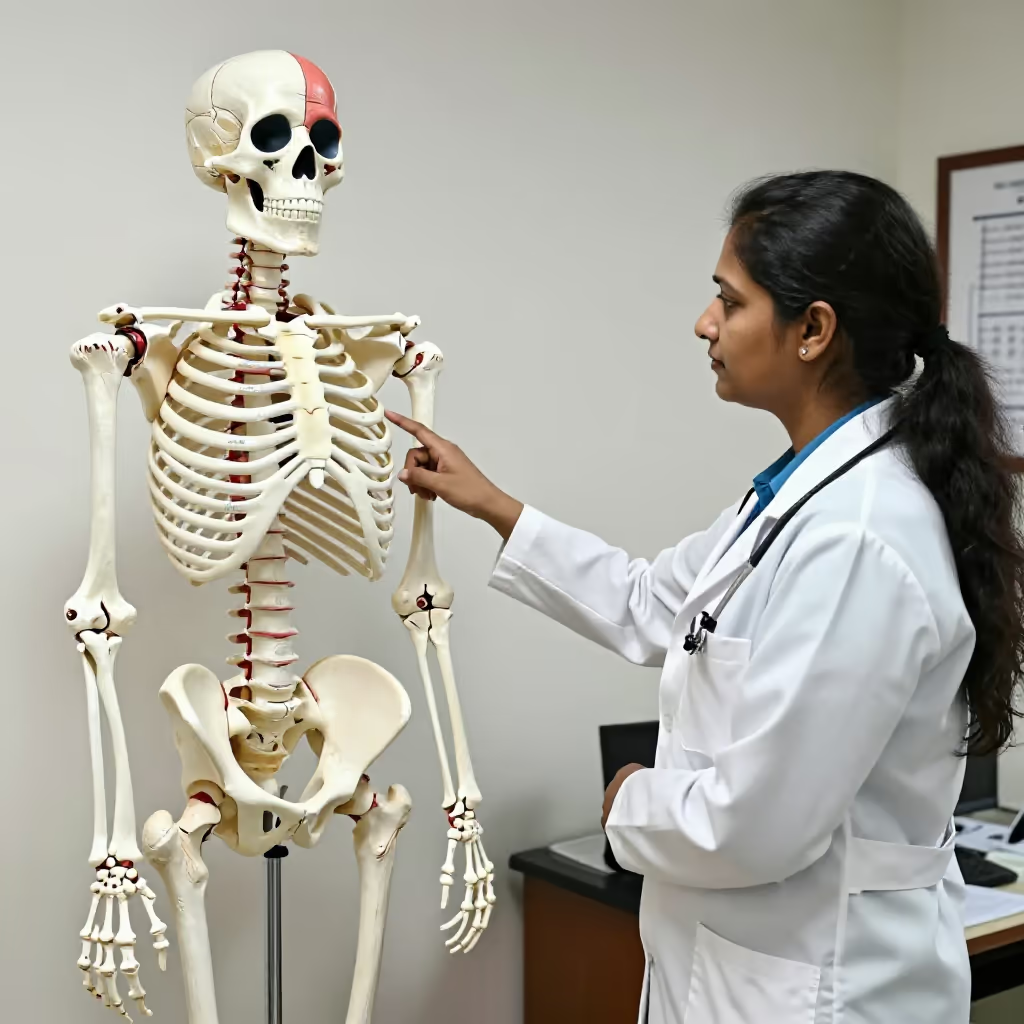
der Mensch
human / person
An individual of the species Homo sapiens; a person in general.
EXAMPLE
Jeder Mensch hat das Recht auf Freiheit.
Every human being has the right to freedom.
human / person
Loading your saved state.
human / person
An individual of the species Homo sapiens; a person in general.
Jeder Mensch hat das Recht auf Freiheit.
Every human being has the right to freedom.
humankind
All human beings as a whole; humanity. In this meaning, the word is often used in the singular without an article or with the definite article.
Der Klimawandel ist eine große Herausforderung für den Menschen.
Climate change is a major challenge for humankind.

man! / wow!
A colloquial exclamation that expresses surprise, annoyance, joy, or another strong emotion.
Mensch, hab ich mich erschrocken!
Man, that scared me!

person
Refers to a person in terms of their character and personality, often in an evaluative way.
Er ist ein durch und durch ehrlicher Mensch.
He is an honest person through and through.
'Der Mensch' belongs to the N-declension. This means that in the genitive, dative, and accusative singular it receives the ending '-en'. A common mistake is forgetting this ending.
Ich habe gestern einen interessanten Menschen kennengelernt.
I met an interesting person yesterday.
The exclamation 'Mensch!' is used in colloquial speech to express surprise, annoyance, or joy. In this function, it is not a noun but an interjection.
Mensch, das ist ja eine tolle Nachricht!
Wow, that's great news!
When 'der Mensch' is used in the singular and often with the definite article in a general or philosophical context, it refers to humanity as a whole.
Der Mensch hat die Verantwortung für den Planeten.
Humankind has responsibility for the planet.
To describe a person's character, 'Mensch' is frequently combined with evaluative adjectives. Typical formulations are 'ein guter Mensch' (a good person), 'ein ehrlicher Mensch' (an honest person), or 'ein herzlicher Mensch' (a warm-hearted person).
Sie ist ein sehr hilfsbereiter Mensch.
She is a very helpful person.
people
Menschen and Leute can both refer to an unspecified group. Menschen tends to emphasize that the focus is on human individuals and their needs. Leute sounds more colloquial and refers to people more as a social group.
Bei dem großen Fest brauchten mehrere Menschen medizinische Hilfe.
Several people needed medical help at the large festival.
Bei dem großen Fest standen viele Leute gemeinsam vor der Bühne.
A lot of people were standing together in front of the stage at the large festival.