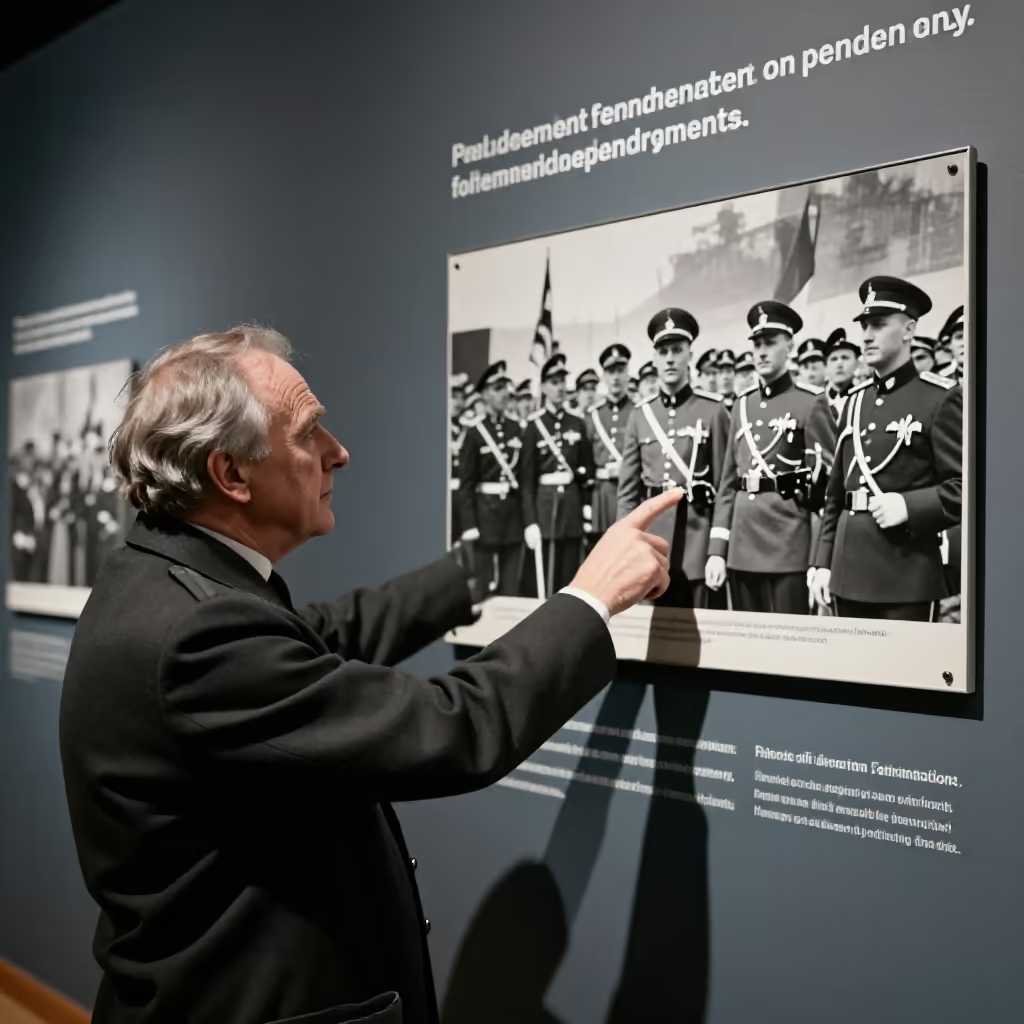
A supporter of the political ideology of National Socialism or a member of the National Socialist German Workers' Party (NSDAP) in a historical context.
example
Viele Nationalsozialisten wurden nach dem Krieg für ihre Verbrechen zur Rechenschaft gezogen.
Many National Socialists were held accountable for their crimes after the war.

Usage tips
Compound structure
The word is made up of 'national' (national) and 'Sozialist' (socialist). It describes the supporters of 'Nationalsozialismus' (National Socialism), a specific political ideology from 20th-century German history.
EXAMPLE
Die Ideologie der Nationalsozialisten war extrem nationalistisch und rassistisch.
The ideology of the National Socialists was extremely nationalist and racist.
Word family
This noun belongs to a word family. The ideology is called 'der Nationalsozialismus' (National Socialism), and the corresponding adjective is 'nationalsozialistisch' (National Socialist/Nazi).
EXAMPLE
Die nationalsozialistische Diktatur dauerte von 1933 bis 1945.
The National Socialist dictatorship lasted from 1933 to 1945.
Common abbreviation
In everyday language and in historical texts, the abbreviation 'Nazi' is used very frequently. This short form has the same negative and serious meaning and is also a noun.
EXAMPLE
Die Ausstellung dokumentiert die Verbrechen der Nazis.
The exhibition documents the crimes of the Nazis.
Historical context
The term is inseparably connected with German history between 1933 and 1945 and the dictatorship of the NSDAP under Adolf Hitler. It is almost always used within this specific historical framework.
EXAMPLE
In der Schule lernen wir über den Aufstieg der Nationalsozialisten zur Macht.
At school, we learn about the National Socialists' rise to power.
Strongly derogatory
Outside the purely historical context, the label 'Nationalsozialist' (National Socialist/Nazi) is a very strong and serious insult. It is used to confront someone with far-right and inhumane views.
EXAMPLE
Er wurde wegen seiner rassistischen Äußerungen als Nationalsozialist bezeichnet.
He was described as a Nazi because of his racist statements.
Compare with
near_synonym · confusable
Nationalsozialist vs Neonazi
neo-Nazi
'der Neonazi' and 'der Nationalsozialist' both have to do with the ideology of National Socialism. 'Nationalsozialist' is especially appropriate for the historical context, meaning supporters or members of the NSDAP during the period of National Socialism. 'Neonazi' is used for people after the Second World War who continue to support or revive this ideology. The words can be confused because both can describe a similar political attitude. More precisely: for the historical period, people usually say 'Nationalsozialist'; for present-day supporters of this ideology, they usually say 'Neonazi'. 'Nationalsozialist' can also be used today as a derogatory term for far-right people, but then it is less precise than 'Neonazi'.
Nationalsozialist
Im Geschichtsunterricht sprachen wir über einen Nationalsozialisten, der damals Mitglied der NSDAP war.
In history class, we talked about a National Socialist who was a member of the NSDAP at the time.
Neonazi
Die Polizei nahm einen Neonazi fest, der auf der Demonstration verbotene Symbole gezeigt hatte.
The police arrested a neo-Nazi who had displayed banned symbols at the demonstration.