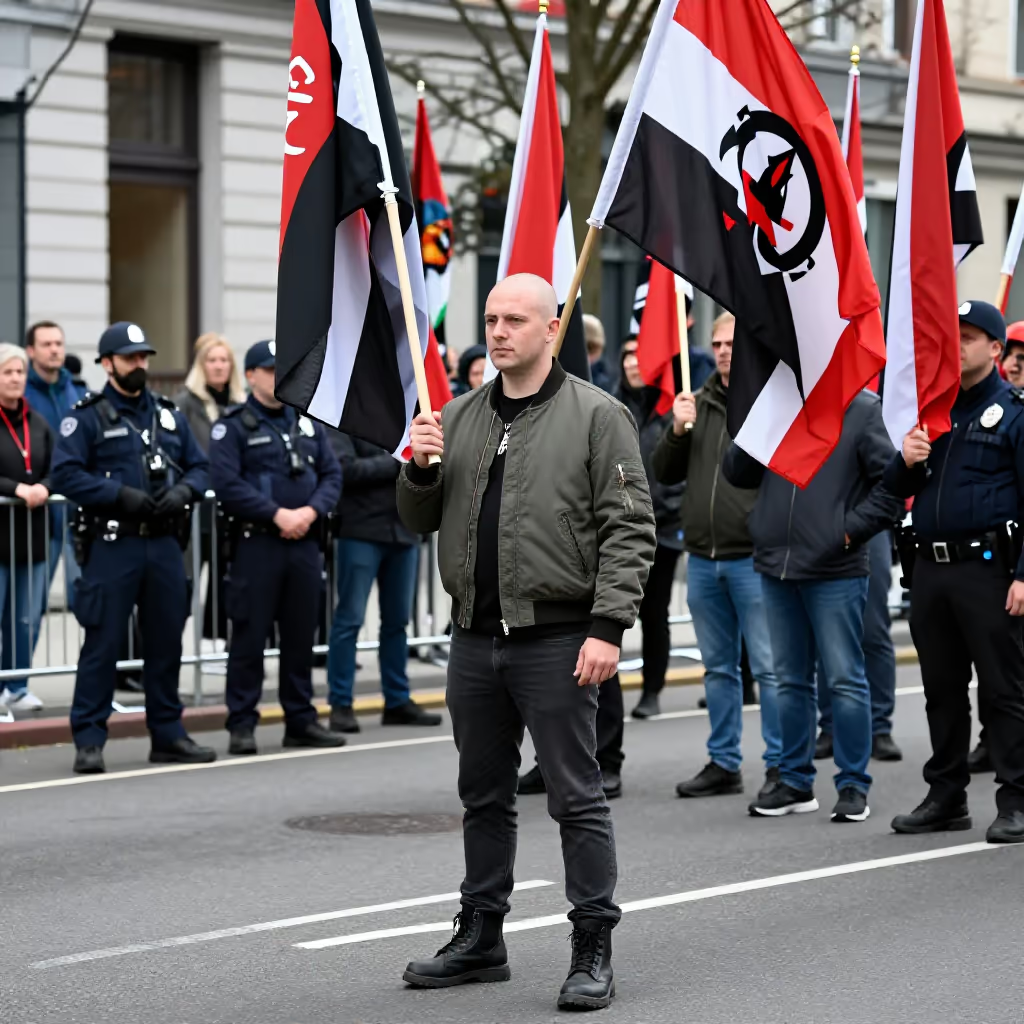
A supporter of fascism, a far-right, anti-democratic, and nationalist political ideology.
example
Historisch gesehen waren die Anhänger Mussolinis in Italien Faschisten.
Historically speaking, Mussolini's supporters in Italy were fascists.

Usage tips
N-declension
'Der Faschist' (the fascist) is a masculine noun of the N-declension. This means that it takes the ending '-en' in all cases except the nominative singular.
EXAMPLE
Die Rede des Faschisten wurde stark kritisiert.
The fascist's speech was heavily criticized.
Word family
The word is derived from the political ideology 'der Faschismus' (fascism). The ending '-ist' refers to a person who adheres to a particular doctrine or movement, as in 'Sozialist' (socialist) or 'Kapitalist' (capitalist).
EXAMPLE
Er hat ein Buch über die Geschichte des Faschismus in Europa gelesen.
He read a book about the history of fascism in Europe.
Strongly negative meaning
The word 'Faschist' (fascist) always has an extremely negative connotation. Even in a purely historical description, it carries a strong sense of rejection. Use it with care.
EXAMPLE
Die Verwendung des Wortes „Faschist“ kann eine Diskussion sofort eskalieren lassen.
The use of the word 'fascist' can immediately make a discussion escalate.
Context clue
Whether the historical meaning or the general insult is meant depends on the context. In historical or academic texts, it refers to the ideology. In everyday debates, it is usually a strongly derogatory insult for authoritarian behavior.
EXAMPLE
Er nannte seinen Chef einen Faschisten, weil er keine andere Meinung zuließ.
He called his boss a fascist because he did not allow any other opinion.
Compare with
near_synonym · confusable
Faschist vs Neonazi
neo-Nazi
'der Neonazi' and 'der Faschist' both refer to people with far-right, anti-democratic views. 'Neonazi' is more specific: it means someone who, after the Second World War, refers back to National Socialism or supports its ideology. 'Faschist' is broader and can refer to a supporter of fascism in general. However, it is also used as a strongly derogatory word for a person perceived as authoritarian or undemocratic. Learners may confuse the words because both are politically very negative and overlap in some contexts. When the topic is specifically National Socialism after 1945, 'Neonazi' is more precise. When it is more generally about fascist or authoritarian ideology, 'Faschist' is more suitable.
Faschist
Im Geschichtsunterricht sprechen wir darüber, warum Faschisten die Demokratie ablehnen.
In history class, we talk about why fascists reject democracy.
Neonazi
Die Polizei nahm einen Neonazi fest, weil er verbotene Symbole gezeigt hatte.
The police arrested a neo-Nazi because he had displayed banned symbols.