


pflegen
to care for
To look after and provide care for a person who is sick, old, or in need of help.
EXAMPLE
Die Krankenschwester pflegt die Patienten auf der Intensivstation.
The nurse cares for the patients in the intensive care unit.
to care for / maintain
Loading your saved state.
to care for
To look after and provide care for a person who is sick, old, or in need of help.
Die Krankenschwester pflegt die Patienten auf der Intensivstation.
The nurse cares for the patients in the intensive care unit.

to maintain
To treat or work on something regularly in order to keep it in good condition. This can refer to the body, plants, objects, or also social relationships.
Es ist wichtig, gute Freundschaften zu pflegen.
It is important to maintain good friendships.

to be in the habit of
To have the habit of doing something specific. This usage is rather formal or elevated.
Er pflegte nach dem Abendessen einen Spaziergang zu machen.
He was in the habit of taking a walk after dinner.
The verb 'pflegen' (to care for / maintain) is the basis for the noun 'die Pflege' (care; e.g., elderly care, nursing care) and the adjective/participle 'gepflegt' (well-kept; e.g., a well-kept garden, a well-groomed appearance).
Die Pflege von kranken Menschen ist eine anspruchsvolle Aufgabe.
Caring for sick people is a demanding task.
The meaning of 'pflegen' (to care for / maintain) becomes clear from the object: if it refers to a person, it is about care. If it refers to a thing or a relationship, it is about maintenance. If 'zu' with an infinitive follows, it describes a habit.
Er pflegt seine kranke Mutter zu Hause.
He cares for his sick mother at home.
In the meaning 'to keep in good condition', 'pflegen' (to maintain) is often used for abstract things. Typical collocations are 'Kontakte pflegen' (to maintain contacts), 'Freundschaften pflegen' (to maintain friendships), 'eine Tradition pflegen' (to maintain a tradition), or 'sein Image pflegen' (to maintain one's image).
Es ist wichtig, berufliche Kontakte zu pflegen.
It is important to maintain professional contacts.
In this formal meaning, 'pflegen' (to be in the habit of) works similarly to a modal verb. It is used with 'zu' and an infinitive at the end of the sentence. The subject is the person who has the habit.
Mein Großvater pflegte zu sagen, dass Geduld eine Tugend sei.
My grandfather used to say that patience was a virtue.
to wait / maintain
When used for a machine, warten refers to regular technical checks and necessary measures to keep it functioning. Pflegen means ongoing, careful treatment, such as cleaning or protecting it. Use „warten“ for technical maintenance, and „pflegen“ when referring more to taking good care of the surface or condition.
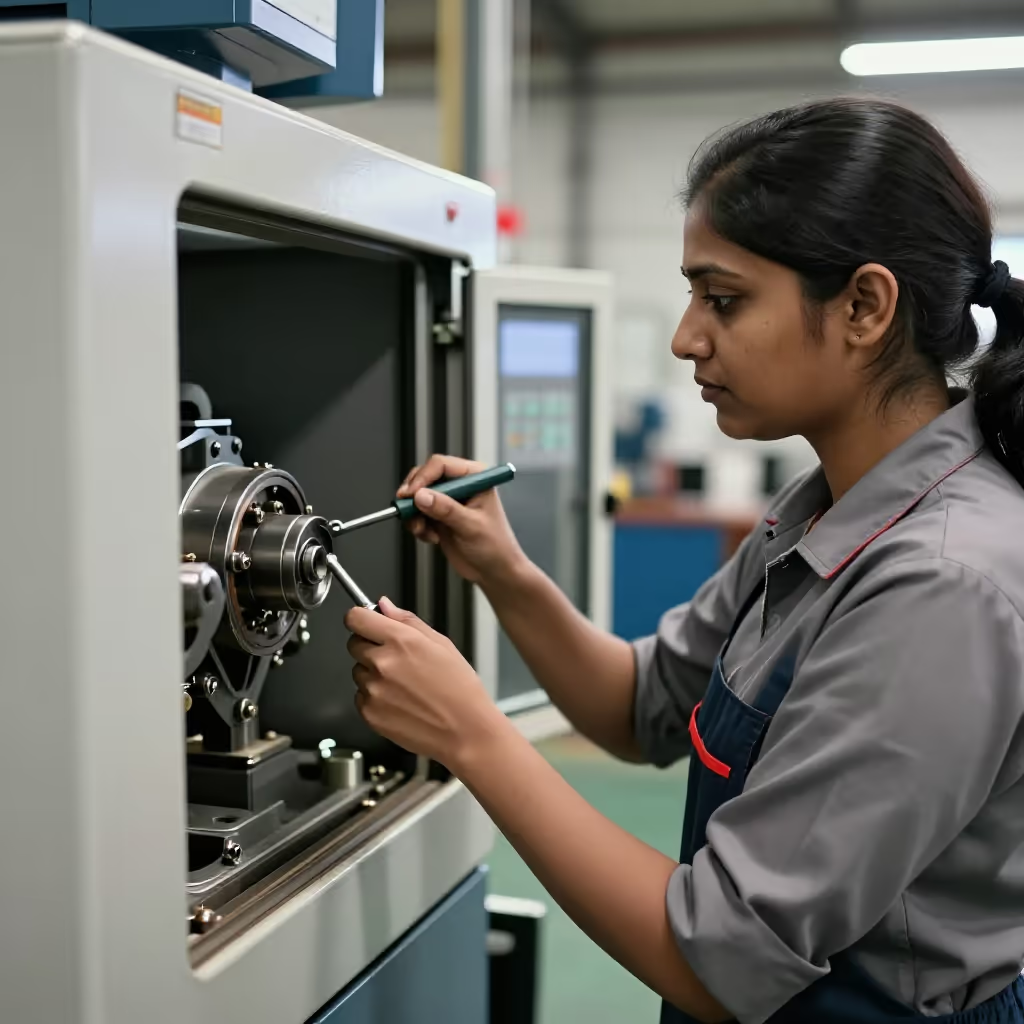
Der Mitarbeiter pflegt die Maschine regelmäßig und reinigt dabei sorgfältig ihre Oberfläche.
The employee takes care of the machine regularly and carefully cleans its surface.
Der Techniker wartet die Maschine regelmäßig und prüft dabei alle wichtigen Teile.
The technician services the machine regularly and checks all its important parts.