

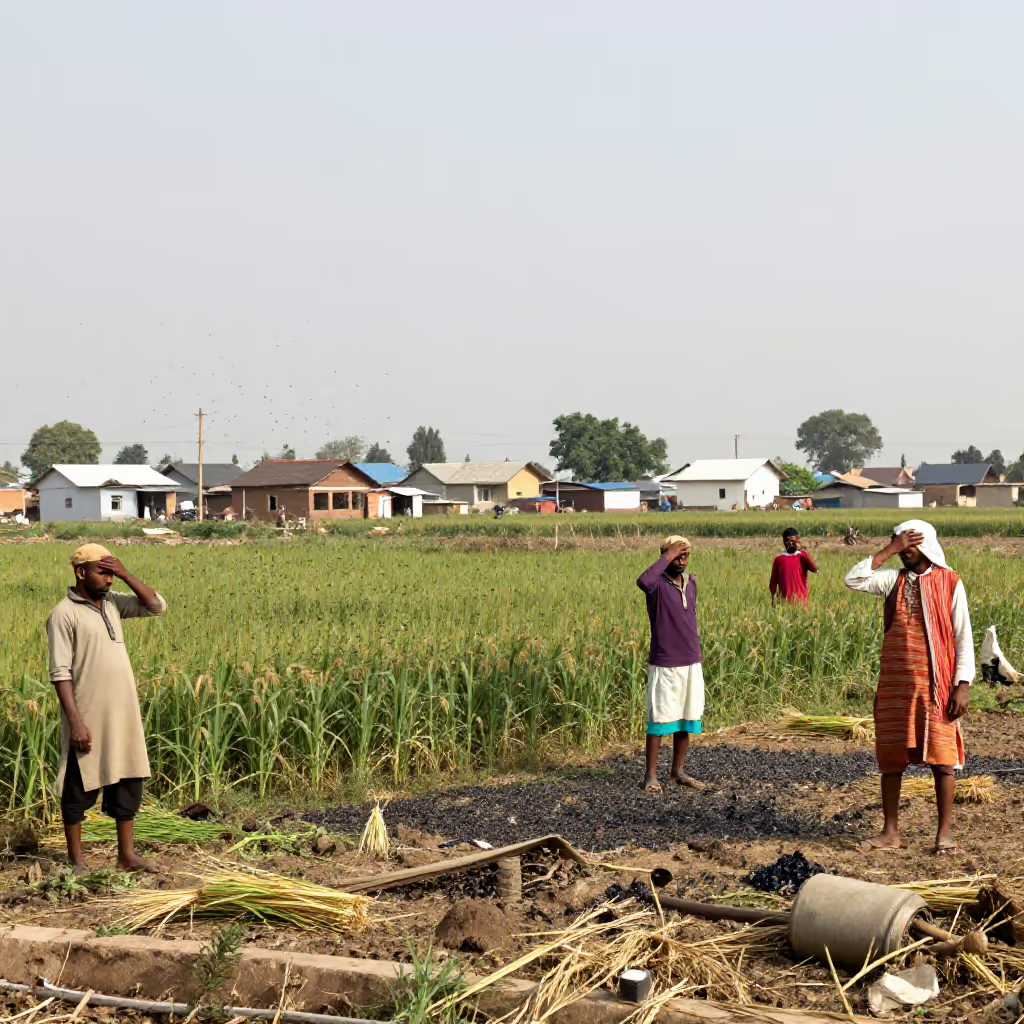
A great misfortune or disaster that affects many people or an entire region, often caused by a mass spread of pests or by a disease.
example
Die Heuschreckenplage vernichtete die gesamte Ernte des Landes.
The plague of locusts destroyed the country's entire harvest.

Usage tips
Word family
The noun 'die Plage' (plague/nuisance) is closely related to the verb 'plagen' (to plague/bother). Both words share the basic idea of suffering, effort, or a major annoyance.
EXAMPLE
Die Mücken sind diesen Sommer eine echte Plage.
The mosquitoes are a real nuisance this summer.
Typical combinations
In the sense of a disaster, 'Plage' (plague) is often used for a mass increase of animals. It can also appear as an ending in compound words such as 'Heuschreckenplage' (plague of locusts), 'Mückenplage' (mosquito plague), or 'Rattenplage' (rat plague).
EXAMPLE
Eine schreckliche Dürre war die größte Plage für die Bauern.
A terrible drought was the greatest plague for the farmers.
Colloquial use
When 'Plage' (nuisance) describes a person or thing, this is always colloquial and slightly exaggerated. The fixed expression is often 'eine (echte) Plage sein' (to be a real nuisance).
EXAMPLE
Mit seinen ständigen Fragen ist der neue Kollege eine Plage.
With his constant questions, the new colleague is a nuisance.
Compare with
near_synonym
Plage vs Strafe
punishment / penalty
'die Strafe' and 'die Plage' can both colloquially mean something very unpleasant or exhausting. 'die Strafe' often sounds as if you have to endure something tedious, even though it is not necessarily a real punishment. 'die Plage' emphasizes more strongly that a person or thing is constantly annoying, disruptive, or creates a lot of work. If it is about a real consequence for wrong behavior, 'die Strafe' fits. If something is mainly a nuisance, 'die Plage' sounds more natural.
Plage
Die vielen Mücken im Garten sind im Sommer eine echte Plage.
The many mosquitoes in the garden are a real nuisance in summer.