

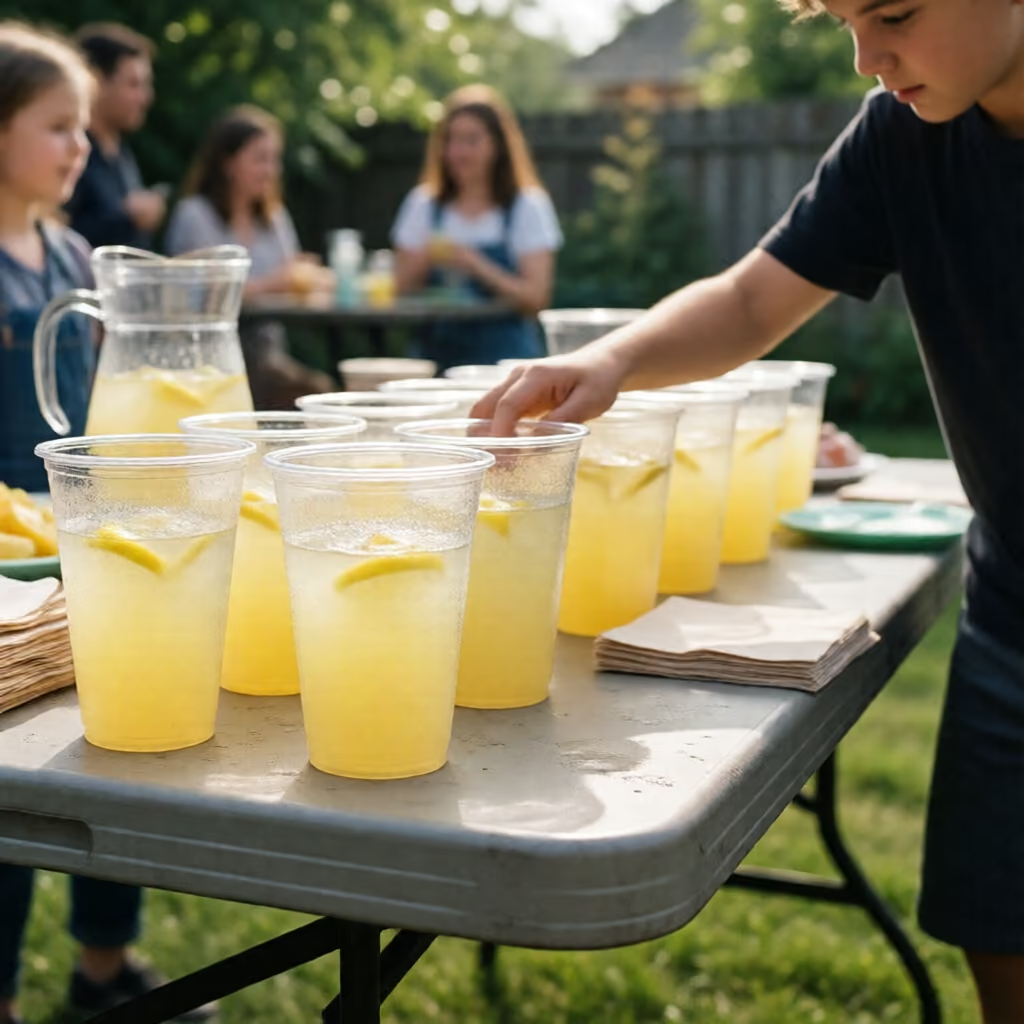
der Plastikbecher
plastic cup
A cup made of plastic, used for drinking or as a container for food.
EXAMPLE
Bei der Feier wurde die Limonade in Plastikbechern serviert.
At the party, the lemonade was served in plastic cups.
plastic cup
der Plastikbecher, die Plastikbecher
Loading your saved state.
plastic cup
A cup made of plastic, used for drinking or as a container for food.
Bei der Feier wurde die Limonade in Plastikbechern serviert.
At the party, the lemonade was served in plastic cups.
| gender | masculine der |
|---|---|
| plural | die Plastikbecher |
| genitive | des Plastikbechers |
| singular | plural | |
|---|---|---|
| nominative | der Plastikbecher | die Plastikbecher |
| accusative | den Plastikbecher | die Plastikbecher |
| dative | dem Plastikbecher | den Plastikbechern |
| genitive | des Plastikbechers | der Plastikbecher |
The article changes with the case; it is shown in colour.
'Plastikbecher' (plastic cup) is made up of 'Plastik' (plastic) and 'Becher' (cup). The first part describes the material, while the second part describes the object's shape and function.
Auf dem Tisch standen mehrere Plastikbecher mit Wasser.
There were several plastic cups of water on the table.
The contents of a plastic cup are usually introduced with 'mit' (with) or 'voll' (full of): 'ein Plastikbecher mit Eistee' (a plastic cup of iced tea), 'ein Plastikbecher voll Wasser' (a plastic cup full of water). After 'voll', the substance is named without an article.
Am Kiosk bekam sie einen Plastikbecher mit Eiskaffee.
At the kiosk, she was given a plastic cup of iced coffee.
Auf der Bank stand ein Plastikbecher voll Wasser.
There was a plastic cup full of water on the bench.
Common expressions include 'aus einem Plastikbecher trinken' (to drink from a plastic cup), 'einen Plastikbecher benutzen' (to use a plastic cup), and 'einen Plastikbecher wegwerfen' (to throw away a plastic cup). With 'benutzen' (to use) and 'wegwerfen' (to throw away), the cup is the direct object; in 'aus einem Plastikbecher trinken' (to drink from a plastic cup), it is in the dative case after the preposition 'aus' (from).
Nach dem Picknick warf sie den leeren Plastikbecher in den Mülleimer.
After the picnic, she threw the empty plastic cup into the trash can.