

polar
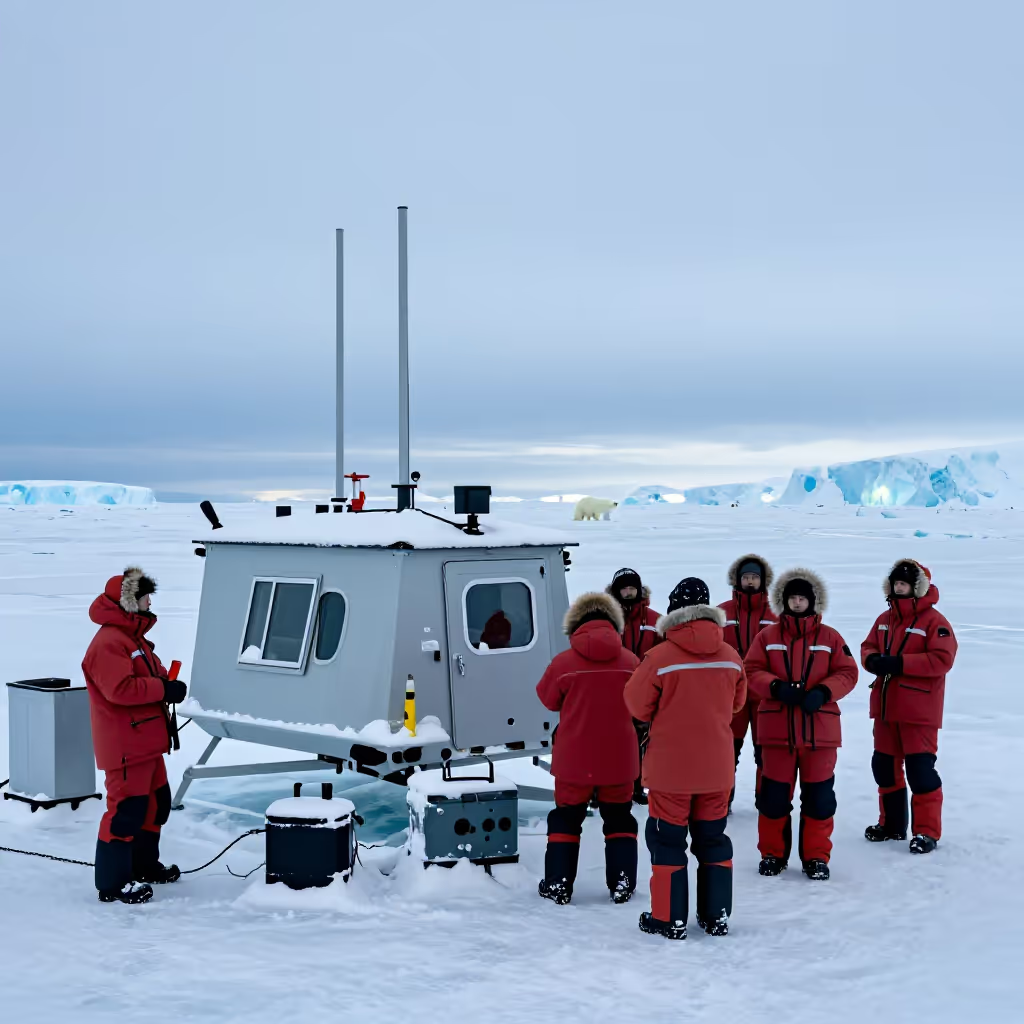
Relating to the geographic poles of the Earth (North or South Pole) or the areas surrounding them.
EXAMPLE
Die polaren Eiskappen schmelzen aufgrund des Klimawandels.
The polar ice caps are melting due to climate change.
Loading your saved state.
Relating to the geographic poles of the Earth (North or South Pole) or the areas surrounding them.
Die polaren Eiskappen schmelzen aufgrund des Klimawandels.
The polar ice caps are melting due to climate change.

opposite
Used figuratively to describe two things that are completely opposite or opposed to each other.
Ihre politischen Ansichten sind polar und führen oft zu Streit.
Their political views are opposite and often lead to arguments.

In physics and chemistry, describing the property of molecules that have an electric dipole moment due to an unequal distribution of charge.
Wasser ist ein polares Lösungsmittel, weshalb es Salze gut lösen kann.
Water is a polar solvent, which is why it can dissolve salts well.
The adjective 'polar' is derived directly from the noun 'der Pol' (pole). It therefore describes properties that have to do with the geographic poles of the Earth or, figuratively, things that are opposite like the poles.
Das polare Eis schmilzt immer schneller.
The polar ice is melting faster and faster.
You can recognize the meaning of 'polar' from the context. If it is about geography or climate, it refers to the North or South Pole. In discussions about opinions or ideas, it means 'completely opposite'. In science (chemistry/physics), it refers to molecules.
Pinguine leben in polaren Regionen der Südhalbkugel.
Penguins live in polar regions of the Southern Hemisphere.
In the figurative meaning 'opposite', 'polar' is very often used predicatively, meaning after a verb like 'sein' (to be). Using it directly before a noun is less common in this meaning.
Die Meinungen der beiden Experten sind polar.
The opinions of the two experts are opposite.
In a geographic context, 'polar' is often combined with certain nouns. Typical combinations are 'polare Regionen' (polar regions), 'polares Klima' (polar climate), 'polares Eis' (polar ice), or 'polare Kälte' (polar cold).
Nur wenige Pflanzen können im polaren Klima überleben.
Only a few plants can survive in a polar climate.
The meaning of 'polar' in physics and chemistry is purely technical language. It is used almost exclusively in scientific or school texts.
Die Polarität eines Lösungsmittels bestimmt, welche Stoffe es lösen kann.
The polarity of a solvent determines which substances it can dissolve.
opposing / contradictory
Both words describe views or things that differ greatly from one another. „Polar“ is more vivid and highlights two extreme opposites, while „gegensätzlich“ can also describe less extreme contradictions. Use „polar“ for particularly sharp contrasts and „gegensätzlich“ as the more general description.

Die beiden Parteien vertreten in dieser Frage polare Ansichten.
The two parties hold polar opposite views on this issue.
Die beiden Parteien vertreten in dieser Frage gegensätzliche Ansichten.
The two parties hold opposing views on this issue.