

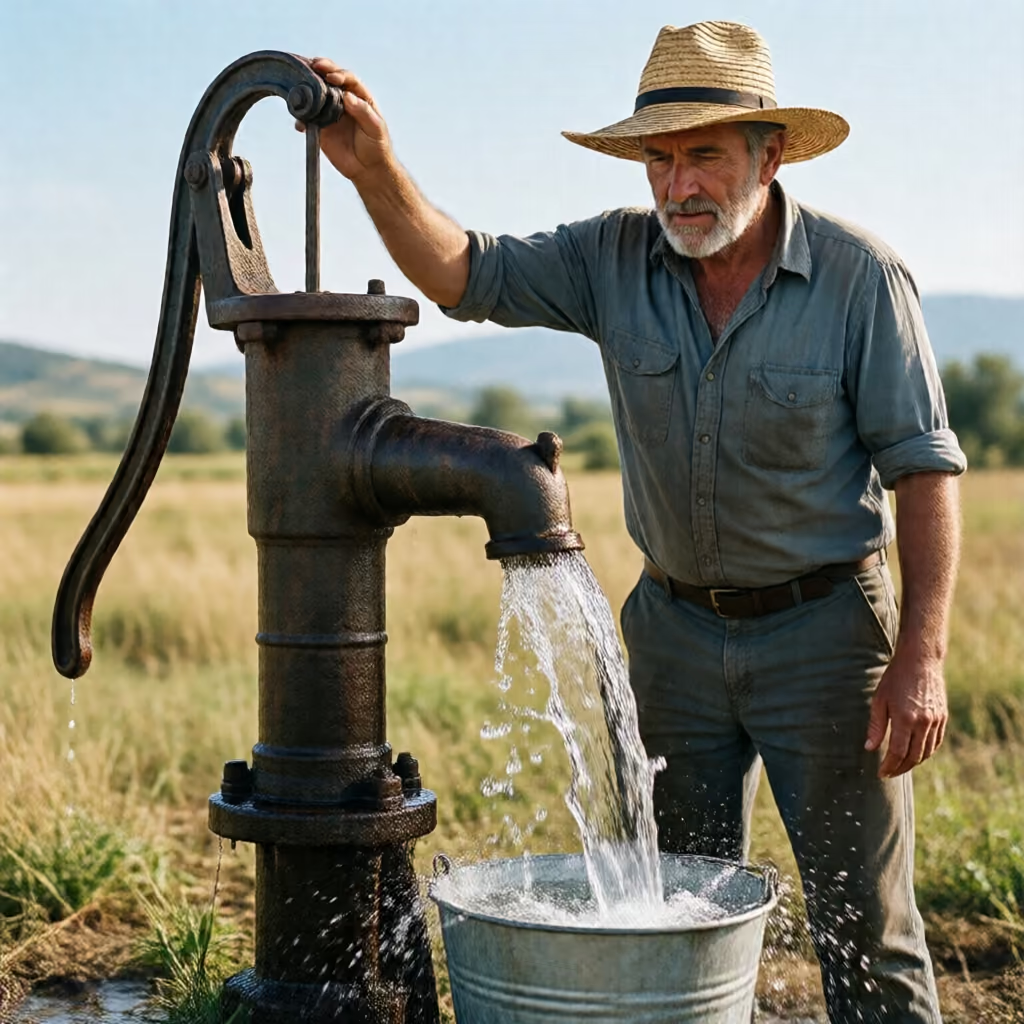
die Pumpe
pump
A device used to draw in, move, or pressurize liquids or gases.
EXAMPLE
Die Pumpe befördert das Wasser aus dem Brunnen in den Tank.
The pump moves the water from the well into the tank.
pump
die Pumpe, die Pumpen
Loading your saved state.
pump
A device used to draw in, move, or pressurize liquids or gases.
Die Pumpe befördert das Wasser aus dem Brunnen in den Tank.
The pump moves the water from the well into the tank.

heart
Colloquial: the heart as the organ that pumps blood through the body.
Nach dem Sprint raste ihm die Pumpe.
After the sprint, his heart was racing.
| gender | feminine die |
|---|---|
| plural | die Pumpen |
| genitive | der Pumpe |
| singular | plural | |
|---|---|---|
| nominative | die Pumpe | die Pumpen |
| accusative | die Pumpe | die Pumpen |
| dative | der Pumpe | den Pumpen |
| genitive | der Pumpe | der Pumpen |
The article changes with the case; it is shown in colour.
'Pumpe' (pump) and 'pumpen' (to pump) are visibly related: a 'Pumpe' is the device used to pump something. This connection helps you remember the device's function.
Mit dieser Pumpe kann man auch Luftmatratzen aufpumpen.
You can also use this pump to inflate air mattresses.
When talking about a technical device, people often say that they connect, switch on, repair, or replace a pump. 'Die Pumpe fällt aus' (The pump stops working) is also a typical expression.
Der Techniker muss die Pumpe reparieren, bevor die Heizung wieder funktioniert.
The technician has to repair the pump before the heating works again.
The meaning 'heart' is colloquial and often occurs with verbs such as 'rasen' (to race), 'schlagen' (to beat), or 'klopfen' (to pound). Words related to sports, exertion, or excitement usually show that the word refers to a heart rather than a technical device.
Der Arzt meinte, seine Pumpe sei für sein Alter noch völlig in Ordnung.
The doctor said that his heart was still perfectly healthy for his age.