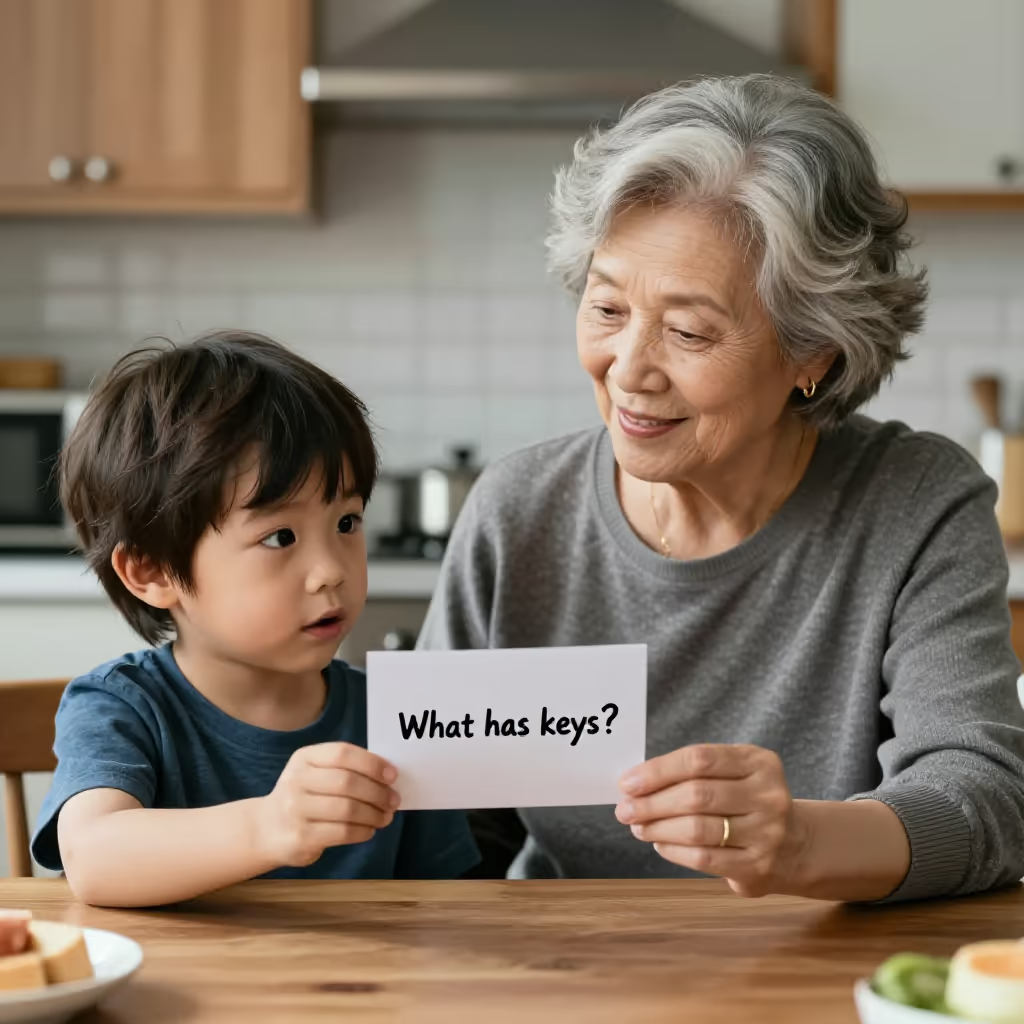
A task or question, often in figurative language, that has to be solved by thinking and putting clues together.
example
Das Kreuzworträtsel in der Zeitung war heute besonders schwierig.
The crossword puzzle in the newspaper was especially difficult today.

Usage tips
Word family
'Das Rätsel' (riddle / mystery) is closely related to the verb 'raten' (to guess). A riddle is a task where you have to guess the correct answer.
EXAMPLE
Kannst du raten, was die Lösung für dieses Rätsel ist?
Can you guess what the solution to this riddle is?
Typical collocations
You can do different things with a riddle or puzzle. Typical verbs are 'ein Rätsel lösen' (to solve a riddle), 'ein Rätsel knacken' (to crack a riddle), or 'jemandem ein Rätsel stellen' (to ask someone a riddle).
EXAMPLE
Er hat stundenlang versucht, das schwierige Rätsel zu lösen.
He spent hours trying to solve the difficult riddle.
Sentence structure and usage
In the figurative meaning, the fixed structure 'Es ist mir ein Rätsel, ...' (It is a mystery to me ...) is often used. It is followed by a subordinate clause beginning with 'wie' (how), 'warum' (why), 'wo' (where), or 'ob' (whether), which describes the inexplicable thing.
EXAMPLE
Es ist mir ein Rätsel, warum er den Job gekündigt hat.
It is a mystery to me why he quit the job.
Dative construction
The fixed expression 'ein Rätsel aufgeben' (to pose a mystery) is used with a dative object. The person faced with the mystery is in the dative: 'jemandem ein Rätsel aufgeben' (to pose a mystery to someone).
EXAMPLE
Ihr seltsames Verhalten gab ihren Freunden ein großes Rätsel auf.
Her strange behavior posed a great mystery to her friends.
Compare with
near_synonym · confusable
Rätsel vs Frage
question
'die Frage' and 'das Rätsel' can both be something for which you are looking for an answer or solution. 'die Frage' is neutral: you ask for information or talk about a topic that needs to be clarified. 'das Rätsel' is more difficult or mysterious. You have to think, put clues together, or explain something unclear. Learners may confuse the words because a riddle often looks like a question. But not every question is a riddle. For ordinary information, you say 'Frage'. When something is tricky, unclear, or hard to understand, 'Rätsel' fits.
Rätsel
Lisa löst im Büro ein Rätsel aus der Zeitung.
Lisa solves a puzzle from the newspaper at the office.
Frage
Am Morgen stellt er der Vermieterin eine Frage zur Heizung.
In the morning, he asks the landlady a question about the heating.