

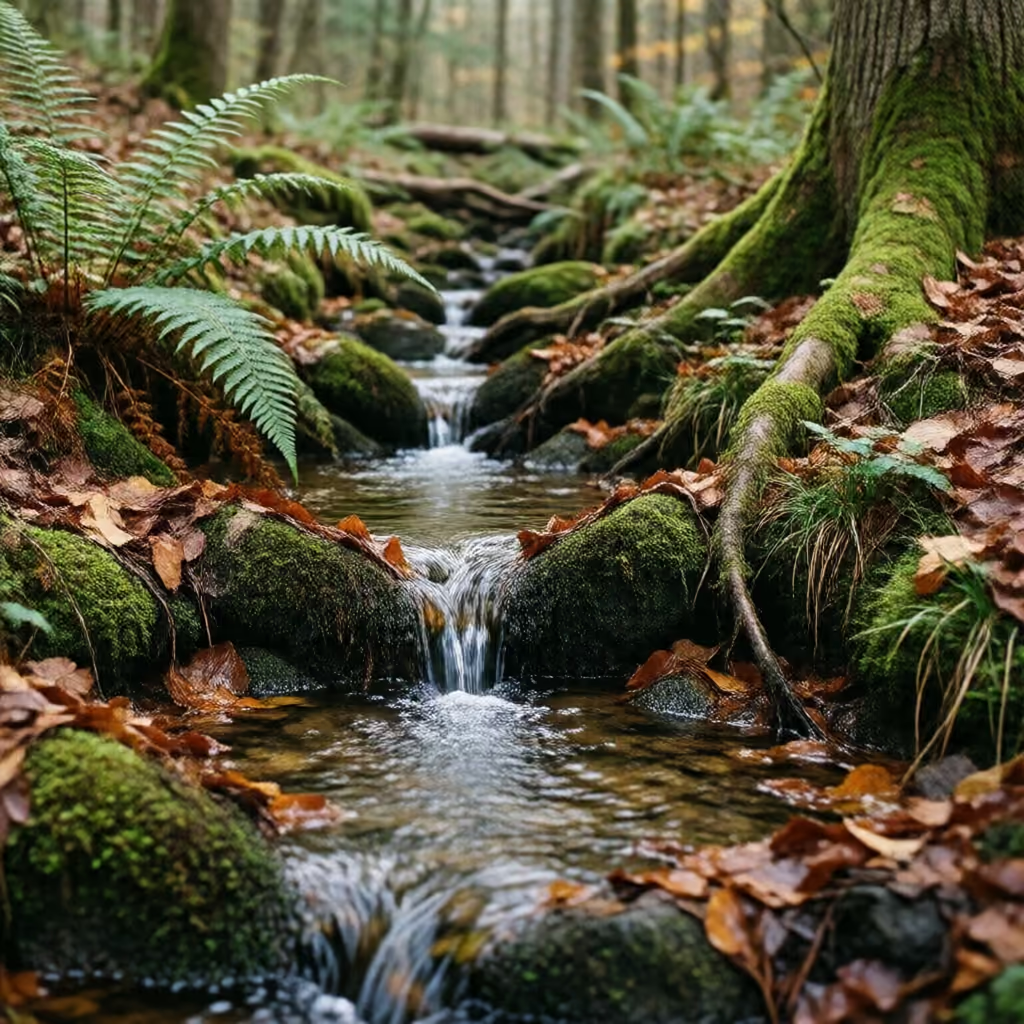
das Rinnsal
streamlet
A small, narrow stream that usually carries very little water.
EXAMPLE
Hinter dem Haus floss ein Rinnsal durch den Wald.
Behind the house, a streamlet flowed through the woods.
streamlet / trickle
das Rinnsal, die Rinnsale
Loading your saved state.
streamlet
A small, narrow stream that usually carries very little water.
Hinter dem Haus floss ein Rinnsal durch den Wald.
Behind the house, a streamlet flowed through the woods.

trickle
A thin or weak flow of liquid.
Ein Rinnsal Blut lief über seine Hand.
A trickle of blood ran over his hand.
| gender | neuter das |
|---|---|
| plural | die Rinnsale |
| genitive | des Rinnsals |
| singular | plural | |
|---|---|---|
| nominative | das Rinnsal | die Rinnsale |
| accusative | das Rinnsal | die Rinnsale |
| dative | dem Rinnsal | den Rinnsalen |
| genitive | des Rinnsals des Rinnsales | der Rinnsale |
The article changes with the case; it is shown in colour.
You can usually identify the meaning from the context: expressions of location such as 'durch den Wald' (through the woods) or 'am Weg' (beside the path) indicate a small stream. When followed by words such as 'Blut' (blood), 'Wasser' (water), or 'Tränen' (tears), 'Rinnsal' (trickle) refers to a thin flow of liquid.
Am Hang bildete sich ein Rinnsal, das zwischen den Steinen verschwand.
A streamlet formed on the slope and disappeared between the stones.
Ein Rinnsal Wasser lief aus dem undichten Rohr.
A trickle of water ran out of the leaky pipe.
When referring to a small stream, 'Rinnsal' (streamlet) often occurs with verbs such as 'plätschern' (to babble), 'fließen' (to flow), or 'sich bilden' (to form). Expressions of location such as 'durch den Wald' (through the woods), 'am Weg' (beside the path), or 'zwischen den Steinen' (between the stones) are also typical complements.
Ein Rinnsal plätscherte über die flachen Steine.
A streamlet babbled over the flat stones.
Nach dem Regen bildete sich ein Rinnsal am Weg.
After the rain, a streamlet formed beside the path.
When referring to a thin flow of liquid, 'Rinnsal' (trickle) often occurs with words naming substances, such as 'Blut' (blood), 'Wasser' (water), or 'Tränen' (tears). An adjective before it often emphasizes how slight the flow is, for example 'dünn' (thin) or 'klein' (small).
Ein dünnes Rinnsal Blut rann aus der kleinen Wunde.
A thin trickle of blood ran from the small wound.
Über ihre Wange lief ein Rinnsal Tränen.
A trickle of tears ran down her cheek.