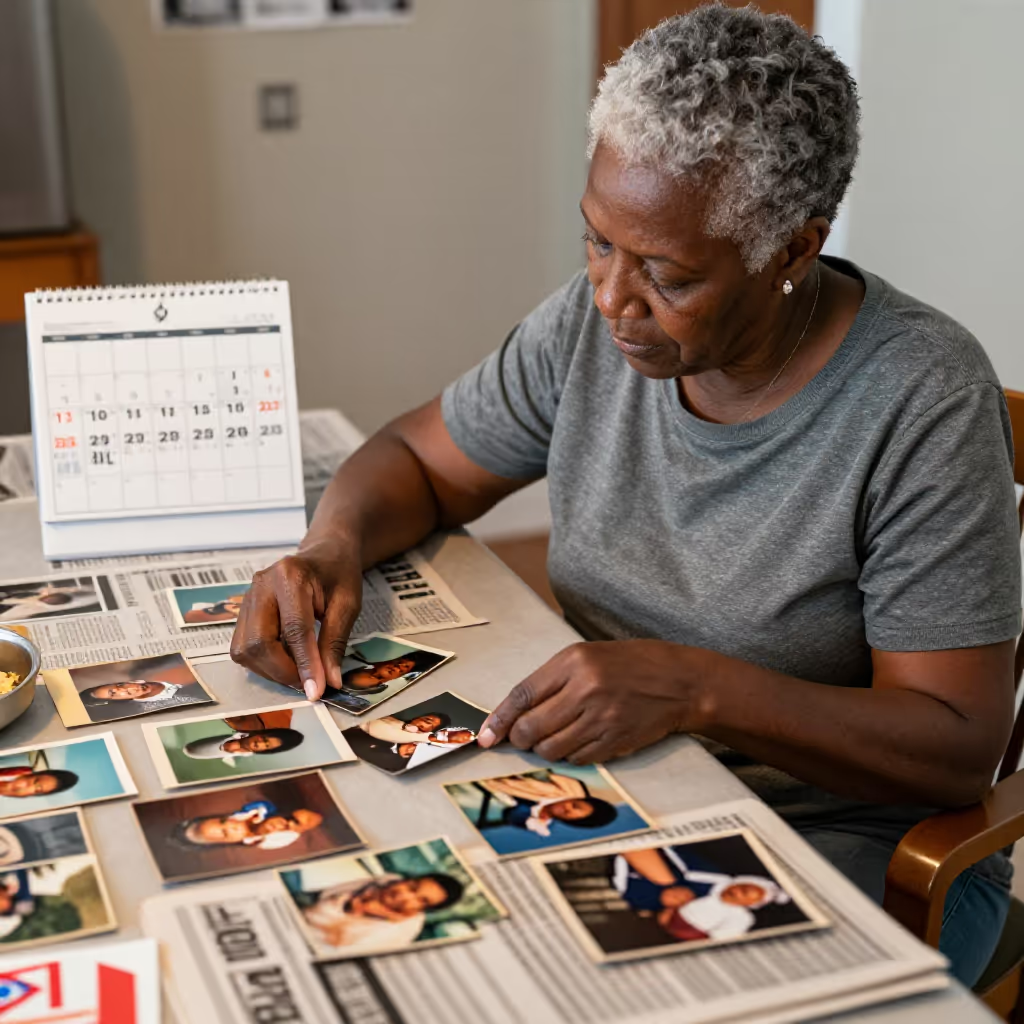
A look back at past events, developments, or a specific period of time, often in order to evaluate or summarize them.
example
In seiner Rede hielt der Firmenchef eine Rückschau auf die Erfolge des letzten Jahrzehnts.
In his speech, the company director gave a review of the successes of the last decade.

Usage tips
Word composition
'Rückschau' (retrospective/review) is made up of 'rück-' (from zurück, back) and 'Schau' (look/view). So it literally means to cast a look back.
EXAMPLE
Die jährliche Rückschau zeigte ein positives Geschäftsergebnis.
The annual review showed a positive business result.
Typical collocations
As a noun, 'Rückschau' (retrospective/review) is very often used with the verb 'halten' (to hold/give). The fixed expression is 'eine Rückschau halten auf' followed by an accusative object.
EXAMPLE
In seiner Abschiedsrede hielt er eine Rückschau auf seine Karriere.
In his farewell speech, he gave a review of his career.
Register
The word 'Rückschau' (retrospective/review) is used mainly in more formal contexts such as speeches, reports, or articles to look back on the past.
EXAMPLE
Der Zeitungsartikel bot eine interessante Rückschau auf die politischen Ereignisse des Jahres.
The newspaper article offered an interesting review of the political events of the year.
Fixed expression
'In der Rückschau' (in retrospect) is a fixed adverbial expression meaning 'looking back'. It is used to evaluate a situation from a later perspective.
EXAMPLE
In der Rückschau war es ein Fehler, das Jobangebot abzulehnen.
In retrospect, it was a mistake to turn down the job offer.
Sentence position
When the expression 'In der Rückschau' (in retrospect) appears at the beginning of a sentence (position 1), the conjugated verb follows directly after it (position 2).
EXAMPLE
In der Rückschau erscheint vieles klarer als im Moment der Entscheidung.
In retrospect, many things seem clearer than at the moment of decision.
Compare with
near_synonym · confusable
Rückschau vs Bilanz
balance sheet / assessment
'Bilanz' and 'Rückschau' can both come at the end of a period of time and look back at the past. 'Bilanz' puts more emphasis on the result: What was successful, what was not, and what is left in the end? 'Rückschau' puts more emphasis on looking back at events and developments. It can sound more personal or narrative. In the expression 'in der Rückschau', it means 'in retrospect' or 'in hindsight'. Learners may confuse the words because both can include an evaluation. If the result is the focus, 'Bilanz' fits better; if the look back is the focus, 'Rückschau' fits better.
Rückschau
In der Rückschau war die Entscheidung mutiger, als sie damals wirkte.
In retrospect, the decision was braver than it seemed at the time.
Bilanz
Die Bilanz der ersten Woche ist klar: Wir haben viel geschafft, aber noch nicht alles erledigt.
The assessment of the first week is clear: we achieved a lot, but we have not finished everything yet.