

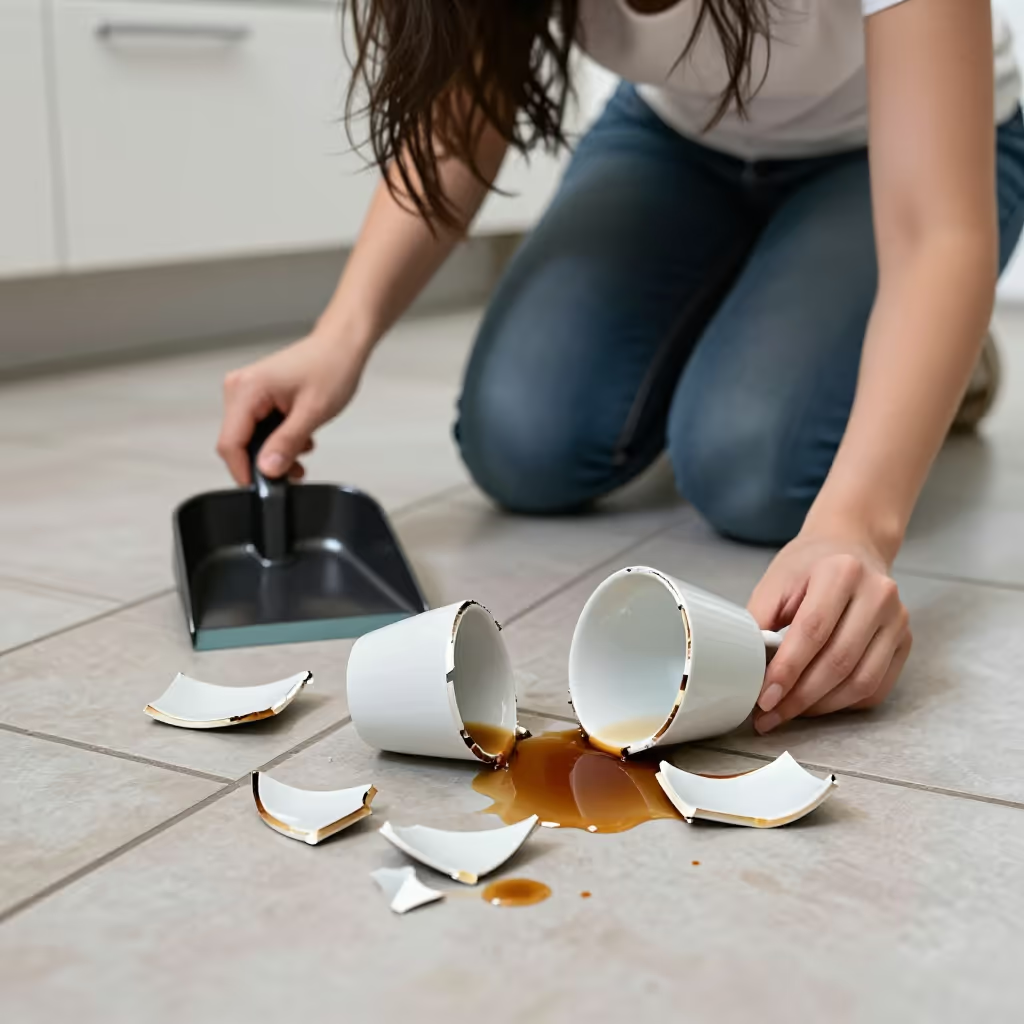
A broken piece of a brittle material such as glass, porcelain, ceramic, or clay. It is often used in the plural.
example
Vorsicht, heb die Scherben der zerbrochenen Vase auf, damit sich niemand verletzt.
Careful, pick up the shards of the broken vase so that nobody gets hurt.

Usage tips
Usually plural
Although a single piece is 'die Scherbe' (the shard), the word is usually used in the plural, 'die Scherben' (the shards). This is because something fragile often breaks into many pieces.
EXAMPLE
Pass auf, auf dem Küchenboden liegen Scherben!
Watch out, there are shards on the kitchen floor!
Typical materials
The word 'Scherbe' (shard) is used specifically for broken pieces of hard, brittle materials. You can talk about shards of glass, porcelain, ceramic, or clay, but not of wood or metal.
EXAMPLE
Am Strand habe ich mich an einer Glasscherbe geschnitten.
I cut myself on a shard of glass at the beach.
Figurative meaning
The idiom 'in Scherben liegen' (to lie in shards) is often used metaphorically. It means that something is destroyed or ruined, for example a plan, a hope, or a relationship.
EXAMPLE
Nach dem Streit lag ihre Freundschaft in Scherben.
After the argument, their friendship lay in ruins.
Fixed expression
There is the well-known saying 'Scherben bringen Glück' (shards bring good luck). People often say it, sometimes jokingly, when something made of glass or porcelain breaks.
EXAMPLE
Oh nein, mein Lieblingsteller! Na ja, Scherben bringen Glück.
Oh no, my favorite plate! Well, broken glass brings good luck.
Compare with
near_synonym · confusable
Scherbe vs Fragment
fragment
'Fragment' and 'Scherbe' can both mean a piece of something whole. The difference mainly lies in the material and the context. A 'Scherbe' is usually a broken piece of glass, porcelain, ceramic, or clay. A 'Fragment' is more general and often sounds somewhat more formal. It can be a broken piece of an object, but also a part of a text, a statue, or a work of art. Learners may confuse the words when something is broken. For glass or ceramics, people usually say 'Scherbe'; for texts, art, or more general broken pieces, 'Fragment' fits better.
Scherbe
Nach dem Sturz lagen überall Scherben von der Vase auf dem Boden.
After the fall, shards of the vase were lying all over the floor.
Fragment
Im Museum sieht man nur ein Fragment der alten Statue.
In the museum, you can see only a fragment of the old statue.