

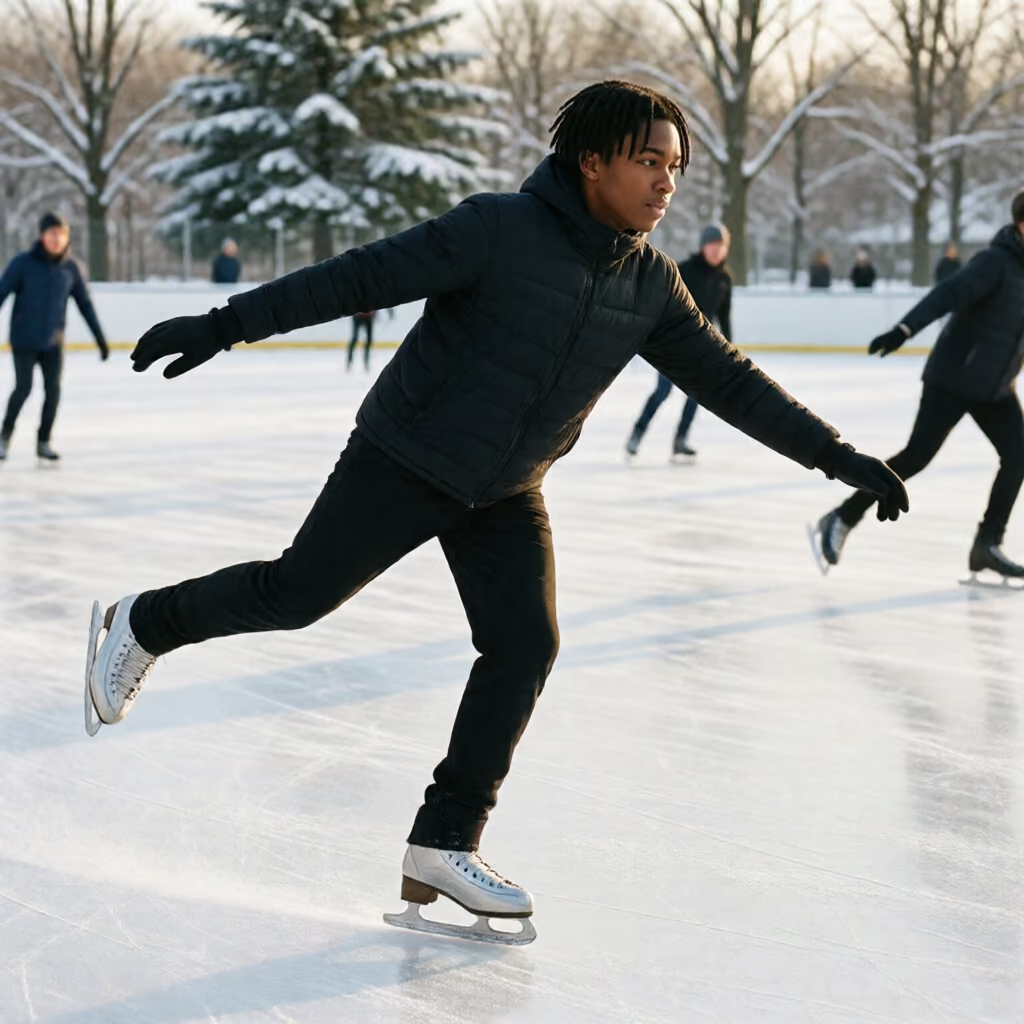
das Schlittschuhlaufen
ice skating
Moving or gliding across an ice surface on ice skates, as a leisure activity or sport.
EXAMPLE
Im Winter gehen wir jedes Wochenende zum Schlittschuhlaufen.
In winter, we go ice skating every weekend.
ice skating
das Schlittschuhlaufen
Loading your saved state.
ice skating
Moving or gliding across an ice surface on ice skates, as a leisure activity or sport.
Im Winter gehen wir jedes Wochenende zum Schlittschuhlaufen.
In winter, we go ice skating every weekend.
| gender | neuter das |
|---|---|
| genitive | des Schlittschuhlaufens |
| singular | plural | |
|---|---|---|
| nominative | das Schlittschuhlaufen | – |
| accusative | das Schlittschuhlaufen | – |
| dative | dem Schlittschuhlaufen | – |
| genitive | des Schlittschuhlaufens | – |
The article changes with the case; it is shown in colour.
'Schlittschuhlaufen' (ice skating) is made up of 'Schlittschuh' (ice skate) and 'laufen' (to run). As a nominalized expression, it is written as one word with a capital letter.
Das Schlittschuhlaufen macht den Kindern besonders viel Spaß.
The children especially enjoy ice skating.
When talking about a planned outing, 'Schlittschuhlaufen' (ice skating) is often used with 'gehen' (to go): 'Man geht zum Schlittschuhlaufen' (You go ice skating). Here, 'zum' is short for 'zu dem'.
Sollen wir morgen nach der Schule zum Schlittschuhlaufen gehen?
Shall we go ice skating tomorrow after school?
As the name of an activity, 'Schlittschuhlaufen' (ice skating) often follows prepositions or contractions such as 'beim' (while doing) or 'zum' (for). 'Beim Schlittschuhlaufen' (while ice skating) refers to the time or situation during the activity.
Beim Schlittschuhlaufen hat sich mein Bruder leicht verletzt.
My brother suffered a minor injury while ice skating.