

schmelzen
to melt
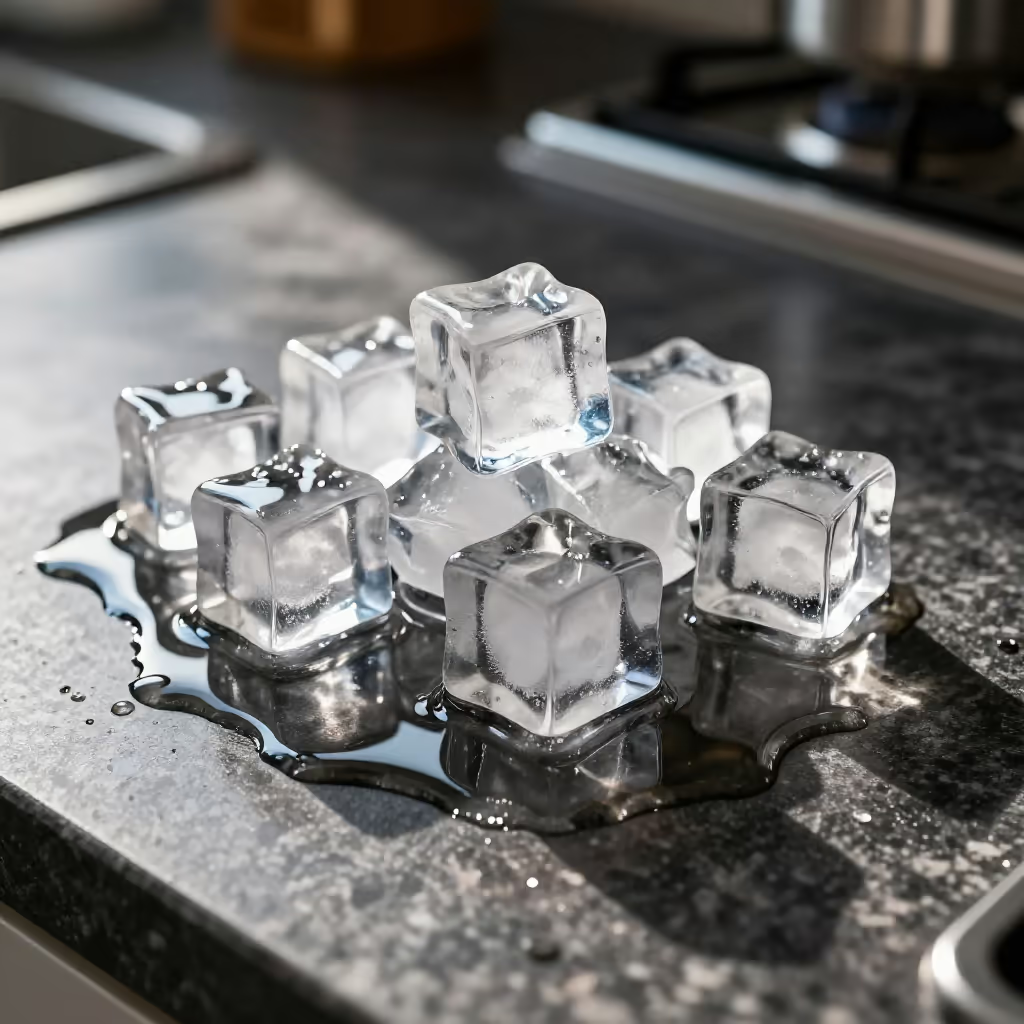
To change from a solid to a liquid state through heat.
EXAMPLE
Das Eis in der Sonne beginnt zu schmelzen.
The ice in the sun begins to melt.
to melt
Loading your saved state.
to melt
To change from a solid to a liquid state through heat.
Das Eis in der Sonne beginnt zu schmelzen.
The ice in the sun begins to melt.

to melt
To make something liquid by heating it.
Für das Fondue schmelzen wir Käse in einem Topf.
For the fondue, we melt cheese in a pot.

to melt away
Figurative for something that becomes less or disappears, often in relation to money or feelings.
Seine Ersparnisse schmolzen durch die Inflation dahin.
His savings melted away because of inflation.

to melt
Figurative for a strong feeling of affection or being moved; to be very emotionally touched.
Bei dem Lächeln des Babys schmolz sie förmlich dahin.
At the baby's smile, she practically melted.
The perfect tense of 'schmelzen' (to melt) is formed with 'sein' when something melts by itself (change of state). It is formed with 'haben' when someone actively melts something (action with an object).
Der Schneemann ist in der Sonne geschmolzen.
The snowman melted in the sun.
'Schmelzen' (to melt) can be used transitively (with an accusative object) or intransitively (without an object). When it is intransitive, the subject is the thing that is melting. When it is transitive, the subject actively melts the object.
Die Butter schmilzt in der heißen Pfanne.
The butter is melting in the hot pan.
In a figurative sense, 'schmelzen' (to melt) or 'dahinschmelzen' (to melt away) describes that something, usually something abstract like money, hope, or a lead, slowly becomes less and disappears.
Sein Vorsprung schmolz mit jeder Runde.
His lead melted away with every lap.
The expression 'dahinschmelzen' (to melt) is often used to express a very strong positive emotional reaction. You are extremely moved by or taken with something or someone.
Als er ihr das Kompliment machte, schmolz sie dahin.
When he gave her the compliment, she melted.
to dissolve / resolve
When something is dissolved, a solid substance distributes itself completely throughout a liquid. When something melts, by contrast, the substance itself becomes liquid through heat. So sugar is dissolved in water, while butter is melted by heating it.

Mia schmilzt die Butter bei geringer Hitze in der Pfanne.
Mia melts the butter in the pan over low heat.
Mia löst den Zucker vollständig im warmen Tee auf.
Mia dissolves the sugar completely in the warm tea.