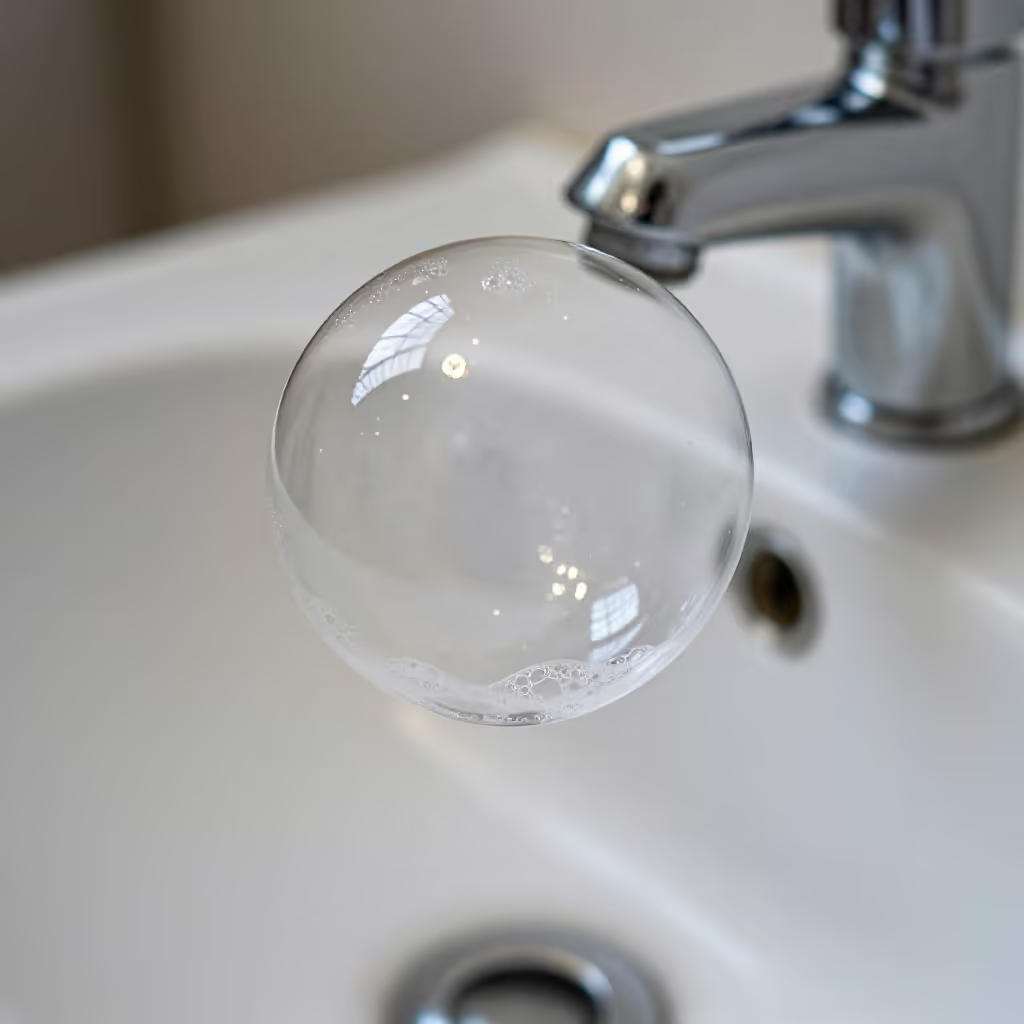
auflösen
to dissolve
To distribute a solid substance in a liquid so that it mixes completely into it and is no longer visible as a separate substance.
Du musst das Pulver in warmem Wasser auflösen.
You have to dissolve the powder in warm water.

to dissolve / resolve
Loading your saved state.
to dissolve
To distribute a solid substance in a liquid so that it mixes completely into it and is no longer visible as a separate substance.
Du musst das Pulver in warmem Wasser auflösen.
You have to dissolve the powder in warm water.

'Auflösen' (to dissolve/resolve) is a separable verb. The prefix 'auf' goes at the end of the main clause. In subordinate clauses and in the infinitive with 'zu', the verb stays together.
Der Zucker löst sich im Tee schnell auf.
The sugar dissolves quickly in the tea.
The verb consists of the prefix 'auf-' and the stem 'lösen' (to loosen/solve). 'Lösen' means to make something loose or to find a solution. The prefix 'auf-' here strengthens the idea of complete separation or clarification.
Können Sie diesen Knoten für mich auflösen?
Can you untie this knot for me?
The reflexive form 'sich auflösen' is used when a group of people disperses or when something loses its form and disappears, for example fog or clouds.
Nach dem Konzert löste sich die Menschenmenge langsam auf.
After the concert, the crowd slowly broke up.
When a solid substance is dissolved in a liquid, the structure is: subject dissolves something (accusative) in something (dative).
Ich löse eine Tablette in einem Glas Wasser auf.
I dissolve a tablet in a glass of water.
In the context of organizations and contracts, 'auflösen' (to dissolve/terminate) is often combined with 'einen Verein' (an association), 'eine Firma' (a company), 'ein Konto' (an account), or 'einen Vertrag' (a contract).
Wegen finanzieller Probleme musste der Verein sich auflösen.
Because of financial problems, the association had to dissolve.
When it is about clarifying an unclear situation, 'auflösen' (to resolve) is typically used with nouns such as 'ein Rätsel' (a riddle), 'ein Geheimnis' (a secret), 'einen Widerspruch' (a contradiction), or 'einen Fall' (a case).
Das Rätsel, wer der Täter war, ließ sich nicht auflösen.
The riddle of who the culprit was could not be resolved.
The phrase 'einen Haushalt auflösen' has a very specific meaning. It describes clearing out an apartment, usually after a death or when someone moves into a nursing home.
Nach dem Umzug seiner Mutter ins Pflegeheim musste er ihren Haushalt auflösen.
After his mother moved into the nursing home, he had to clear out her household.
In technical fields such as photography, film, or optics, 'auflösen' (to resolve) means how many details an image or a device can show. In this context, people speak of high or low resolution.
Mein neuer Monitor kann Bilder in 4K auflösen.
My new monitor can display images in 4K resolution.
to found / be based on
'gründen' and 'auflösen' form a clear contrast when talking about groups, associations, companies, or organizations. With 'gründen', something new begins and takes on a fixed form. With 'auflösen', this unit is officially ended or it breaks up. So 'gründen' looks at the beginning, while 'auflösen' looks at the end. This contrast does not fit all meanings of 'auflösen', but mainly groups and organizations.

Wegen zu weniger Mitglieder muss der Verein sich nach dem Sommer auflösen.
Because it has too few members, the association has to dissolve after the summer.
In der Schule gibt es viele Schüler, die am Montag eine Theatergruppe gründen wollen.
At school, there are many students who want to found a theater group on Monday.