

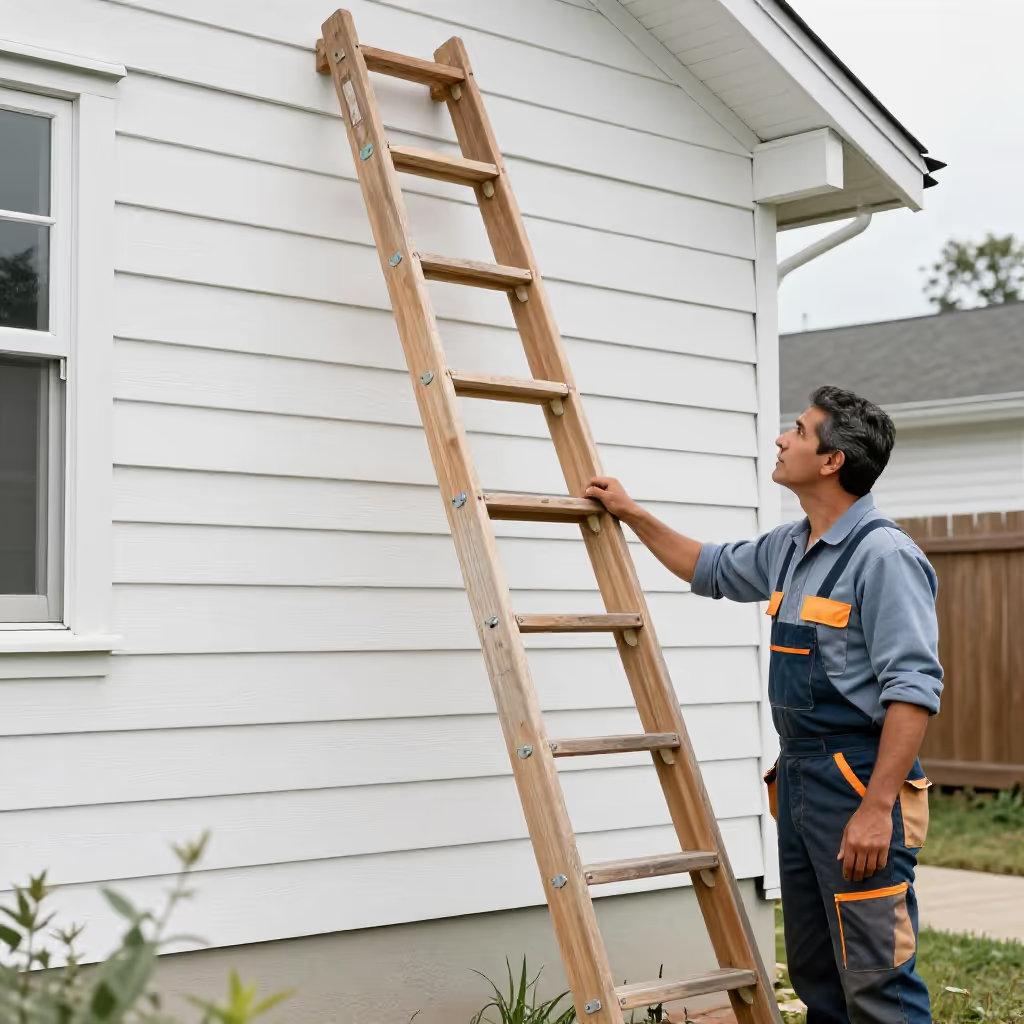
schräg
slanted
Not horizontal or vertical; in an inclined or diagonal position.
EXAMPLE
Das Bild hängt schräg an der Wand, du musst es geraderücken.
The picture is hanging crookedly on the wall; you need to straighten it.
slanted / odd
Loading your saved state.
slanted
Not horizontal or vertical; in an inclined or diagonal position.
Das Bild hängt schräg an der Wand, du musst es geraderücken.
The picture is hanging crookedly on the wall; you need to straighten it.

odd
Colloquial for strange, peculiar, bizarre, or unconventional.
Er ist ein netter Kerl, hat aber einen ziemlich schrägen Humor.
He's a nice guy, but he has a pretty odd sense of humor.

diagonally opposite
On the other side, but offset diagonally.
Die Apotheke befindet sich schräg gegenüber vom Supermarkt.
The pharmacy is diagonally opposite the supermarket.

off-key
Refers to a tone that sounds unpleasant, wrong, or unharmonious.
Aus dem Keller drangen schräge Töne von einer Anfängerband.
Off-key notes from a beginner band came from the basement.
The meaning of 'schräg' depends strongly on the noun it describes. If it refers to an object, it means the position. If it refers to a person or an idea, it means 'seltsam' (strange). If it refers to music or sounds, it means 'unharmonisch' (unharmonious).
Die schräge Wand im Dachgeschoss ist ein architektonisches Detail.
The slanted wall in the attic is an architectural detail.
The meaning 'seltsam' (strange) or 'unkonventionell' (unconventional) is colloquial. In formal texts, other words would be used instead.
Sie trug ein ziemlich schräges Kleid auf der Party.
She wore a pretty odd dress at the party.
In the colloquial meaning, 'schräg' (odd) is often combined with people or their characteristics. Common phrases are 'ein schräger Typ' (an odd guy), 'ein schräger Vogel' (a strange person), or 'schräger Humor' (odd humor).
Mein neuer Kollege ist ein schräger Vogel, aber sehr sympathisch.
My new colleague is an odd bird, but very likable.
The expression 'schräg gegenüber' (diagonally opposite) is a fixed location phrase. It describes that something is on the other side, for example of a street, and at the same time offset diagonally.
Wir wohnen schräg gegenüber von der Bäckerei.
We live diagonally opposite the bakery.
When 'schräg' is used in connection with music, instruments, or voices, it always means 'falsch' (wrong/off-key), 'unharmonisch' (unharmonious), or 'misstönend' (discordant).
Er hat versucht, Gitarre zu spielen, aber es kamen nur schräge Töne heraus.
He tried to play the guitar, but only off-key notes came out.
funny / strange
Both words can describe an unusual situation. „Schräg“ sounds more colloquial and suggests something bizarre or unconventional, while „komisch“ can simply mean strange and, depending on the context, can also be understood as funny. „Schräg“ is usually the more precise choice for a deliberately bizarre situation.

Es war schräg, dass er mitten im Gespräch plötzlich den Raum verließ.
It was weird that he suddenly left the room in the middle of the conversation.
Es war komisch, dass er mitten im Gespräch plötzlich den Raum verließ.
It was strange that he suddenly left the room in the middle of the conversation.