

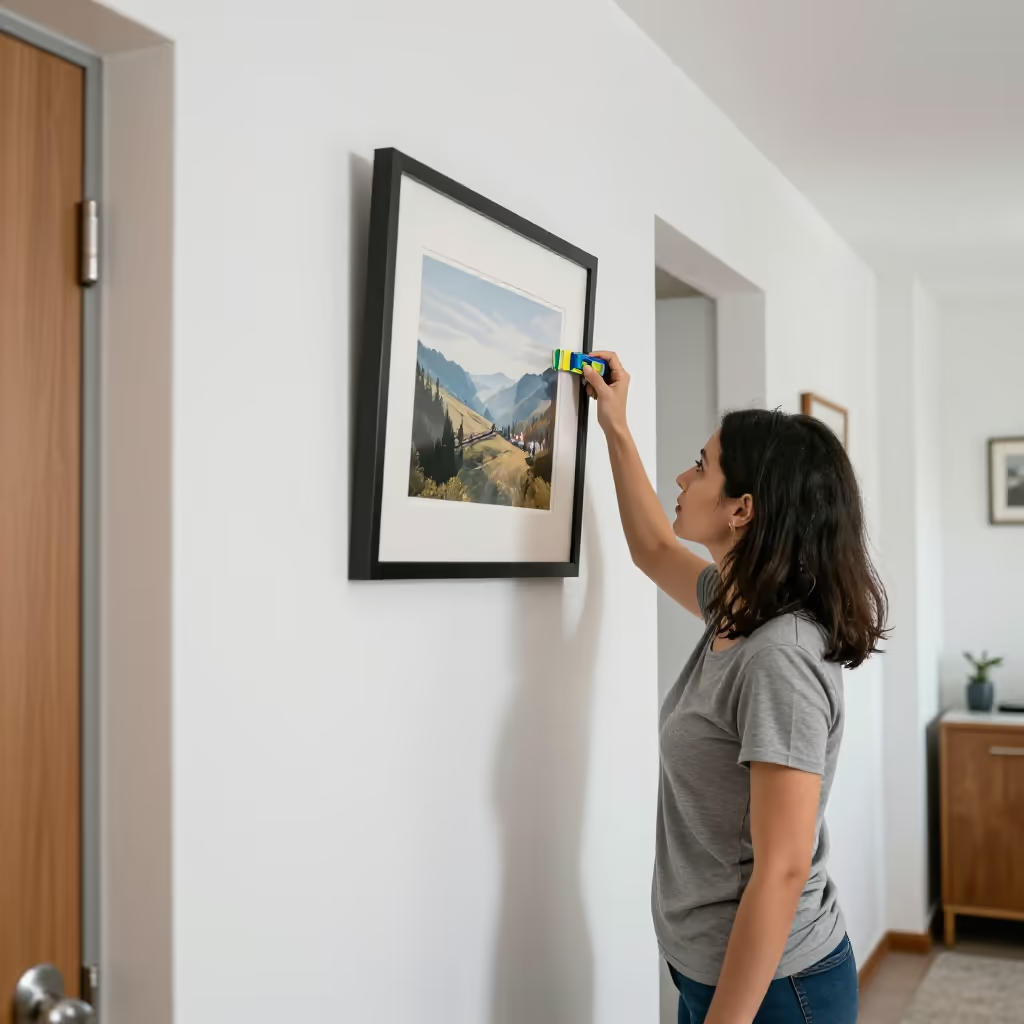
schief
crooked / tilted
Not straight or horizontal; tilted or curved.
EXAMPLE
Das Bild an der Wand hängt ein bisschen schief.
The picture on the wall is hanging a little crooked.
crooked / off-key
Loading your saved state.
crooked / tilted
Not straight or horizontal; tilted or curved.
Das Bild an der Wand hängt ein bisschen schief.
The picture on the wall is hanging a little crooked.

to go wrong
Used in a fixed expression to express that something fails, goes wrong, or does not go as planned.
Hoffentlich geht bei der Prüfung morgen nichts schief.
Hopefully nothing goes wrong in the exam tomorrow.

off-key
In reference to notes or singing: not hitting the right pitch; sounding out of tune or wrong.
Er hat das Lied so schief gesungen, dass alle lachen mussten.
He sang the song so off-key that everyone had to laugh.

to look askance at
In a fixed expression: to look at someone with suspicion, envy, or disapproval.
Seit dem Streit sehen sich die Nachbarn nur noch schief an.
Since the argument, the neighbors only look askance at each other.
In the meaning of 'misslingen' (to fail), 'schief' is almost always combined with the verbs 'gehen' (to go) or 'laufen' (to run/go). 'Schiefgehen' (to go wrong) and 'schieflaufen' (to go wrong) are separable verbs in which 'schief' stands at the end of the sentence.
Bei der Organisation des Festes ist einiges schiefgelaufen.
Quite a few things went wrong during the organization of the party.
The expression 'jemanden schief ansehen' (to look askance at someone) is a fixed expression. 'Ansehen' (to look at) is a separable verb here, and the person who is being looked at disapprovingly is in the accusative.
Nachdem er den Fehler gemacht hatte, sahen ihn seine Kollegen schief an.
After he had made the mistake, his colleagues looked askance at him.
The meaning 'unrein' (out of tune) or 'falsch' (wrong) is used exclusively in the context of music, noises, and tones. People say 'schief singen' (to sing off-key) or 'schiefe Töne' (off-key notes).
Die Geige klingt ein wenig schief, sie muss gestimmt werden.
The violin sounds a little off-key; it needs to be tuned.
In its literal meaning, 'schief' is often used to describe the position of objects. Typical collocations are 'ein schiefer Turm' (a leaning tower), 'ein schiefes Lächeln' (a crooked smile), or 'ein Bild hängt schief' (a picture is hanging crooked).
Kannst du das Poster bitte geraderücken? Es hängt total schief.
Can you straighten the poster, please? It's hanging completely crooked.
wrong / false
When singing, both words can express that something does not sound right. Schief refers more precisely to a pitch that is not hit correctly. Falsch is the broader judgment that the note or the singing is not right. For precise reference to pitch, Schief is therefore especially appropriate.

Die Sängerin singt den letzten Ton schief und trifft seine Tonhöhe nicht.
The singer sings the last note off-key and misses its pitch.
Die Sängerin singt den Refrain falsch und trifft mehrere Töne nicht.
The singer sings the chorus incorrectly and misses several notes.