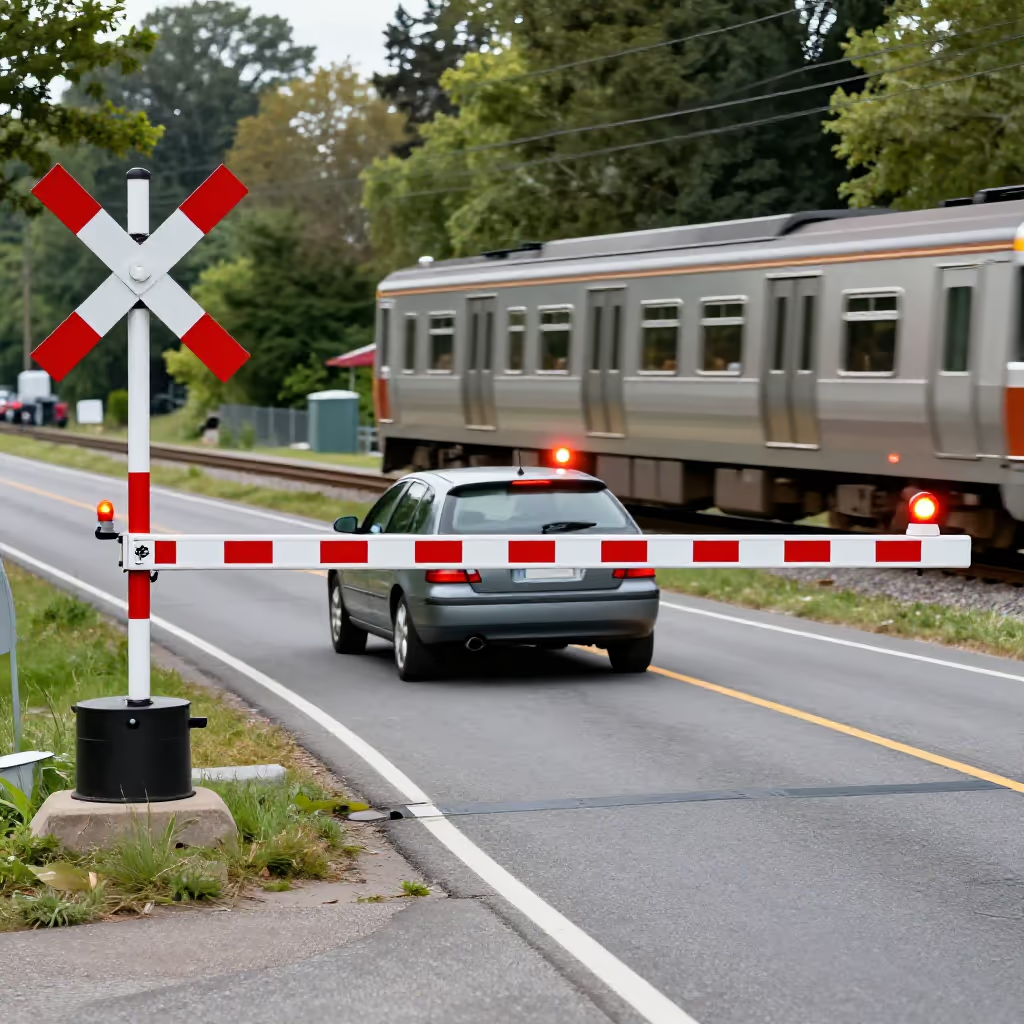
A movable barrier, usually in the form of a beam, that temporarily blocks a passage or access, e.g. at level crossings or parking garage entrances.
example
Als der Zug nahte, senkten sich die Schranken am Bahnübergang.
As the train approached, the barriers at the level crossing came down.

Usage tips
Word family
The word 'Schranke' (barrier) is related to 'Schrank' (cabinet/wardrobe). Both terms have the basic idea of enclosing, setting something apart, or blocking something.
EXAMPLE
Die Schranke blockiert die Einfahrt zum Parkplatz.
The barrier blocks the entrance to the parking lot.
Context clue
In the singular, 'die Schranke' almost always refers to a physical barrier. In the figurative sense of boundaries or limits, the word is used almost exclusively in the plural, 'die Schranken' (limits/barriers).
EXAMPLE
Der Autofahrer wartete vor der geschlossenen Schranke.
The driver waited in front of the closed barrier.
Typical verbs
In connection with the physical barrier, verbs such as 'sich senken' (to come down), 'hochgehen' (to go up), 'sich öffnen' (to open), or 'sich schließen' (to close) are often used.
EXAMPLE
Als der Zug kam, senkten sich die Schranken automatisch.
When the train came, the barriers came down automatically.
Typical expressions
In the figurative sense, 'Schranken' (limits/barriers) is often used in fixed expressions, such as 'jemandem Schranken setzen' (to set limits for someone) or 'Schranken überwinden' (to overcome obstacles).
EXAMPLE
Mit ihrer Kreativität überwand sie alle technischen Schranken.
With her creativity, she overcame all technical barriers.
Fixed expression
The idiom 'jemanden in die Schranken weisen' (to put someone in their place) has a fixed structure. The person being reprimanded is always in the accusative.
EXAMPLE
Der Chef musste den unhöflichen Mitarbeiter in die Schranken weisen.
The boss had to put the rude employee in his place.
Compare with
near_synonym · confusable
Schranke vs Grenze
border / limit
'Grenze' and 'Schranke' can both refer to something that stops further progress or action. 'Grenze' is more general and can be a limit, a dividing line, or a personal rule. 'Schranke' is first of all a concrete barrier, for example a beam at a level crossing. In a figurative sense, 'Schranke' often means an obstacle or a limit, especially in the plural: 'Schranken'. The words can be confusing because both give a stop signal in a figurative sense. When speaking generally about a limit, 'Grenze' is usually more natural. When a real barrier or a strong obstacle is meant, 'Schranke' fits better.
Schranke
Am Bahnübergang bleibt der Bus vor der geschlossenen Schranke stehen.
At the level crossing, the bus stops in front of the closed barrier.
Grenze
Ich setze heute eine klare Grenze und beantworte nach Feierabend keine E-Mails mehr.
Today I am setting a clear boundary and will not answer any emails after work.