


die Grenze
border
The political or geographic line that separates two countries, states, or areas from each other.
EXAMPLE
An der Grenze mussten wir unsere Pässe zeigen.
At the border, we had to show our passports.
border / limit
Loading your saved state.
border
The political or geographic line that separates two countries, states, or areas from each other.
An der Grenze mussten wir unsere Pässe zeigen.
At the border, we had to show our passports.
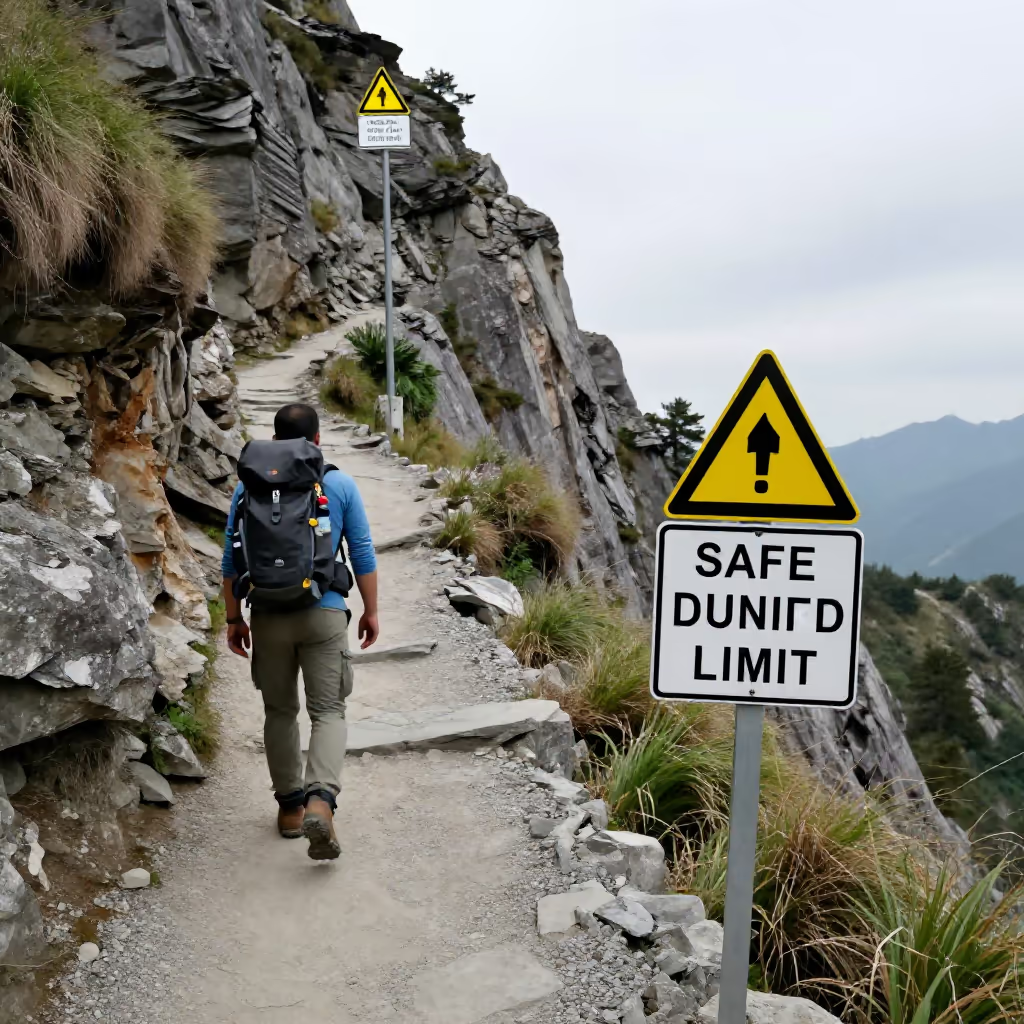
limit
A limit or dividing line in a figurative sense; the end of a range or a possibility.
Seine Unhöflichkeit überschreitet jede Grenze des guten Benehmens.
His rudeness crosses every limit of good manners.

to reach one's limits
To reach the point where one's own strength, ability, or patience ends.
Bei diesem schwierigen Projekt bin ich an meine Grenzen gestoßen.
With this difficult project, I reached my limits.

to set boundaries
To make clear to a person what behavior is not acceptable and to establish rules.
Es ist wichtig, dass Eltern ihren Kindern klare Grenzen setzen.
It is important for parents to set clear boundaries for their children.
The meaning of 'Grenze' (border/limit) is easy to recognize from context. If it is about countries, geography, or travel, it refers to the geographic line. If it is about behavior, abilities, or abstract ideas, it means a limit.
Wir sind mit dem Auto über die Grenze nach Österreich gefahren.
We drove across the border into Austria by car.
For the geographic border, the prepositions are crucial: 'an der Grenze' (at the border; dative) describes a location, while 'über die Grenze' (across the border; accusative) describes movement.
Das Dorf liegt direkt an der Grenze zur Schweiz.
The village is located right on the border with Switzerland.
In the figurative sense, 'Grenze' (limit/boundary) is often used with verbs such as 'Grenzen setzen' (to set boundaries), 'Grenzen ziehen' (to draw boundaries, in order to define something), or 'Grenzen überschreiten' (to cross boundaries, to behave inappropriately).
Sein Verhalten hat wirklich eine Grenze überschritten.
His behavior really crossed a line.
The idiom 'an seine Grenzen stoßen' (to reach one's limits) means that one's own strength or ability comes to an end. The possessive pronoun ('meine', 'deine', 'seine', etc.) always adapts to the person.
Bei dieser komplizierten Aufgabe stoße ich an meine Grenzen.
With this complicated task, I am reaching my limits.
In the fixed expression 'jemandem Grenzen setzen' (to set boundaries for someone), the person whose behavior is to be restricted is always in the dative.
Der Lehrer musste dem unruhigen Schüler klare Grenzen setzen.
The teacher had to set clear boundaries for the restless student.
edge / margin
“Grenze” and “Rand” can both refer to the end of an area. A “Grenze” is a line that separates two areas from each other. The “Rand” is the outer edge or outer part of a surface; it does not necessarily separate two areas.

Der Fluss bildet die Grenze zwischen dem Park und dem Wohngebiet.
The river forms the border between the park and the residential area.
Am Rand des Parks stehen mehrere alte Bäume.
Several old trees stand at the edge of the park.