


schweizer
Swiss
Refers to origin from Switzerland or belonging to Switzerland. It is a non-declinable form of the adjective.
EXAMPLE
Zum Nachtisch gab es original schweizer Schokolade.
For dessert, there was genuine Swiss chocolate.
Swiss
Loading your saved state.
Swiss
Refers to origin from Switzerland or belonging to Switzerland. It is a non-declinable form of the adjective.
Zum Nachtisch gab es original schweizer Schokolade.
For dessert, there was genuine Swiss chocolate.
Adjectives derived from a place and ending in '-er' are not declined. The form 'schweizer' (Swiss) always stays the same, no matter what gender, case, or number the noun has.
Ich mag diesen schweizer Käse.
I like this Swiss cheese.
The word is derived from the country name 'die Schweiz' (Switzerland) and formed with the ending '-er'. This pattern is used for many adjectives that describe geographic origin.
Die schweizer Alpen sind ein beliebtes Reiseziel.
The Swiss Alps are a popular travel destination.
'Schweizer' (Swiss) is often used in connection with well-known products from Switzerland. Typical examples are 'schweizer Käse' (Swiss cheese), 'schweizer Schokolade' (Swiss chocolate), and 'schweizer Uhren' (Swiss watches).
Er hat mir ein schweizer Taschenmesser geschenkt.
He gave me a Swiss army knife.
Swiss
Schweizer and schweizerisch can both express origin in or affiliation with Switzerland. Schweizer comes before a noun and remains unchanged. Schweizerisch, by contrast, is declined like an ordinary adjective and can also stand predicatively without a following noun.
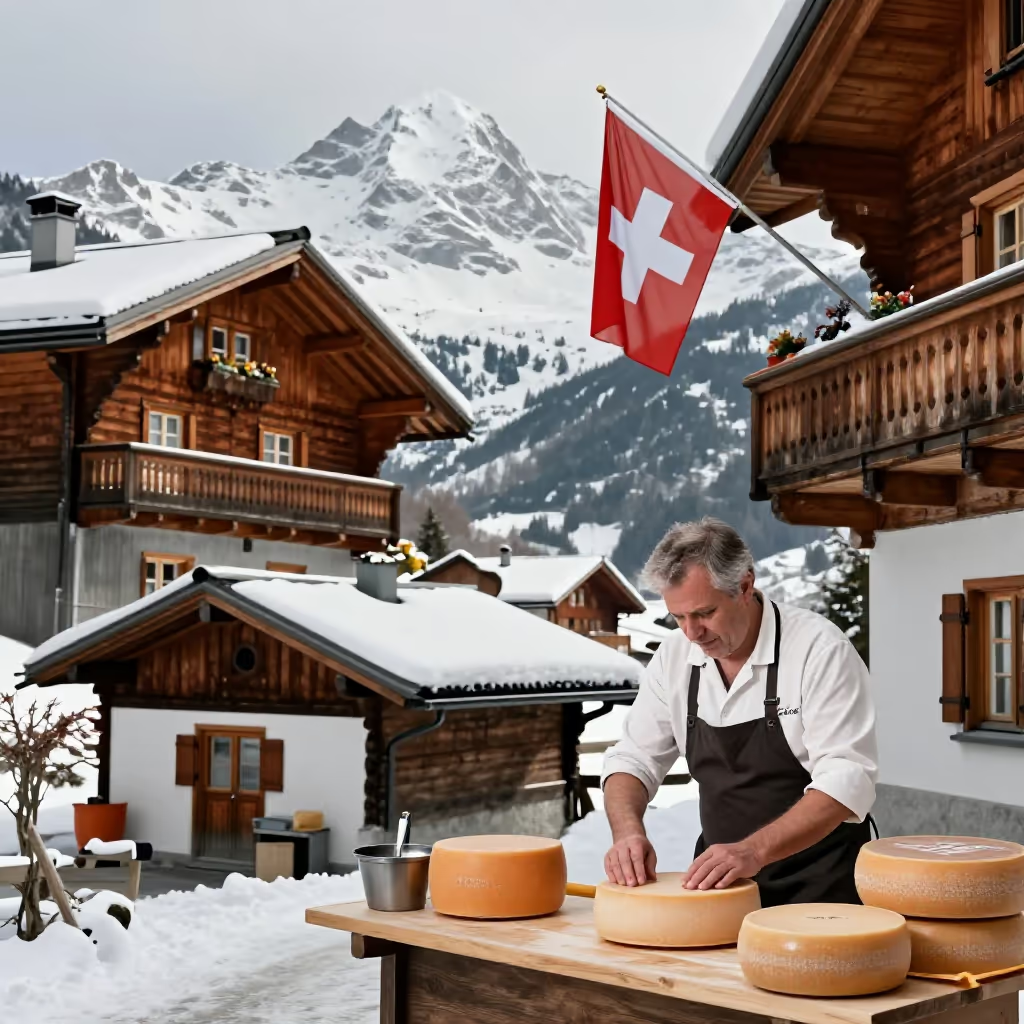
Das Geschäft verkauft vor allem Schweizer Käse.
The shop mainly sells Swiss cheese.
Das Geschäft verkauft vor allem schweizerische Käsesorten.
The shop mainly sells Swiss varieties of cheese.