

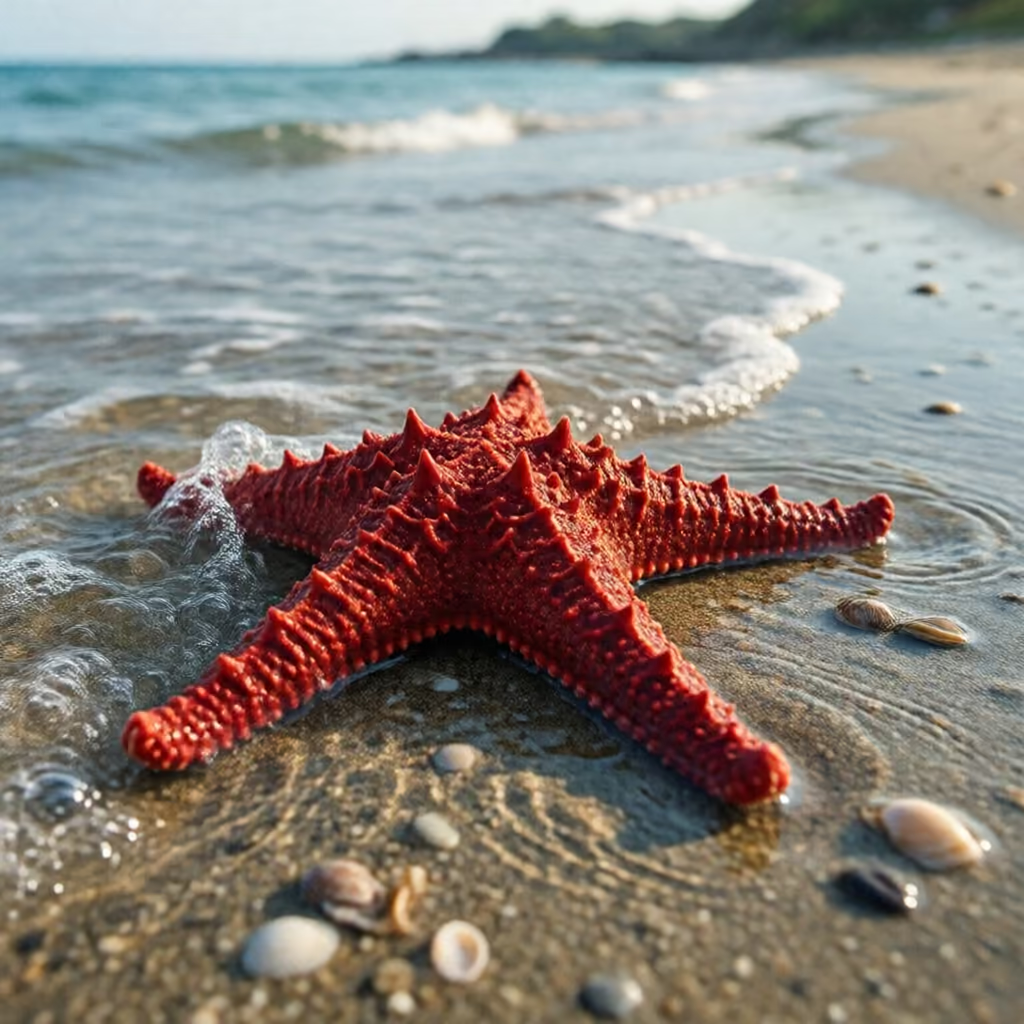
der Seestern
starfish
A usually five-armed marine animal that lives on the ocean floor and belongs to the group of echinoderms.
EXAMPLE
Am Strand fanden die Kinder einen roten Seestern.
The children found a red starfish on the beach.
starfish
der Seestern, die Seesterne
Loading your saved state.
starfish
A usually five-armed marine animal that lives on the ocean floor and belongs to the group of echinoderms.
Am Strand fanden die Kinder einen roten Seestern.
The children found a red starfish on the beach.
| gender | masculine der |
|---|---|
| plural | die Seesterne |
| genitive | des Seesterns |
| singular | plural | |
|---|---|---|
| nominative | der Seestern | die Seesterne |
| accusative | den Seestern | die Seesterne |
| dative | dem Seestern | den Seesternen |
| genitive | des Seesterns des Seesternes | der Seesterne |
The article changes with the case; it is shown in colour.
'Seestern' (starfish) is made up of 'See' (sea) and 'Stern' (star). The name describes the star-shaped form of an animal that lives in the sea.
Im flachen Wasser entdeckte Mia einen kleinen Seestern.
In the shallow water, Mia discovered a small starfish.
'Seestern' (starfish) is often used with verbs such as 'entdecken' (to discover), 'beobachten' (to observe), 'fotografieren' (to photograph), and 'finden' (to find). These combinations are especially common when talking about trips to the coast or visits to an aquarium.
Die Besucher konnten im Aquarium einen Seestern beobachten.
The visitors were able to observe a starfish in the aquarium.
In sentences about its habitat, 'Seestern' (starfish) often appears with location phrases such as 'im Meer' (in the sea), 'am Meeresboden' (on the ocean floor), or 'im Aquarium' (in the aquarium). These phrases help identify the word in a natural history context.
Der Seestern bewegt sich langsam am Meeresboden fort.
The starfish moves slowly along the ocean floor.