


die Sicherheit
safety
The state in which one is protected from dangers or risks.
EXAMPLE
Die Sicherheit der Fahrgäste hat für uns oberste Priorität.
The safety of the passengers is our top priority.
safety / certainty / security
Loading your saved state.
safety
The state in which one is protected from dangers or risks.
Die Sicherheit der Fahrgäste hat für uns oberste Priorität.
The safety of the passengers is our top priority.

certainty
The certainty that something is true, correct, or reliable.
Ich kann nicht mit letzter Sicherheit sagen, ob er die Wahrheit spricht.
I can't say with absolute certainty whether he is telling the truth.

security / collateral
A sum of money or valuable item deposited as a guarantee, for example in a rental contract or for a loan.
Als neuer Mieter musste er eine Sicherheit in Höhe von zwei Monatsmieten hinterlegen.
As a new tenant, he had to deposit security equal to two months' rent.
security
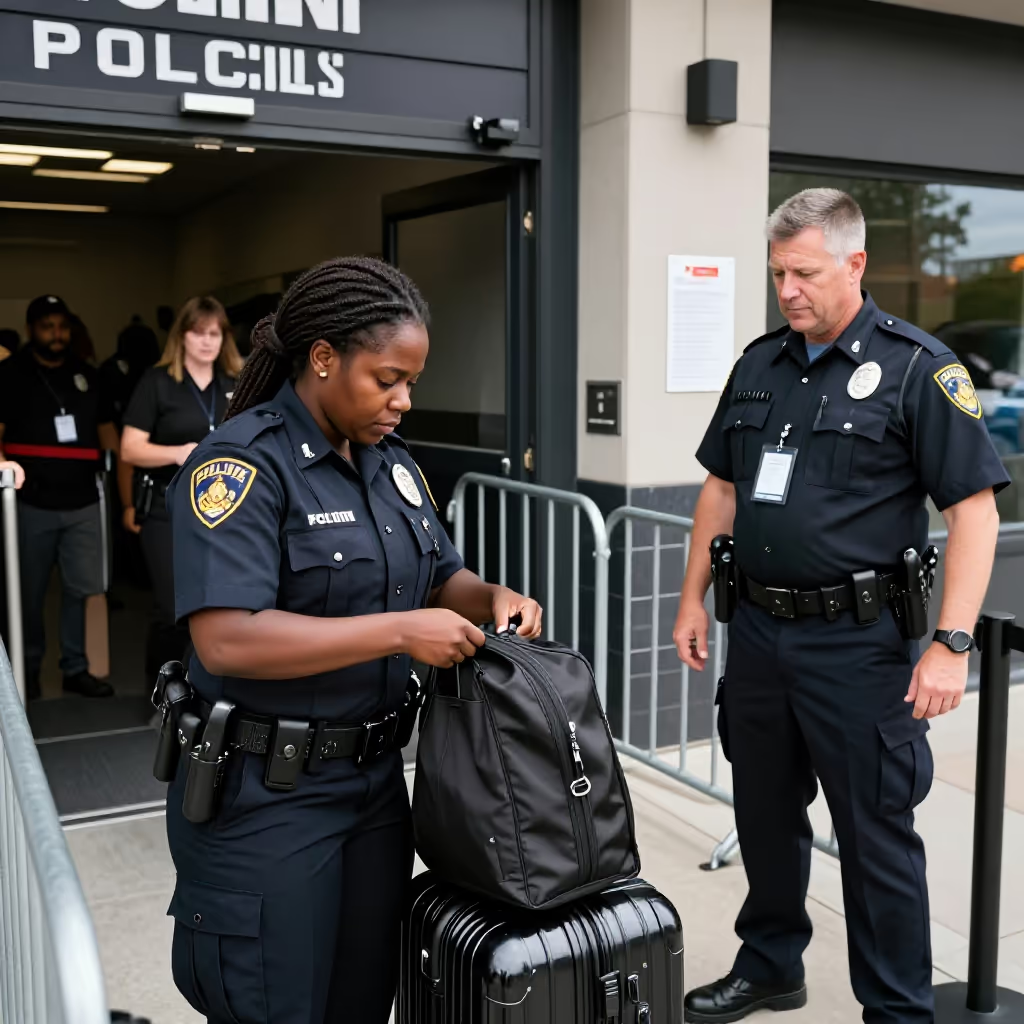
Collectively refers to people or an organization responsible for protection and order (e.g., security service, police).
Die Sicherheit am Eingang kontrollierte die Taschen der Besucher.
Security at the entrance checked the visitors' bags.

certainly
A fixed expression meaning that something is completely certain or definitely the case.
Sie wird mit Sicherheit zur Party kommen.
She will certainly come to the party.
'Sicherheit' (safety/certainty/security) is the noun corresponding to the adjective 'sicher' (safe/sure). The ending '-heit' is often used to turn an adjective into an abstract noun that describes a state or quality.
Ich bin nicht sicher, ob das die richtige Entscheidung ist.
I'm not sure whether that is the right decision.
In the context of protection from danger, 'Sicherheit' (safety) is often used with certain verbs. Typical expressions are 'jemanden in Sicherheit bringen' (to get someone to safety), 'für Sicherheit sorgen' (to ensure safety), or 'die Sicherheit gewährleisten' (to guarantee safety).
Die Feuerwehr brachte die Bewohner des Hauses in Sicherheit.
The fire department got the residents of the house to safety.
When it is about certainty, 'Sicherheit' (certainty) often appears in phrases such as 'mit Sicherheit sagen' (to say with certainty), 'absolute Sicherheit haben' (to have absolute certainty), or 'keine Sicherheit geben' (to give no certainty/guarantee).
Ich kann dir leider keine hundertprozentige Sicherheit geben, dass der Plan funktioniert.
Unfortunately, I can't give you one hundred percent certainty that the plan will work.
This meaning occurs almost only in a financial or legal context. Signal words are verbs such as 'hinterlegen' (to deposit) or 'leisten' (to provide), as well as nouns such as 'Kredit' (loan), 'Miete' (rent), or 'Kaution' (deposit).
Für den Kredit verlangt die Bank eine Sicherheit.
For the loan, the bank requires collateral.
In this meaning, 'Sicherheit' (security) is used in the singular but refers to a group of people. You can recognize it when the word, as the subject, performs an action, e.g., 'die Sicherheit kontrolliert' (security checks) or 'die Sicherheit greift ein' (security intervenes).
Die Sicherheit hat den Mann aus dem Stadion entfernt.
Security removed the man from the stadium.
The fixed expression 'mit Sicherheit' (certainly/with certainty) functions like an adverb expressing a high degree of certainty. It can stand at the beginning of a sentence (then the verb follows) or in the middle of the sentence.
Mit Sicherheit wird es morgen regnen.
It will certainly rain tomorrow.
protection
Schutz is the action, measure, or barrier that wards off a danger. Sicherheit is more the resulting state of having less risk. A fence therefore provides protection and increases safety without necessarily guaranteeing it completely.
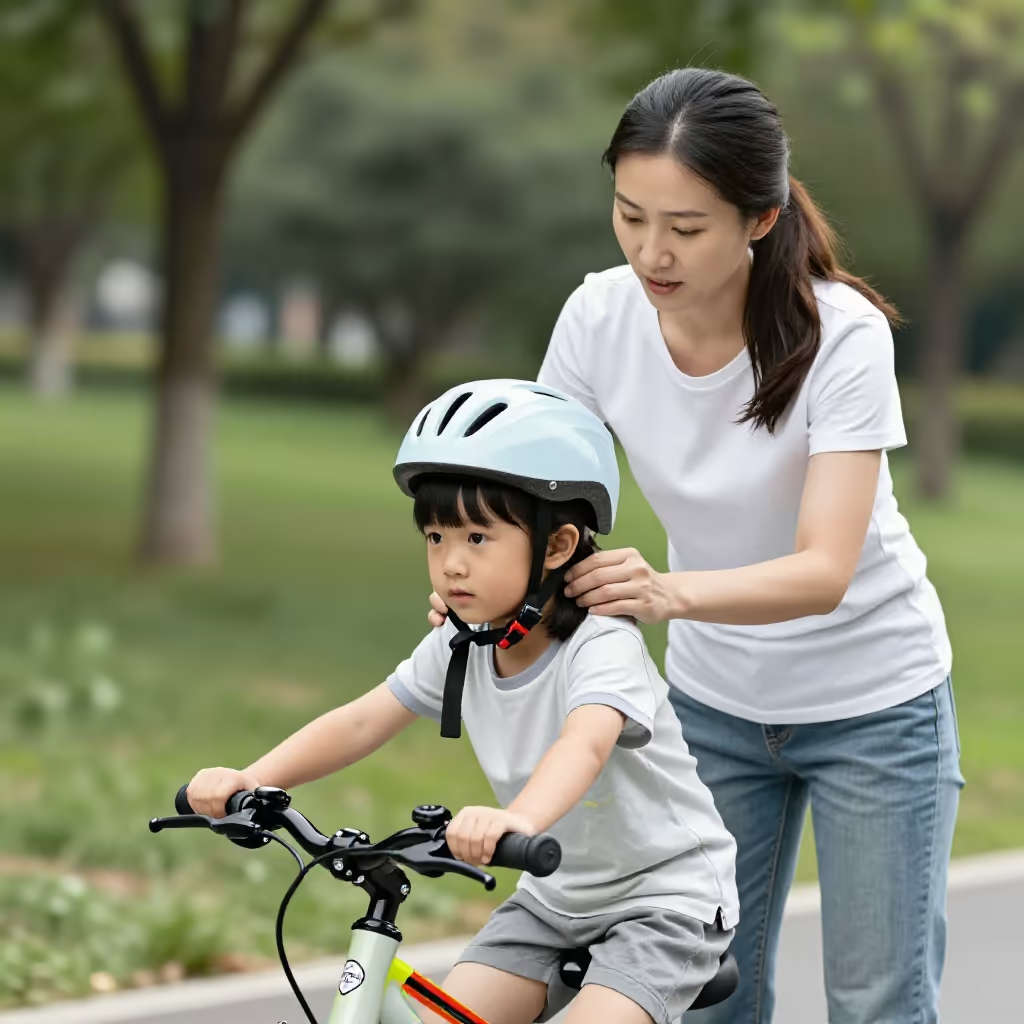
Durch den neuen Zaun ist die Sicherheit der Kinder auf dem Spielplatz größer.
The new fence has made the playground safer for the children.
Der neue Zaun bietet den Kindern auf dem Spielplatz Schutz vor der Straße.
The new fence protects the children at the playground from the road.