
A political and economic ideology that aims for a social order in which the means of production (e.g. factories, land) are collectively owned and a fair distribution of goods and opportunities is central.
example
Die theoretischen Grundlagen des Sozialismus wurden maßgeblich von Karl Marx und Friedrich Engels entwickelt.
The theoretical foundations of socialism were developed significantly by Karl Marx and Friedrich Engels.
Usage tips
Word formation
The ending '-ismus' in German often indicates a political, philosophical, or scientific doctrine or ideology. Other examples are Kapitalismus (capitalism), Feminismus (feminism), or Idealismus (idealism).
EXAMPLE
Im Philosophieunterricht haben wir verschiedene Strömungen des Idealismus besprochen.
In philosophy class, we discussed various currents of idealism.
Word family
The word family includes the adjective 'sozialistisch' (socialist / socialistic), e.g. 'eine sozialistische Partei' (a socialist party), and the terms for people 'der Sozialist' (the male socialist) and 'die Sozialistin' (the female socialist).
EXAMPLE
Er vertritt seit seiner Jugend sozialistische Ideen.
He has represented socialist ideas since his youth.
Context clue
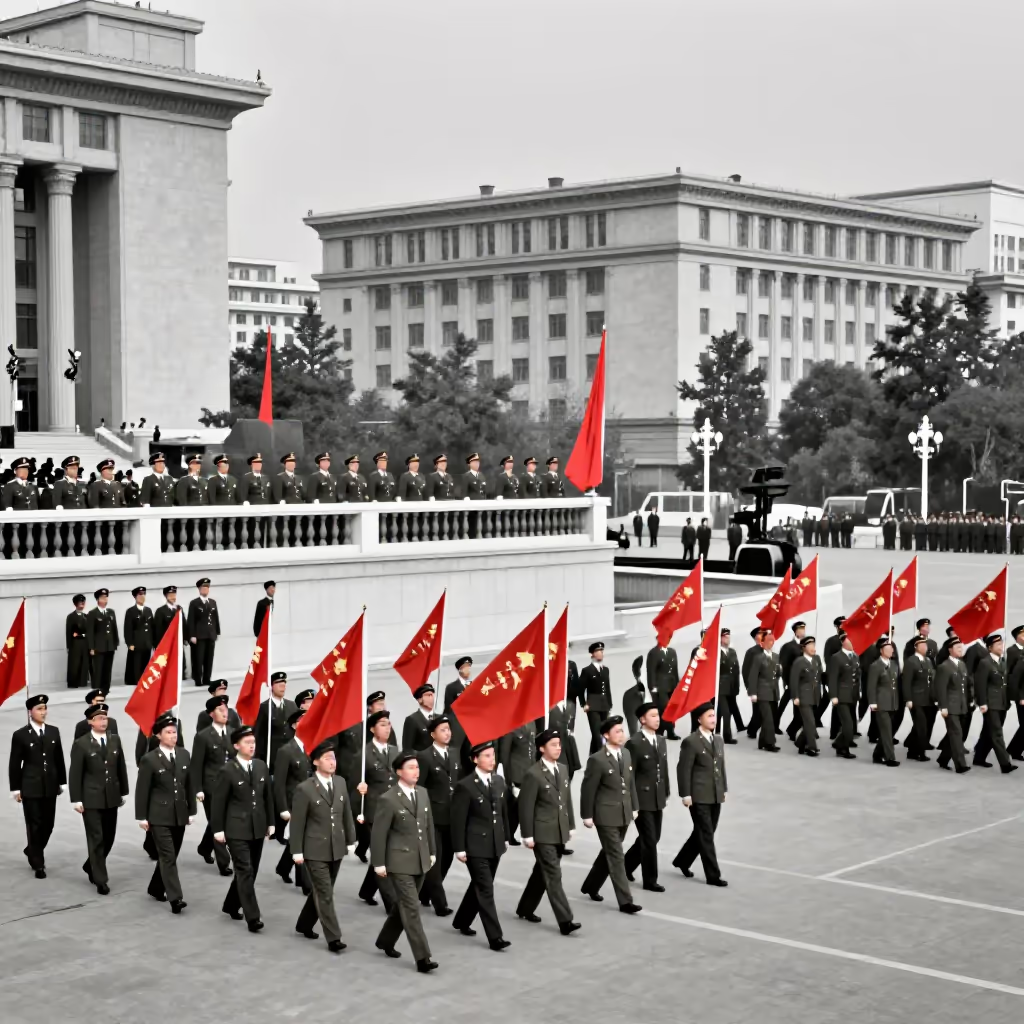
When a specific historical state is being referred to, this is often made clear by additions such as 'der real existierende Sozialismus' (actually existing socialism) or a clear geographical reference, e.g. 'der Sozialismus in der DDR' (socialism in the GDR).
EXAMPLE
Viele Bücher beschreiben das Alltagsleben im real existierenden Sozialismus.
Many books describe everyday life under actually existing socialism.
Typical collocations
When 'Sozialismus' (socialism) refers to the ideology, it is often combined with nouns such as 'Theorie' (theory), 'Grundlagen' (foundations), 'Ideen' (ideas), or 'Kritik' (criticism). For example, people speak of the 'Theorie des Sozialismus' (the theory of socialism).
EXAMPLE
Die Kritik am Sozialismus ist vielfältig.
Criticism of socialism is varied.
Compare with
antonym · confusable
Sozialismus vs Kapitalismus
capitalism
'Sozialismus' and 'Kapitalismus' are opposite terms for political and economic systems. In 'Sozialismus', collective ownership and fair distribution are more central. In 'Kapitalismus', private property and the market are especially important. Learners may confuse the words because both often appear in discussions about the economy, the state, and society. As a simple guide: 'Sozialismus' thinks more in terms of the community, while 'Kapitalismus' thinks more in terms of private ownership and the market.
Sozialismus
Im Geschichtsunterricht sprachen wir über den Sozialismus in verschiedenen Ländern des 20. Jahrhunderts.
In history class, we talked about socialism in various countries of the 20th century.
Kapitalismus
Viele Firmen entscheiden im Kapitalismus selbst, welche Produkte sie verkaufen wollen.
In capitalism, many companies decide for themselves which products they want to sell.