

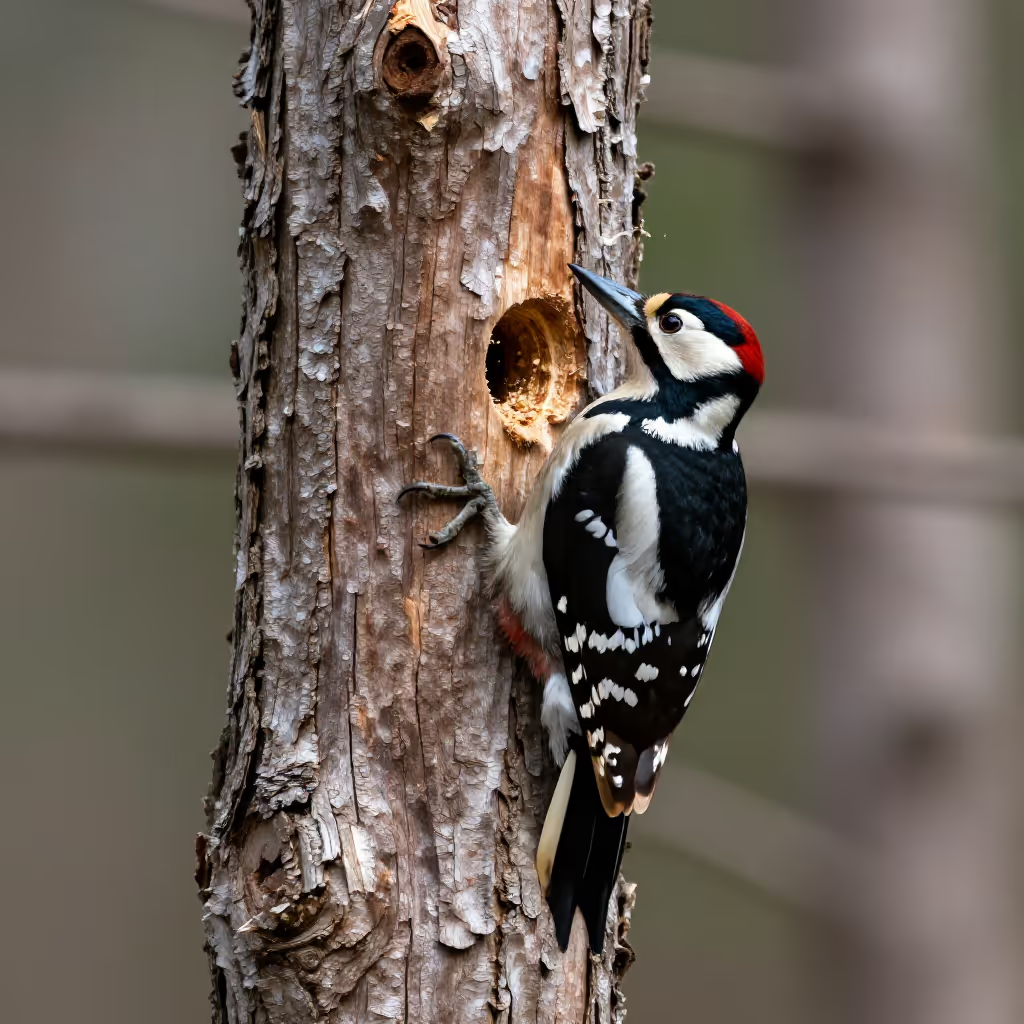
der Specht
woodpecker
A bird known for tapping holes into tree trunks with its beak in order to find insects or build nesting cavities.
Im Wald hörten wir das laute Klopfen eines Spechts.
In the forest, we heard the loud tapping of a woodpecker.
woodpecker
der Specht, die Spechte
Loading your saved state.

woodpecker
A bird known for tapping holes into tree trunks with its beak in order to find insects or build nesting cavities.
Im Wald hörten wir das laute Klopfen eines Spechts.
In the forest, we heard the loud tapping of a woodpecker.
| gender | masculine der |
|---|---|
| plural | die Spechte |
| genitive | des Spechts |
| singular | plural | |
|---|---|---|
| nominative | der Specht | die Spechte |
| accusative | den Specht | die Spechte |
| dative | dem Specht | den Spechten |
| genitive | des Spechts des Spechtes | der Spechte |
The article changes with the case; it is shown in colour.
The characteristic sound of a woodpecker is described with the verb 'klopfen' (to tap/knock). You often hear a woodpecker before you see it.
Hör mal, da klopft ein Specht am Baum!
Listen, there's a woodpecker tapping on the tree!
Der Specht klopft ein Loch in die Rinde.
The woodpecker is tapping a hole into the bark.
'Specht' (woodpecker) is the base word for many specific species of woodpecker. Often a color or feature is placed before it to name the species.
Der Buntspecht ist in europäischen Wäldern sehr häufig.
The great spotted woodpecker is very common in European forests.
Wir haben einen seltenen Grünspecht gesehen.
We saw a rare green woodpecker.
When describing the place where a woodpecker is active, the prepositions 'an' (for the vertical surface) or 'in' (for the larger location) are often used.
Ein Specht hämmert an die Rinde der alten Eiche.
A woodpecker is hammering at the bark of the old oak tree.
Im Stadtpark kann man manchmal einen Specht beobachten.
In the city park, you can sometimes observe a woodpecker.