

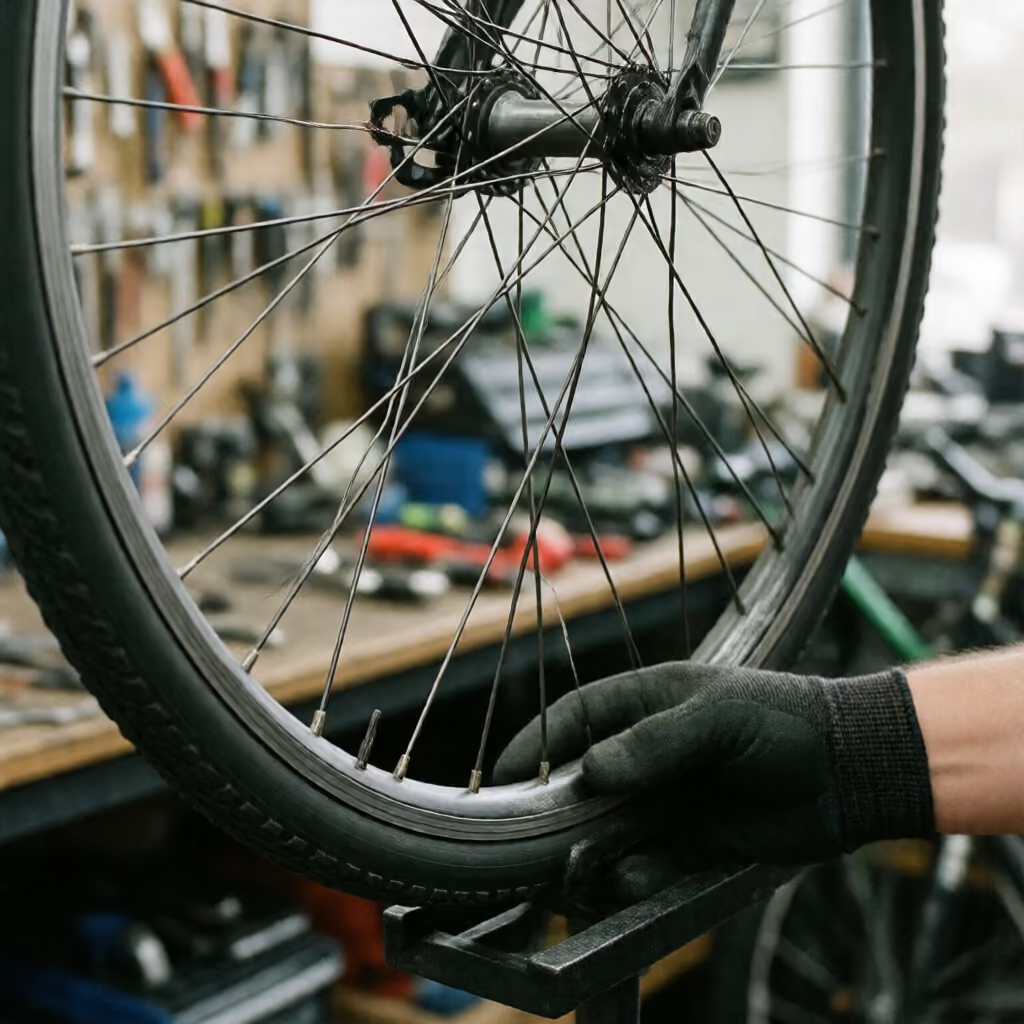
die Speiche
spoke
One of the rods in a wheel that connect the hub at the center to the rim at the outer edge.
EXAMPLE
Am Hinterrad meines Fahrrads ist eine Speiche gebrochen.
A spoke on the rear wheel of my bicycle has broken.
spoke / radius
die Speiche, die Speichen
Loading your saved state.
spoke
One of the rods in a wheel that connect the hub at the center to the rim at the outer edge.
Am Hinterrad meines Fahrrads ist eine Speiche gebrochen.
A spoke on the rear wheel of my bicycle has broken.

radius
One of the two bones in the forearm, located on the thumb side. Its medical name is the radius.
Beim Sturz auf die ausgestreckte Hand brach sie sich die Speiche.
She broke her radius when she fell onto her outstretched hand.
| gender | feminine die |
|---|---|
| plural | die Speichen |
| genitive | der Speiche |
| singular | plural | |
|---|---|---|
| nominative | die Speiche | die Speichen |
| accusative | die Speiche | die Speichen |
| dative | der Speiche | den Speichen |
| genitive | der Speiche | der Speichen |
The article changes with the case; it is shown in colour.
Words such as 'Felge' (rim), 'Nabe' (hub), and 'Hinterrad' (rear wheel) point to the wheel-related meaning. With 'Röntgenbild' (X-ray), 'Unterarm' (forearm), or 'Gips' (cast), the bone is meant.
Die Werkstatt hat am Hinterrad zwei beschädigte Speichen entdeckt.
The repair shop found two damaged spokes on the rear wheel.
Auf dem Röntgenbild ist ein Bruch der Speiche zu erkennen.
A fracture of the radius is visible on the X-ray.
In bicycle repair, typical collocations include 'Speichen spannen' (to tension spokes), 'Speichen nachspannen' (to retighten spokes), and 'eine Speiche ersetzen' (to replace a spoke). 'Nachspannen' (to retighten) is used when spokes have become too loose.
Nach der langen Radtour musste die Mechanikerin einige Speichen nachspannen.
After the long bike ride, the mechanic had to retighten some spokes.
A typical pattern is 'sich die Speiche brechen' (to break one's radius). The reflexive pronoun is in the dative and 'die Speiche' (the radius) is in the accusative; this makes it clear whose bone is injured.
Ich habe mir beim Skifahren die Speiche gebrochen.
I broke my radius while skiing.