


sprechen
to speak
To have and use the ability to articulate sounds, words, and sentences; to talk.
EXAMPLE
Nach dem Schock konnte er eine Weile nicht sprechen.
After the shock, he couldn't speak for a while.
to speak
Loading your saved state.
to speak
To have and use the ability to articulate sounds, words, and sentences; to talk.
Nach dem Schock konnte er eine Weile nicht sprechen.
After the shock, he couldn't speak for a while.

to speak with
To have a conversation or discussion with one or more people.
Ich muss nachher noch mit meiner Chefin sprechen.
I still need to speak with my boss later.

to speak
To know and be able to use a particular language.
Sprechen Sie Englisch?
Do you speak English?

to speak about
To discuss a specific topic in a conversation.
Lass uns nicht immer über die Arbeit sprechen.
Let's not always speak about work.

to speak for itself
To be so clear or obvious that no further explanation is needed.
Die beeindruckenden Verkaufszahlen sprechen für sich.
The impressive sales figures speak for themselves.

to think well/poorly of
To have a positive or negative opinion of someone; to be well-disposed or ill-disposed toward someone.
Seit dem Vorfall ist sie nicht mehr gut auf ihn zu sprechen.
Since the incident, she no longer thinks well of him.
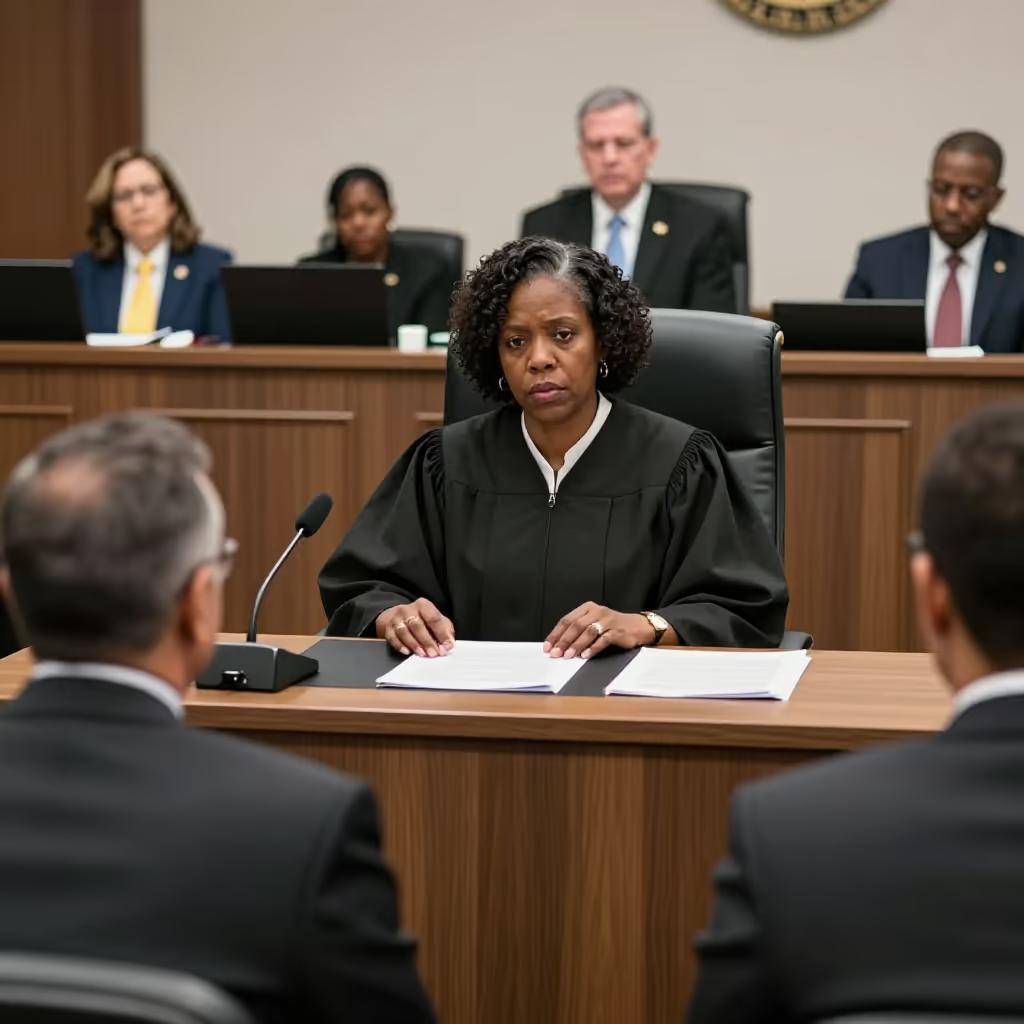
to deliver a verdict
To announce a judicial decision in a formal, legal context.
Das Gericht wird nächste Woche das Urteil sprechen.
The court will deliver the verdict next week.
The verb 'sprechen' (to speak) is the root of many important words related to communication. These include 'die Sprache' (the language; the system one speaks) and 'der Spruch' (a short, often wise saying).
Welche Sprachen sprichst du?
Which languages do you speak?
The meaning of 'sprechen' (to speak) changes depending on the preposition. You speak 'mit' (with) a person (dative), but 'über' (about) a topic (accusative).
Ich spreche mit meinem Freund.
I speak with my friend.
The perfect tense of 'sprechen' (to speak) is always formed with the auxiliary verb 'haben' (to have). The past participle is 'gesprochen' (spoken).
Wir haben lange über die Zukunft gesprochen.
We spoke for a long time about the future.
When talking about languages, 'sprechen' (to speak) is often combined with adverbs that describe the level. Typical examples are 'fließend sprechen' (to speak fluently), 'gut sprechen' (to speak well), or 'ein bisschen sprechen' (to speak a little).
Er spricht fließend Spanisch.
He speaks Spanish fluently.
The expression 'für sich sprechen' (to speak for itself) is often used for things that are so clear that they need no comment. Typical subjects are 'die Zahlen' (the figures/numbers), 'die Ergebnisse' (the results), or 'die Fakten' (the facts).
Die Ergebnisse der Studie sprechen für sich.
The results of the study speak for themselves.
In the expression 'gut/schlecht auf jemanden zu sprechen sein' (to think well/poorly of someone), the person being referred to is always in the accusative after the preposition 'auf'.
Nach dem Streit ist er nicht gut auf seinen Nachbarn zu sprechen.
After the argument, he doesn't think well of his neighbor.
The combination 'ein Urteil sprechen' (to deliver a verdict) belongs to the formal language of the justice system. This phrasing is not used in everyday speech.
Der Richter wird morgen das Urteil sprechen.
The judge will deliver the verdict tomorrow.
to talk
Here, reden refers to the current activity: someone is expressing themselves orally and communicating. Sprechen, by contrast, is also used for the lasting ability to know a particular language. Sprechen is therefore the appropriate word when describing language skills.

Die neuen Kollegen sprechen schon sehr gut Deutsch.
The new colleagues already speak German very well.
In der Pause reden die neuen Kollegen gerade Deutsch miteinander.
During the break, the new colleagues are talking to each other in German.