

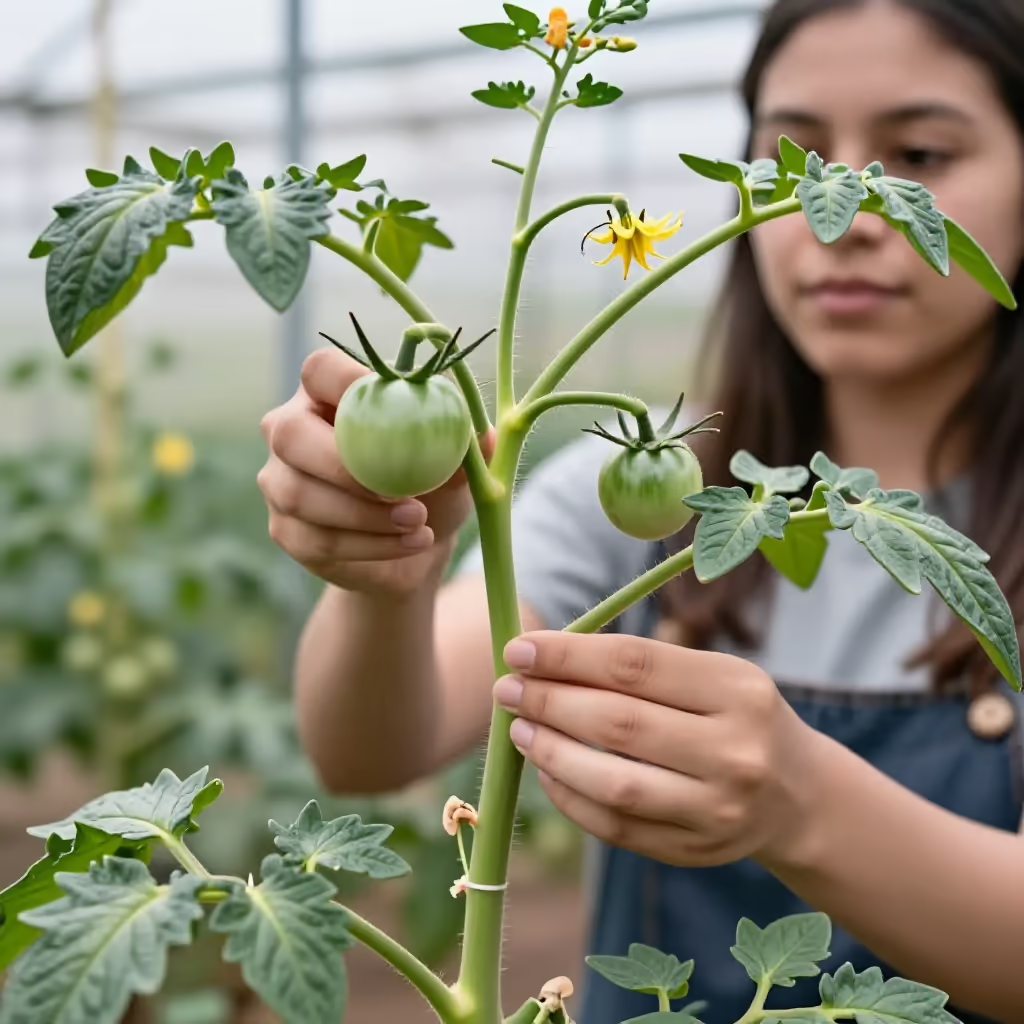
The part of a plant that carries the leaves, flowers, and fruits and supplies them with water and nutrients. It is the main axis of the shoot.
example
Sie brach den langen Stengel der Rose ab, bevor sie sie in die Vase stellte.
She broke off the long stem of the rose before placing it in the vase.
Usage tips
Spelling
There are two spellings for this word: 'Stengel' is the older form, while 'Stängel' is the newer form recommended since the spelling reform. However, both are widespread and understood.
EXAMPLE
Der Stängel dieser Pflanze ist besonders dick.
The stem of this plant is especially thick.
Typical collocations
'Stengel' (stem) is often combined with verbs such as 'abbrechen' (to break off), 'abschneiden' (to cut off), or 'knicken' (to bend/snap). Most often one speaks of the stem 'einer Blume' (of a flower), 'einer Rose' (of a rose), or 'einer Pflanze' (of a plant).
EXAMPLE
Pass auf, dass du den Stengel der Tulpe nicht knickst.
Be careful not to bend the stem of the tulip.
Word structure
'Stengel' (stem) often serves as the base word in compound nouns to describe the part of a plant more precisely. Examples include 'Blumenstengel' (flower stem) or 'Kohlrabistengel' (kohlrabi stem).
EXAMPLE
Der Blumenstengel war schon etwas welk.
The flower stem was already somewhat wilted.
Compare with
near_synonym · confusable
Stengel vs Stamm
trunk / tribe
'der Stamm' and 'der Stengel' both refer to supporting parts of plants, but they are not used for the same plants. 'Stamm' is used especially for trees: it is thick, woody, and supports the branches. 'Stengel' is used more for smaller plants or flowers: it is usually thinner and carries leaves or flowers. Learners may confuse the words because both support something and grow upward. A simple guide is: a tree has a 'Stamm' (trunk), a flower has a 'Stengel' (stem).
Stengel
Beim Pflücken ist der Stengel der Blume abgebrochen.
While it was being picked, the stem of the flower broke off.
Stamm
Nach dem Sturm war der Stamm des alten Baumes tief gerissen.
After the storm, the trunk of the old tree was deeply cracked.