


still
quiet
Without noise; quiet or silent.
EXAMPLE
Sei bitte still, das Baby schläft.
Please be quiet; the baby is sleeping.
quiet / still
Loading your saved state.
quiet
Without noise; quiet or silent.
Sei bitte still, das Baby schläft.
Please be quiet; the baby is sleeping.
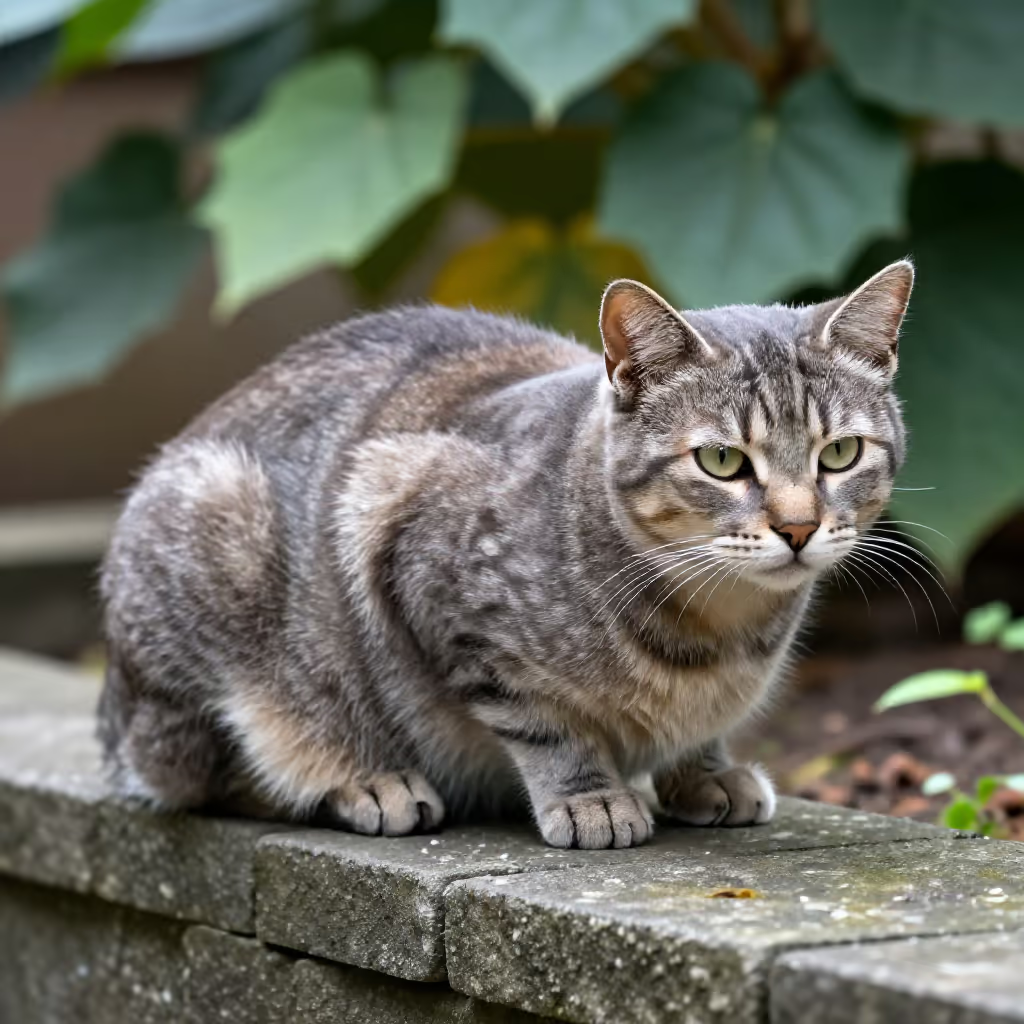
Without movement; motionless or still.
Das Wasser des Sees war heute Morgen vollkommen still.
The water of the lake was completely still this morning.

still water
Water without carbonation.
Ich hätte gern ein stilles Wasser, bitte.
I'd like a still water, please.

silent / hidden
Secret, hidden, or unnoticed.
Er ist ein stiller Teilhaber der Firma und tritt nicht öffentlich in Erscheinung.
He is a silent partner in the company and does not appear publicly.
'Still' means 'leise' (quiet) or 'unbewegt' (motionless). It is a false friend of the English word 'still', which describes an ongoing action. For that, German uses the word 'noch' (still/yet).
Er arbeitet noch an seinem Projekt.
He is still working on his project.
'Still' can stand before a noun as an adjective or describe a verb as an adverb. As an adverb, it remains unchanged.
Wir machten einen Spaziergang an einem stillen See.
We took a walk by a still lake.
Whether 'still' means 'leise' (quiet) or 'unbewegt' (motionless) depends on the context. 'Still sein' (to be quiet) or 'still werden' (to become quiet) usually refers to noise, while 'still sitzen' (to sit still), 'still stehen' (to stand still), or 'still halten' (to hold still) describes lack of movement.
Als die Lehrerin ins Zimmer kam, wurden alle Schüler sofort still.
When the teacher came into the room, all the students immediately became quiet.
The combination 'stilles Wasser' (still water) is a fixed expression for water without carbonation. It is frequently used in restaurants and cafés.
Einmal Pommes und ein stilles Wasser, bitte.
One order of fries and a still water, please.
In the figurative meaning 'heimlich' (secret) or 'unbemerkt' (unnoticed), 'still' appears in fixed expressions, e.g. 'ein stiller Teilhaber' (silent partner), 'eine stille Beobachterin' (a silent observer), or 'stille Reserven' (hidden reserves).
Sie war nur eine stille Beobachterin des Gesprächs und sagte nichts.
She was only a silent observer of the conversation and said nothing.
quiet / calm
Both words can describe a situation with little noise or movement. Still emphasizes more strongly that practically nothing can be heard or seen, while ruhig can also describe a generally relaxed situation with some activity. Choose still when there is almost complete silence or immobility.

Während der Prüfung bleibt der Flur vor dem Raum völlig still.
The hallway outside the room remains completely silent during the exam.
Im Park ist es am frühen Morgen ruhig, obwohl schon einige Menschen spazieren gehen.
The park is quiet early in the morning, even though a few people are already out walking.